

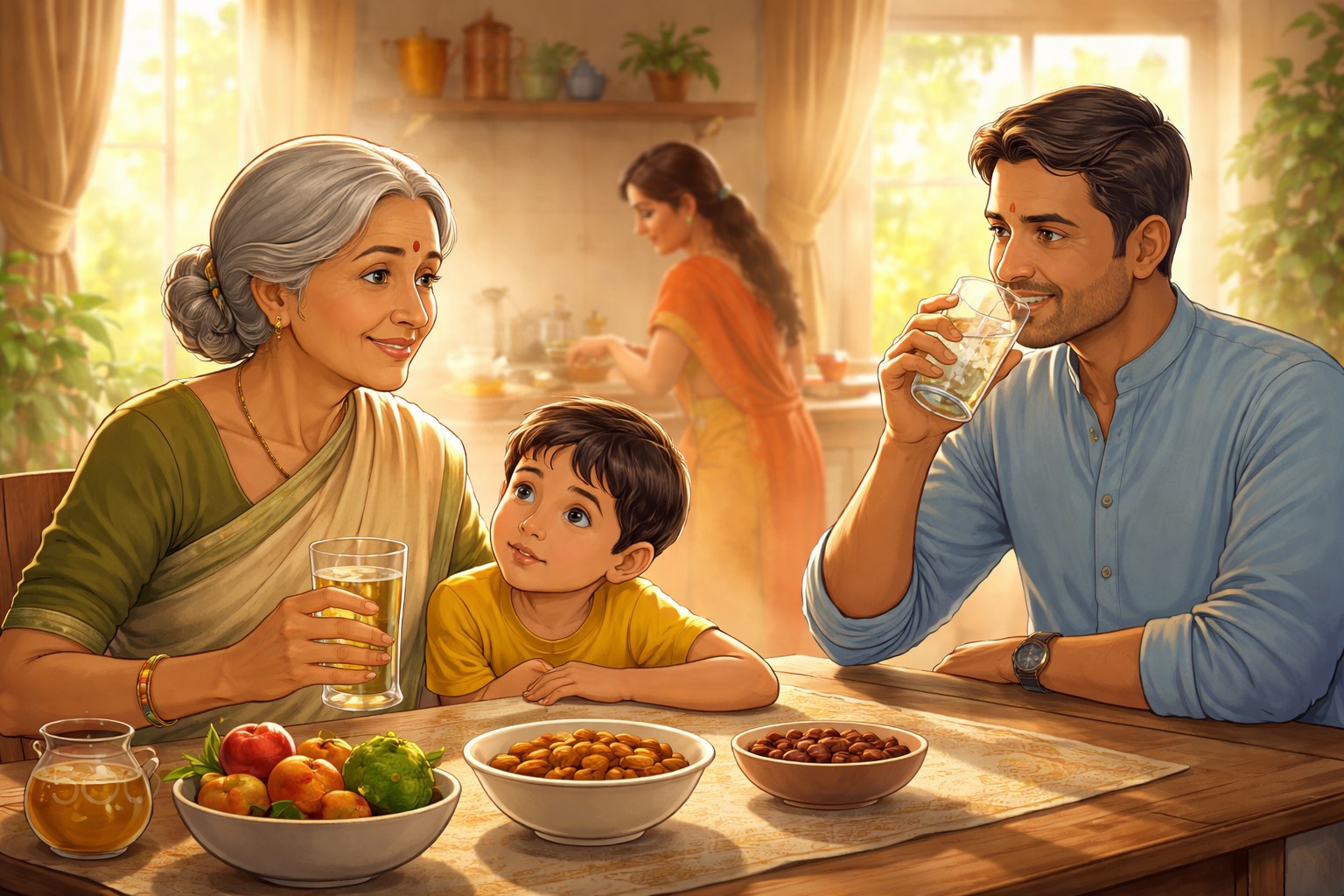
1. The Morning Without Breakfast
The kitchen was unusually silent.
No clinking of steel plates. No smell of paratha. Only sunlight slipping through the window and falling on Dadi’s silver hair. She was sitting calmly, sipping warm water with a pinch of salt.
“Dadi,” Dhruv asked, rubbing his eyes, “why aren’t you eating? Are you sick?”
Dadi smiled. “No, beta. I am fasting today.”
Dhruv frowned. “But why only you? Why do only women fast?”
Dadi paused gently. “That is tradition in many homes,” she said softly, “but fasting is not for women alone. It is for any human who wishes to clean the body and quiet the mind.”
2. Hunger Is Not an Emergency
By noon, Dhruv kept watching her carefully. Dadi was reading, watering plants, moving slowly but steadily.
“Aren’t you hungry?” Dhruv finally asked.
“Hunger comes like a wave,” Dadi replied. “It rises. It falls. It is not a fire that burns the house.”
She explained how the body stores energy. “When we eat all the time, the body keeps releasing insulin. When insulin stays high, we never burn stored fat. But when insulin lowers, the body unlocks stored energy. It remembers how to survive.”
Dhruv blinked. “So fasting lowers insulin?”
“Yes,” Dadi nodded. “And that switch is powerful.”
3. It Is Not About Less Food
“But Papa says weight loss means eating less,” Dhruv insisted.
Dadi chuckled softly. “Not only less food — better timing.”
She explained that obesity is not just about calories but also about hormones. When we snack all day, insulin never rests. And when insulin never rests, fat never leaves.
“Your body is like a house,” she said. “If the storeroom is locked, how will you take out the stored things?”
Fasting, she explained, is like unlocking that door. Short fasts, when done properly, do not automatically slow metabolism. Sometimes, the body becomes sharper. More alert.
4. Men, Women, and Balance
Dhruv was still thinking deeply. “Then why don’t men fast like this?”
“They can,” Dadi replied firmly. “Fasting is good for both men and women.”
She explained that hormones differ. Women must be more attentive to their cycles and nutritional needs. But benefits like improved insulin sensitivity, reduced inflammation, and digestive rest belong to everyone.
“Fasting is not punishment,” Dadi said. “It is rhythm.”
Like day and night. Feast and pause. Effort and recovery.
5. The Cleaning Inside
By afternoon, Dadi was watering the tulsi plant on the balcony.
“How do you still have energy?” Dhruv asked, amazed.
“Because the body is cleaning itself,” Dadi replied.
She spoke about autophagy — the process where cells recycle damaged parts when food is absent. “When we constantly eat, the body is busy digesting. When we pause, it repairs.”
She mentioned how constant activation of growth signals, like mTOR, may accelerate aging. “Balance brings longevity,” she said simply.
Dhruv did not fully understand longevity. But he understood cleaning.
6. Waves of Hunger, Waves of Clarity
Around 4 PM, something felt different. Dadi seemed peaceful. Bright-eyed. Calm.
“Are you tired now?” Dhruv asked again.
“No,” she smiled. “Sometimes fasting increases growth hormone. The body protects muscles. Adrenaline rises slightly, so we stay alert.”
She added a pinch of salt to her water. “Electrolytes matter,” she whispered like a secret.
“Hunger came at 11,” she continued. “Then it left.”
Dhruv learned something new: hunger is hormonal, not an emergency alarm.
7. The Bigger Picture
As evening approached, Dhruv leaned on Dadi’s shoulder.
“So fasting makes us thin?”
“It can,” Dadi replied. “But that is not the main goal.”
She explained that chronic overnutrition may overstimulate aging pathways. That periodic rest from food mirrors how humans evolved — sometimes feast, sometimes scarcity.
“Food is medicine,” she said softly. “But rest from food is also medicine.”
“Is it safe for everyone?”
“No,” Dadi answered carefully. “Not for pregnant women. Not for those with certain illnesses. Wisdom must guide fasting, not ego.”
8. The Feast Matters Too
The next morning, Dadi broke her fast slowly. She began with soaked almonds. Then simple khichdi. A small spoon of ghee. No frenzy. No revenge-eating.
“Fasting is only half the story,” she told Dhruv. “Feasting properly is the other half.”
She explained that nutrient-dense food prevents binge cycles. That consistency beats extremism. That the body loves rhythm, not shock.
“Some people fast heroically,” she smiled, “and then eat foolishly.”
Balance, she said, is true wisdom.
9. The Clock Inside Us
That evening Papa joined the conversation.
“I will try 12 hours,” he declared confidently.
“Start gently,” Dadi advised. “Twelve hours. Then maybe fourteen. Then sixteen — only if the body agrees.”
She spoke about circadian rhythm — how eating earlier aligns with metabolism. Late-night eating confuses hormones and disturbs sleep.
“We are not machines,” she said. “We are biological clocks.”
Dhruv imagined a small golden clock ticking inside his tummy.
10. Disease Is Slow Accumulation
Papa listened more seriously now. “What about diseases?” he asked.
Dadi’s voice softened. “Most chronic diseases grow slowly — years of excess, stress, inflammation.”
She explained how inflammation underlies many modern illnesses. How insulin resistance builds gradually.
“Fasting reduces the load,” she said. “It gives digestion rest. It lowers inflammatory signals.”
Not magic. Not instant cure. But steady repair.
11. The Body Wants to Heal
One afternoon, Dhruv brought fresh tulsi leaves from the balcony.
Dadi smiled warmly. “The body has intelligence. It wants to heal.”
Remove obstacles — overeating, poor sleep, constant stress — and healing begins.
She spoke of sunlight, fresh air, clean water, gentle movement, deep sleep, and emotional calm as primary medicines.
“Before modern hospitals,” she said quietly, “nature was our pharmacy.”
12. Mind and Metabolism
Dhruv once found Dadi meditating during her fast.
“Does fasting help the mind?” he whispered.
“Yes,” Dadi replied. “Mind and metabolism are connected.”
Stress hormones disturb insulin. Anxiety affects digestion. Restless thoughts disturb sleep.
“When we fast calmly,” she said, “clarity comes.”
Fasting was not only physical. It was mental decluttering.
13. Evolution Remembers
After a few days, Papa completed his first 14-hour fast.
“I thought I would be weak,” he admitted. “But I feel steady.”
Dadi nodded. “Humans evolved in cycles of feast and famine. Our biology remembers.”
Short-term fasting may activate repair pathways. Growth slows. Maintenance improves.
“Scarcity, in moderation, strengthens,” she said.
Dhruv imagined ancient humans under wide skies, walking, waiting, trusting.
14. Not Tradition. Wisdom.
A week later, Papa continued gently. Even Dhruv tried delaying breakfast slightly on Sundays.
“See?” Dadi smiled. “Fasting is not female duty. It is human wisdom.”
“But always with care,” she added. “Pregnancy, illness, eating disorders — fasting is not for everyone.”
Prevention is quieter than treatment. Consistency is stronger than drama. Listening is wiser than forcing.
Dhruv hugged her tightly.
“Dadi,” he said thoughtfully, “fasting is like cleaning the house.”
Dadi laughed. “Yes,” she replied. “And also like cleaning the mind.”
The kitchen filled again with fragrance. But now there was something else in the air — understanding. Not hunger. Not restriction. Just rhythm.
Epilogue — Fasting as Love
One evening, Dhruv noticed something new.
Papa was fasting — quietly — because Ma’s health reports were coming the next day.
“Why are you fasting?” Dhruv asked.
“For strength,” Papa said softly. “For clarity. For your mother.”
Dadi watched with gentle pride.
That night, Dhruv understood.
Fasting is not about empty plates.
It is about steady hearts.
And sometimes, it is simply love.

Appendix — Suggested Reading
The Longevity Diet — Valter Longo
The Complete Guide to Fasting — Dr. Jason Fung & Jimmy Moore
The Obesity Code — Dr. Jason Fung
Fast. Feast. Repeat. — Gin Stephens
The Fasting Cure — Upton Sinclair
The Fasting Fix — Andreas Michalsen