
~ A Case for Moving Beyond Black-Box EVMs toward Paper Ballot with Optical Scan
✦ Introduction: Democracy Needs Trust, Not Just Speed
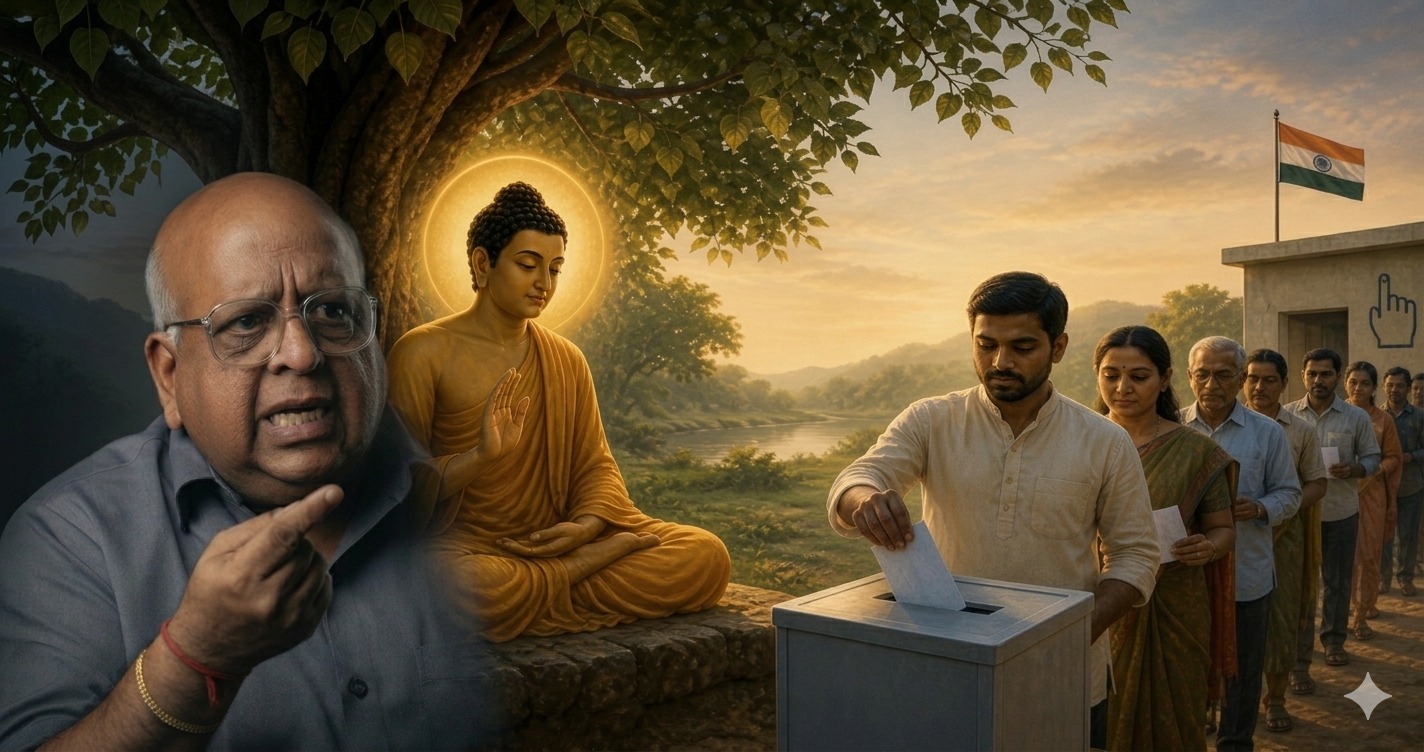
When we talk about elections, we often ask the wrong question. We focus on how fast votes can be counted. The deeper question is whether people will truly trust the result.
An election succeeds not when numbers flash quickly on TV screens. It succeeds when the losing side accepts defeat peacefully. That calm acceptance is the real test of democracy. Peace after loss matters far more than joy after victory.
India runs the world’s largest elections with nearly 97 crore registered voters and over 10.5 lakh polling stations. Speed and logistics matter on this massive scale. Yet trust remains more important. A fast result doubted by millions actually weakens democracy. Elections are trust systems first.
✦ Chapter 1: Why India Chose EVMs in the First Place
EVMs were introduced to fix serious flaws in paper ballot elections. Booth capturing, ballot stuffing, and fake votes were widespread. Invalid votes often reached 2-3% and sometimes decided winners through confusion rather than choice.
Counting stretched for days or weeks. Printing and guarding crores of paper ballots created many manipulation risks. EVMs reduced invalid votes sharply to below 0.1% in recent polls. They made voting clearer and counting cleaner. Polling officers gained better control over the process.
These machines marked a genuine reform. Trials started in 1982 and nationwide use began in 2004. They cut violence at booths and delivered faster results. Yet the solution to yesterday’s visible fraud has created today’s invisible doubts about electronic trust.
✦ Chapter 2: The Strange Problem of Invisible Trust
Indian EVMs are standalone machines. They have no internet, Wi-Fi, Bluetooth or SIM cards. This design strongly protects them from remote hacking.
Votes exist only inside sealed chips. Ordinary citizens cannot see or understand the counting logic. They must trust what happens inside silicon without verification. This creates a gap between technical security and public confidence.
Germany’s Constitutional Court ruled in 2009 that democracy must be understandable to average citizens. Voters should not need computer experts to verify results. Elections cannot feel like black boxes. People must meaningfully check the process.
✦ Chapter 3: The Most Important Moment Happens Before Election Day
EVMs use One Time Programmable microcontrollers. Software is burned once during manufacturing and cannot be changed later. This removes risks of updates or remote malware.
Security therefore depends entirely on the first programming. If the code is honest at manufacturing, it stays strong. If manipulated early, the same protection locks in the problem forever. Experts call this the “first write problem.”
India’s EVMs are made only by BEL and ECIL. Government control reduces some risks. However, independent verification of source code and manufacturing remains limited. Democracy often rests on that first invisible line of code written long before polling day.
✦ Chapter 4: Can a Machine Be Dishonest Before It Is Born?
The biggest fear is supply chain attacks during manufacturing. A machine could behave normally most times but activate under specific conditions. Cybersecurity experts study such threats in banking, defense and infrastructure.
A smart logic bomb might shift votes only after 500 ballots, after 4 PM, or for certain ballot positions. Hardware Trojans could hide at circuit level. These attacks are difficult and costly. Yet engineers never call them impossible. They measure probability, cost and detection risk.
In elections, even low probability carries high stakes. A subtle shift in close races can change outcomes without dramatic signs. Honest security demands we acknowledge these possibilities.
✦ Chapter 5: How One Vote Can Become Two
Many elections turn on tiny margins. One transferred vote creates a two-vote swing because the winner gains one and the loser loses one. This arithmetic decides seats and governments.
Imagine Candidate A with 50,000 votes and B with 49,999. Margin is one vote. One shift makes it 50,001 to 49,998. Margin jumps to three. In 2019 Lok Sabha polls, many seats were won by margins under 5,000 votes. Dozens fell below 1%.
Strategic manipulation targets thin margins. A few flipped seats can decide who forms the government. Protecting every single vote is therefore critical. Democracy can change through simple arithmetic.
✦ Chapter 6: VVPAT Is a Witness, But We Rarely Let It Speak
VVPAT prints a paper slip for each vote. Voters see their choice for seven seconds behind glass before it drops into a sealed box. This creates a physical record outside the machine.
The paper acts as an independent witness. Yet rules allow checking slips from only five polling stations per constituency. The Supreme Court raised this from one to five in 2019. In a typical assembly constituency with around 2,000 polling booths, if only 5 booths are checked – that is just 0.25% of the total. It still covers a tiny fraction of total votes.
If the witness is rarely examined, trust stays symbolic. Paper must function as real evidence that can challenge machine results when needed. It should be more than decoration.
✦ Chapter 7: Why Checking Only Five Booths Feels Incomplete
Fixed checks of five booths ignore statistical reality. A 50-vote victory faces far higher risk than a 50,000-vote win. Both receive the same limited verification. This feels unfair when stakes differ so much.
Probability science shows the weakness. If problems exist in only a few of 200 booths, random selection of five often misses them. Risk Limiting Audits solve this. They continue checking until the chance of a wrong winner falls below 5%.
These audits scale with margin closeness. They offer measurable scientific confidence instead of fixed habits. Democracy strengthens when verification follows data and statistics.
✦ Chapter 8: Germany Asked the Most Important Question
Germany’s Constitutional Court ruled in 2009 that citizens must verify key election steps without technical expertise. Elections form the core of democratic legitimacy. They cannot depend on blind trust in machines or experts.
A failed bank app can be fixed. A failed election questions the government’s right to rule. Ordinary voters should understand how votes become results. Paper records help maintain this visibility and simplicity.
Germany’s decision influences global debates. It shows that constitutional caution matters more than technological speed. Sometimes the simplest tools best protect democracy.
✦ Chapter 9: Why Rich, Advanced Countries Still Love Paper
Advanced nations often prefer paper-backed systems. Japan relies heavily on hand-marked paper ballots. South Korea and parts of the US use paper with optical scanning. Paper remains the legal record for recounts.
They follow “software independence.” Even if software fails completely, physical ballots can be manually checked. The Netherlands returned to paper after security issues. Canada and France maintain strong paper elements.
This reflects constitutional wisdom, not backwardness. Trust in results matters more than counting speed. A pencil-marked ballot can protect legitimacy better than sophisticated processors.
✦ Chapter 10: The Better Model Already Exists
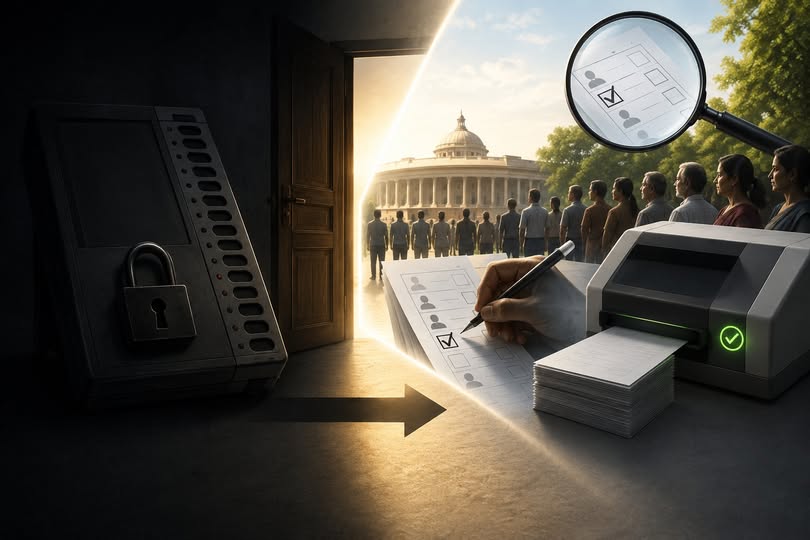
A balanced model already works well. Voters mark paper ballots by hand and feed them into optical scanners. Machines count quickly while physical ballots stay as the legal truth.
This hybrid is common in many US states, South Korea and the Philippines. Scanners achieve high accuracy. Recounts use original papers, not electronic memory. Citizens gain speed plus verifiable trust.
Machines act as assistants, not final judges. This avoids extremes of pure EVMs or old manual chaos. It delivers both efficiency and public confidence.
✦ Chapter 11: Optical Scan Is Faster Than People Imagine
Modern optical scanners read hand-marked ballots instantly using image recognition. They process hundreds of ballots per minute with strong error correction. High-speed models handle thousands per hour.
Precinct scanners at booths give immediate feedback. Central scanners work at secure counting centers. Both far exceed old manual methods. Standardized designs reduce invalid votes sharply.
Paper always survives machine issues. This technology provides speed while keeping transparency. Voters understand and trust the physical record.
✦ Chapter 12: Paper Can Be Fast Without Becoming Chaos Again
Modern paper systems use parallel counting tables and high-speed scanners. Improved ballot layouts cut mistakes. Automatic triggers expand audits only for close races.
Many countries declare results within hours or one day. Old memories of endless delays no longer apply. Visible checks add trust without major slowdowns.
A result everyone accepts in eight hours beats a fast three-hour announcement full of doubt. Extra time can deliver lasting peace and legitimacy.
✦ Chapter 13: Can India Afford the Change?
A full transition to paper-plus-optical-scan would cost thousands of crores. Equipping 10.5 lakh stations with scanners, printing, training and infrastructure is expensive at India’s scale.
Yet eroded public trust costs more. Lost faith leads to instability, protests and weakened institutions. History proves damaged electoral legitimacy is far costlier than hardware.
We must balance budgets against democratic health. The real question is whether India can afford permanent doubt in its elections.
✦ Chapter 14: India Does Not Need Revolution, It Needs a Transition
Reform should be gradual. Strengthen VVPAT audits with risk-limiting methods in close seats. Run large pilots with optical scan in selected states.
Independent audits, open reports and observer involvement will build confidence. Successful pilots guide national rollout. This prevents chaos and new suspicions.
Strong systems grow through repeated proof. The goal is a process resilient to questions from all sides. Patience matters as much as passion.
✦ Chapter 15: Elections Should Not Require Faith
Citizens should not silently wonder if the process was honest. Democracy needs visible, verifiable steps. Faith belongs in religion, not elections.
Paper with optical scanning offers balance. Technology speeds counting. Physical paper provides the clear witness. Machines help but never become unquestionable.
Legitimacy matters more than speed. A nation survives slower counting. It struggles with deep suspicion about how governments are formed. The safest system lets citizens verify their votes.
✦ Epilogue: The System the Loser Still Trusts
Ask one simple question. If your side loses, will you still trust the result? This is the true test of any election system. It cuts through all technical arguments and focuses on the human heart of democracy.
A good system creates peace because people genuinely believe the process was fair, not because they fear the consequences of questioning it. The best voting method is one where even the loser can look at the outcome, examine the evidence, and say with sincerity, “I lost fairly.” This acceptance prevents unrest and builds long-term stability.
Visible trust, not invisible technology locked inside chips, lies at the heart of a strong democracy. When citizens can hold paper records, watch transparent counts, and verify results without needing experts, legitimacy becomes real and lasting. Ultimately, the success of an election is measured not by speed or sophistication, but by the quiet confidence it leaves behind, even in the heart of the one who lost.
✦ 15 Actionable Steps for India to Move from EVM Dependence to Paper Ballot + Optical Scan
 Replace fixed VVPAT checks with margin-based Risk-Limiting Audits so close contests get deeper verification.
Make automatic recounts mandatory when victory margins are extremely small, without waiting for political demands.
Start paper ballot + optical scan pilots in selected state elections before any national rollout.
Create independent audit teams with IITs, IISc, statisticians, and chip-security experts for technical oversight.
Publish full technical details of EVMs, VVPATs, and Symbol Loading Units to reduce suspicion through transparency.
Maintain public batch traceability of every machine, including manufacturing, repairs, and movement history.
Introduce hybrid voting where paper ballots are primary and optical scanners provide fast counting.
Use precinct optical scanners where possible so ballots are scanned immediately at polling stations.
Build secure central scanning facilities for remote areas where precinct scanners are impractical.
Publish post-election audit reports showing mismatches, recounts, and VVPAT verification outcomes.
Strengthen chain-of-custody rules for storage, transport, and sealing of all voting materials.
Hold controlled public security challenge tests where experts can examine system claims under supervision.
Build civic education programs so citizens understand how voting technology and audits actually work.
Protect strong whistleblower channels for election officials and insiders who report procedural failures.
Set a clear 10-year transition roadmap from EVM dependence toward paper ballot + optical scan systems.
✦  Appendix: Book References
 Real-World Electronic Voting: Design, Analysis and Deployment by Feng Hao & Peter Y. A. Ryan
A practical guide to how modern electronic voting systems are built, attacked, audited, and trusted.
Secure Electronic Voting by Dimitris A. Gritzalis
Explains the core security challenges of e-voting, from privacy and fraud prevention to system design.
Towards Trustworthy Elections by David Chaum, Ronald L. Rivest, Jeremy Clark & others
Focuses on how elections earn legitimacy through transparency, verifiability, and public trust.
EVM: Electronic Voting Machines by Alok Shukla
An India-specific study of EVMs, VVPATs, legal debates, and practical election management.
Democracy at Risk! Can We Trust Our Electronic Voting Machines? by G. V. L. Narasimha Rao
Presents strong criticism of Indian EVM systems and argues for deeper public scrutiny.
Hardware Security: Design, Threats, and Safeguards by Debdeep Mukhopadhyay, Rajat Subhra Chakraborty & others
Explores chip-level threats like hardware Trojans, supply-chain attacks, and trust in silicon.
Verified Voting and Risk-Limiting Audits by Philip B. Stark
The mathematical foundation of election auditing and how sampling can verify winners with high confidence.
Code: And Other Laws of Cyberspace by Lawrence Lessig
Shows how system design and architecture quietly shape freedom, trust, and institutional power.
The Wisdom of Crowds by James Surowiecki
Explains how collective judgment works best when systems are transparent, diverse, and independently verifiable.
The Fifth Risk by Michael Lewis
Reveals how invisible public systems like elections depend on competence, trust, and institutional seriousness.