

✦ Introduction — What Do We Really Know About Our Neighbours?
Ask an average Indian student about the art, music, literature, or cultural traditions of our neighbouring countries, and the response may often be limited. We may know headlines about border tensions or cricket matches, but how many of us can describe Bhutanese monastery murals, Sri Lankan Kandyan dance, Nepali paubha paintings, Bangladeshi baul music, or Maldivian bodu beru drumming? Awareness is often shaped more by news cycles than by civilizational knowledge. This gap matters. When cultural understanding is absent, stereotypes quietly take root. Education must fill this space with informed curiosity rather than inherited suspicion.
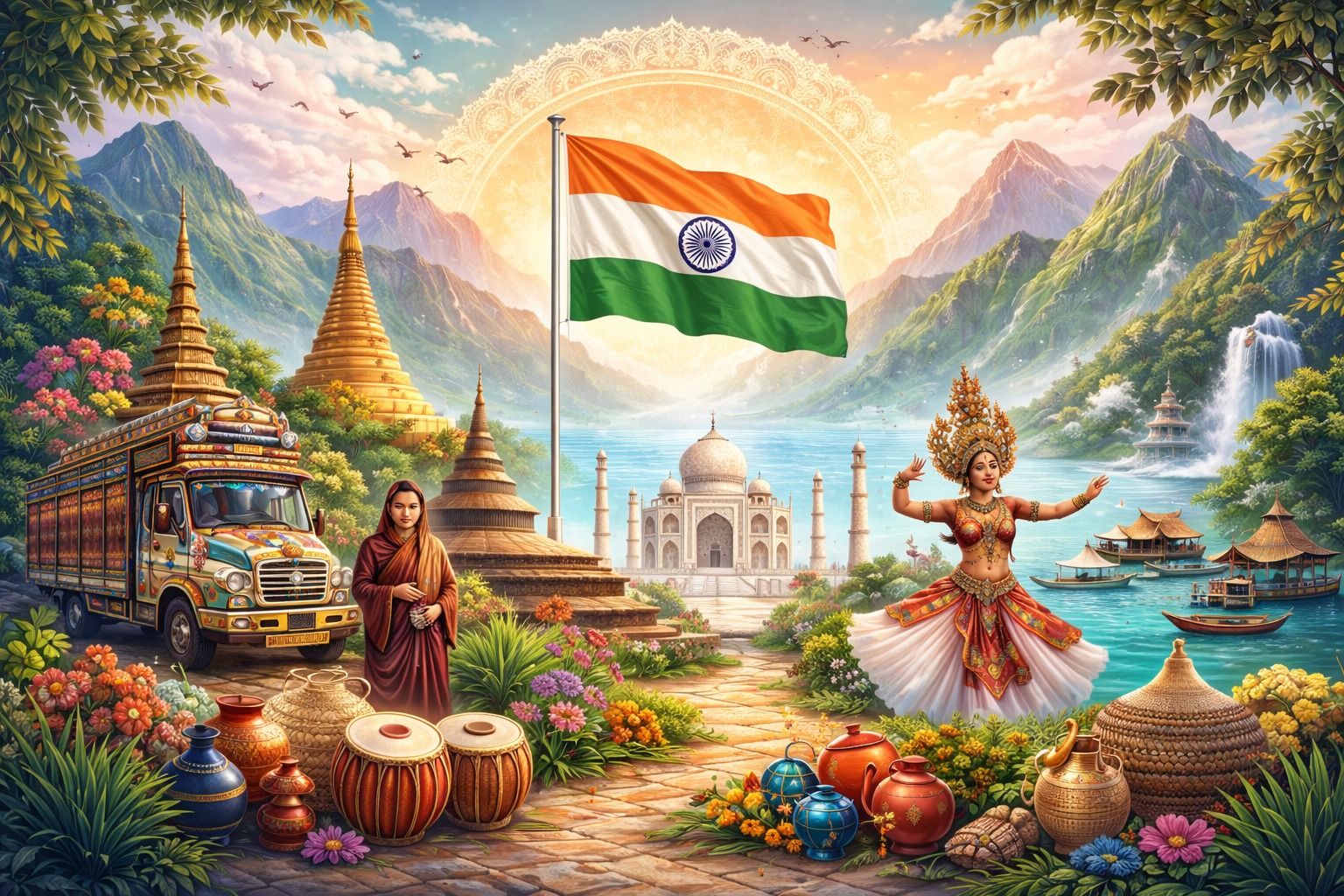
India shares land or maritime boundaries with nine countries: Pakistan, China, Nepal, Bhutan, Bangladesh, Myanmar, Sri Lanka, Afghanistan, and Maldives. Each carries a rich cultural inheritance. Pakistan’s truck art bursts with color and devotional poetry; China’s ink landscape paintings reflect harmony between humanity and nature; Nepal preserves temple architecture blending Hindu and Buddhist traditions; Bhutan protects monastic dance rituals; Bangladesh nurtures baul mystic songs; Myanmar is home to gilded pagodas and intricate lacquerware; Sri Lanka sustains ancient Buddhist chronicles and rhythmic dance traditions; Afghanistan’s poetry and miniature art speak of resilience; the Maldives celebrates oceanic life through music and craft.
To introduce these cultural traditions into textbooks is not a sentimental exercise. It is an educational responsibility. A confident nation studies its neighbours deeply, not to imitate them blindly, but to understand them clearly. At the same time, understanding does not mean neglecting security. A strong defence protects sovereignty; informed education protects wisdom. Both must develop together.
✦ Chapter 1 — Beyond Borders: Civilizations That Flow Across Lines
Political borders are modern arrangements, often shaped by wars, treaties, and colonial legacies. Civilizations, however, are older and more fluid. Languages, culinary traditions, religious practices, and artistic forms frequently extend beyond present-day maps. The Himalayas divide terrain, yet communities on both sides share myths and ritual patterns. Rivers cross nations without visas. Markets historically connected distant regions long before modern passports existed.
Recognizing this historical continuity helps students see that culture cannot be reduced to territorial rivalry. Shared histories do not eliminate political disagreements, but they soften simplistic narratives. When education highlights these continuities, it encourages analytical thinking. Students learn to distinguish between governments and peoples, between policy disputes and civilizational memory. This clarity is essential in a region where borders are sensitive and identities deeply felt.
A curriculum that emphasizes flowing civilizations trains citizens to think historically rather than react emotionally. It builds perspective. And perspective reduces the risk of miscalculation — one of the greatest triggers of conflict.
✦ Chapter 2 — Shared Histories: Trade, Faith, and the Movement of Ideas
From ancient trade routes to maritime exchanges across the Indian Ocean, India’s neighbours have long been participants in shared networks of knowledge and belief. Buddhism traveled from the Gangetic plains into Sri Lanka, Nepal, Bhutan, China, and beyond. In each place it evolved uniquely, shaped by local languages and aesthetics. Trade carried textiles, spices, manuscripts, and musical instruments across borders.
These exchanges remind us that cultural development is rarely isolated. Afghan poetry absorbed Persian influences; Sri Lankan chronicles preserved Buddhist traditions with island characteristics; Myanmar’s pagodas reflect both local craftsmanship and regional inspiration. Culture grows through adaptation, not isolation.
By teaching these interconnected histories, textbooks can prevent narrow nationalism from distorting reality. Students learn that interaction is not weakness but the norm of human development. At the same time, they understand that cultural exchange coexists with political competition. Recognizing both dimensions prepares young minds for mature citizenship.
✦ Chapter 3 — The Himalayan Bridge: Culture in the Shadow of Mountains
The Himalayas are often described as a natural barrier. Yet historically they have also functioned as bridges. Monks, traders, and pilgrims moved across passes linking India with Nepal, Bhutan, and regions connected to China. Artistic traditions such as thangka and paubha paintings show remarkable thematic continuities, while retaining distinct regional styles.
Monastic festivals in Bhutan combine masked dances, ritual music, and vibrant costumes. Nepali temples demonstrate layered architectural symbolism. In border areas of India’s Northeast, communities share kinship ties and folklore with Myanmar and Bhutan. These are living relationships, not museum artifacts.
Understanding the Himalayan region as a cultural bridge reshapes how students perceive frontier zones. They are not empty buffers but vibrant spaces of exchange. Development in these areas strengthens both social harmony and national security. Cultural inclusion and infrastructure go hand in hand.
✦ Chapter 4 — The Northeast Corridor: Where Identity and Geography Meet
Northeast India occupies a strategic and cultural crossroads. Its communities maintain linguistic and ethnic continuities with neighbouring Myanmar and Bangladesh. Music traditions, weaving patterns, and harvest festivals reflect centuries of regional interaction. At the same time, the area faces developmental challenges that influence stability.
When border regions feel isolated, vulnerabilities grow. Infrastructure, education, and economic opportunity are therefore not only social goals but strategic necessities. Connectivity enhances trade and builds trust across communities, reducing alienation.
Teaching students about the Northeast as a corridor rather than a periphery changes national perception. It highlights how geography, identity, and policy intersect. A strong nation invests in its border regions not merely for defence, but for dignity and inclusion.
✦ Chapter 5 — Reading a Nation Through Its Art
Art expresses collective psychology. Pakistan’s decorated trucks often display calligraphy, poetry, and bright floral imagery — symbols of pride and devotion. Chinese ink paintings frequently portray vast landscapes where humans appear small within nature, suggesting philosophical harmony. Sri Lankan Kandyan dance conveys ritual strength and continuity. Bangladeshi baul singers articulate mystical longing through music.
These artistic forms reveal values, anxieties, aspirations, and spiritual frameworks. By studying them, students learn to interpret symbolism rather than rely on stereotypes. Cultural literacy sharpens observation skills and deepens empathy.
Understanding art does not imply agreement with political positions. It means appreciating how societies narrate themselves. When future diplomats, journalists, or soldiers possess this awareness, they operate with greater insight and fewer assumptions.
✦ Chapter 6 — Memory, Pride, and National Narratives
Every nation carries historical memories — victories, invasions, alliances, humiliations. These memories shape diplomatic behavior. Afghanistan’s literary traditions speak of resilience amid turmoil. Bangladesh’s cultural identity is strongly tied to language movements. Nepal balances historical relationships between larger powers. China draws upon a long civilizational continuity in shaping its global posture.
When textbooks ignore these narratives, students lack context for contemporary developments. Policies do not emerge from nowhere; they are rooted in collective memory. Education that acknowledges this complexity prepares students to interpret events more thoughtfully.
At the same time, understanding historical pride in neighbouring countries strengthens India’s own self-confidence. Recognizing another’s narrative does not weaken one’s own. Instead, it encourages respectful engagement combined with strategic clarity.
✦ Chapter 7 — Culture and Strategy: Why Understanding Prevents Miscalculation
Security challenges often arise from misreading intentions. Cultural signals — diplomatic language, symbolic gestures, public rhetoric — carry meanings shaped by tradition. Without cultural literacy, these signals can be misunderstood. Miscalculation escalates tension.
Modern security involves not only armed forces but information awareness. Media narratives, social platforms, and emotional messaging influence public opinion. Citizens educated about neighbouring societies are less vulnerable to misinformation. They analyze before reacting.
Strong defence remains essential. Borders must be protected with vigilance and preparedness. Yet vigilance paired with ignorance is unstable. Vigilance paired with understanding is durable. Education, therefore, becomes a subtle but powerful pillar of national security.
✦ Chapter 8 — Soft Power and Hard Power: Two Pillars of National Strength
In international relations, nations rely on both persuasion and protection. Cultural exchange, educational scholarships, cinema, yoga, literature, and humanitarian assistance build goodwill. Military preparedness, border infrastructure, intelligence systems, and strategic alliances ensure sovereignty. These two dimensions are not opposites; they are complementary pillars of stability. A nation that invests only in soft power risks vulnerability. A nation that invests only in hard power risks isolation.
India’s civilizational influence is visible across the region. The Ramayana is retold in Sri Lanka and Southeast Asia. Sanskrit vocabulary shaped classical traditions in Nepal. Buddhist philosophy traveled to Bhutan, Myanmar, and China. Even shared culinary traditions and textile patterns reveal layers of interaction. These common threads offer a foundation for dialogue.
At the same time, strong defence capabilities remain essential. Cultural familiarity does not eliminate territorial disputes or geopolitical competition. Instead, it ensures that strategic decisions are informed rather than reactive. A mature state balances openness with vigilance.
✦ Chapter 9 — Borders in the 21st Century: Geography, Technology, and Information
Borders today are not only physical. They are digital, informational, and psychological. Satellite imagery, cyber systems, and media narratives influence security calculations. Information warfare exploits cultural ignorance by spreading distorted images of neighbouring societies. When citizens lack understanding, misinformation travels faster than truth.
Recent tensions along the India–China border, political instability in Myanmar, and shifts in Afghanistan’s governance demonstrate how quickly regional conditions can change. Economic challenges in Sri Lanka and infrastructure competition across South Asia highlight how strategic interests intersect with domestic realities. These developments must be studied calmly and analytically in classrooms.
Cultural literacy equips students to interpret such events without exaggeration. Recognizing shared civilizational layers — such as Buddhist linkages with Sri Lanka or Nepal, maritime ties with the Maldives, or linguistic connections with Bangladesh — encourages perspective. Awareness reduces fear while maintaining alertness.
✦ Chapter 10 — Infrastructure, Connectivity, and Regional Stability
Roads, railways, ports, and digital corridors are more than economic projects; they shape geopolitical realities. Connectivity strengthens trade and interdependence, reducing incentives for conflict. At the same time, infrastructure has strategic implications, especially in border areas and maritime routes.
India’s outreach to neighbouring countries through development partnerships, disaster relief, and training programs reflects both cooperation and responsibility. Shared river systems, energy grids, and transport corridors bind regional futures together. Cultural exchange deepens when physical connections improve.
Yet infrastructure competition also exists. Students must understand that development projects may carry economic, political, and security dimensions simultaneously. Teaching this complexity builds analytical maturity. It shows how economic policy, diplomacy, and defence planning intersect within regional stability.
✦ Chapter 11 — Contemporary Realities: Lessons from Recent Regional Developments
The region has experienced rapid change in recent years. Border tensions between India and China underscored the importance of preparedness. Political transitions in Nepal and Bangladesh revealed the influence of domestic identity on foreign policy. Economic crisis in Sri Lanka highlighted how internal instability can affect regional security. Developments in Afghanistan altered strategic calculations across South Asia. Political unrest in Myanmar has impacted border communities in Northeast India.
Studying these events in textbooks encourages reasoned discussion rather than emotional reaction. Students learn to separate governments from citizens, and temporary crises from long-term civilizational bonds. They also observe how shared cultural roots sometimes provide channels for dialogue during tense moments.
India’s cultural influence — through shared epics, linguistic connections, educational exchanges, and religious heritage — continues to offer a platform for engagement even when political differences arise. Awareness of these layers strengthens diplomatic flexibility.
✦ Chapter 12 — Education as National Security: Reforming the Curriculum
If awareness among citizens is limited, the solution lies in education. Introducing structured modules on neighbouring art, literature, music, architecture, and philosophy can transform perception. Comparative studies may include Pakistani truck art, Chinese calligraphy, Nepali paubha painting, Bhutanese masked dances, Bangladeshi baul music, Sri Lankan Buddhist chronicles, Afghan poetry, Myanmar’s pagodas, and Maldivian maritime culture.
Such curriculum reform fosters curiosity rather than suspicion. Students can explore shared influences — Buddhism’s journey, Sanskritic imprints, maritime trade, and common folklore — while also studying differences honestly. Field projects, cultural exhibitions, and exchange programs deepen understanding.
Education thus becomes a subtle instrument of national security. An informed citizenry is less vulnerable to propaganda and more capable of supporting balanced foreign policy. Cultural literacy builds resilience.
✦ Chapter 13 — Strong Defence, Clear Mind: Vigilance with Understanding
National security requires alert armed forces, secure borders, and modern technology. These responsibilities cannot be neglected. However, strength must be accompanied by clarity. Emotional nationalism without knowledge can create misjudgment. Knowledge without preparedness can create complacency. The two must evolve together.
India’s defence forces protect sovereignty along land and maritime borders. Meanwhile, civil society, educators, and scholars protect intellectual sovereignty by cultivating informed perspectives. When students understand neighbouring societies, they avoid caricatures. They support firm policy decisions grounded in reason rather than anger.
This balanced approach reflects civilizational maturity. Appreciating Sri Lanka’s Buddhist heritage or Nepal’s shared traditions does not weaken vigilance. Instead, it humanizes engagement while preserving national interest.
✦ Chapter 14 — A Confident Civilization: Peace with Preparedness
India’s philosophical heritage emphasizes dialogue, pluralism, and coexistence. Yet history also teaches the importance of preparedness. A confident civilization does not isolate itself in fear, nor does it abandon caution in idealism. It studies, engages, protects, and adapts.
Across South Asia and beyond, echoes of Indian influence — in epics, language, philosophy, trade, and art — continue to resonate. These shared strands offer possibilities for cooperation. At the same time, geopolitical realities demand strategic foresight and disciplined defence.
The future of regional stability depends on citizens who think deeply and act responsibly. Textbooks that integrate cultural understanding with strategic awareness prepare such citizens. Peace without strength is fragile. Strength without understanding is dangerous. A mature nation cultivates both — and in doing so, transforms knowledge into its quietest, strongest defence.
✦ Epilogue — Balanced Attention, Broader Vision
Public conversation in India often becomes narrowly focused on one neighbour. Security concerns are real and must be addressed firmly. However, it is neither strategic nor educationally healthy to allow one country to dominate our mental landscape. Pakistan is one of India’s neighbours — important, complex, and deserving of clear-eyed policy — but it is not the only neighbour shaping our future. India shares space, history, and strategic interaction with eight others: China, Nepal, Bhutan, Bangladesh, Myanmar, Sri Lanka, Afghanistan, and Maldives. A mature nation distributes its intellectual attention proportionately.
Overemphasis on a single relationship can distort perception. It narrows strategic imagination and reduces public awareness of broader regional dynamics — trade corridors, maritime security, Himalayan ecology, cultural diplomacy, and emerging economic partnerships. A balanced curriculum should therefore introduce a dedicated chapter titled “Understanding Our Neighbours” in school textbooks. This chapter would not promote sentimentality, nor would it dilute vigilance. Instead, it would cultivate perspective: each neighbouring country studied for its art, literature, historical memory, political system, and contemporary challenges.
India’s civilizational confidence allows it to engage widely without insecurity. The goal of education is not to prioritize rivalry but to cultivate awareness. When young Indians learn about all nine neighbours — their cultural achievements, internal debates, and strategic choices — they become citizens capable of reasoned judgment. Strong defence remains essential. But intellectual imbalance is also a weakness. Broad awareness is strength.
Reference Works

Northeastern India and Its Neighbours: Negotiating Security and Development
Edited by Rakhee Bhattacharya
India–China Dialogues Beyond Borders
Edited by Swati Mishra and Ranjana Sheel
The Himalayan Arc
Edited by Namita Gokhale
India’s Relations with Neighboring South and South East Asian Countries
Edited by Lipi Ghosh and Anasua Basu Ray Chaudhury
The China–Pakistan Axis
By Andrew Small
All Roads Lead North
By Amish Raj Mulmi
✦ Appendix — 15 Actionable Recommendations for Curriculum Reform
→ Introduce a compulsory chapter titled “Understanding Our Neighbours” in middle and senior school civics textbooks.
→ Include short cultural profiles of all nine neighbouring countries, covering art, literature, festivals, and historical influences.
→ Develop comparative modules showing shared civilizational threads such as Buddhism, trade routes, and linguistic exchange.
→ Add classroom case studies on recent regional developments to build analytical skills.
→ Encourage student research projects on one neighbouring country per academic term.
→ Invite cultural scholars and artists from neighbouring countries for virtual or in-person lectures.
→ Organize regional art exhibitions featuring student interpretations of neighbouring cultures.
→ Promote border-region studies to understand the Northeast and Himalayan corridors as bridges, not peripheries.
→ Include media literacy training to counter misinformation related to neighbouring countries.
→ Integrate geography lessons with cultural history to connect terrain and tradition.
→ Develop optional exchange programs or digital pen-pal initiatives with schools in neighbouring countries where feasible.
→ Highlight India’s cultural influence abroad — epics, philosophy, language, and trade — alongside reciprocal influences.
→ Encourage debate sessions that distinguish between political disagreements and cultural understanding.
→ Provide teacher-training modules focused on balanced regional education.
→ Review textbooks periodically to ensure proportional attention to all neighbours, avoiding excessive focus on any single country.