

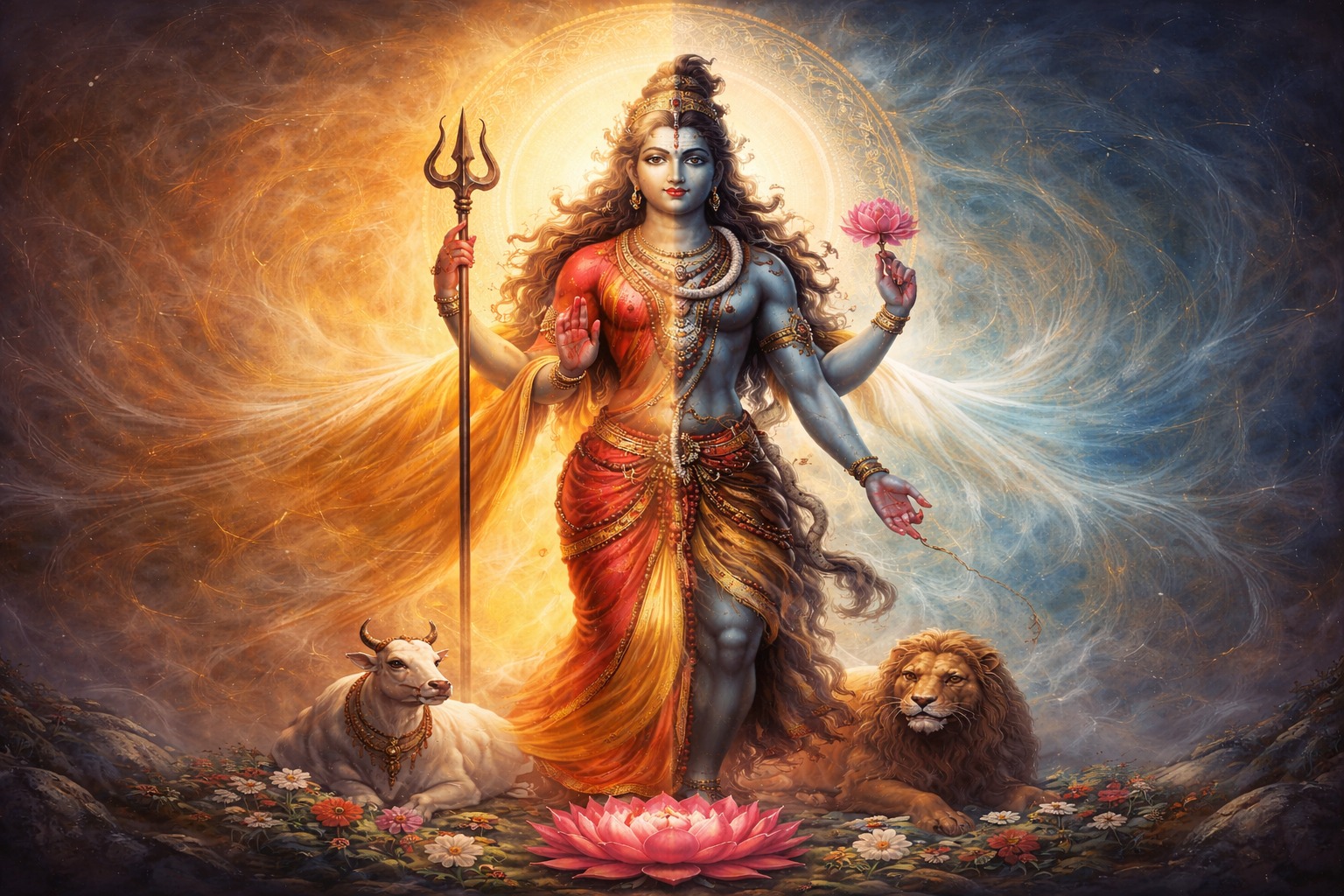
Introduction — Ardhanarishvara: The Symbol of Wholeness
The image of Ardhanarishvara — half Shiva, half Shakti — is not merely artistic imagination. It is a metaphysical statement about reality and a psychological statement about human maturity. The right side represents stillness, witnessing, and unchanging awareness. The left side represents movement, creativity, emotion, and dynamic force. Together, they form a single being. Not two entities stitched together — but one indivisible existence expressed as polarity.
In this symbol lies a radical insight: consciousness and energy are never separate. Shiva without Shakti is inert; Shakti without Shiva is directionless. In human terms, clarity without vitality becomes lifeless detachment, and vitality without awareness becomes chaos. The integration of both is wholeness. The journey of Shiva–Shakti philosophy is therefore not about renouncing life, nor indulging it blindly, but about harmonizing awareness and power within oneself.
✦ Chapter 1 — Consciousness as the Ground: Who Is the Witness?
At the heart of Shaiva philosophy lies a simple but destabilizing inquiry: who is the one aware of experience? Thoughts change, emotions fluctuate, sensations rise and fall — yet something constant observes them. That silent observer is referred to as Shiva, not as a distant deity, but as pure consciousness itself. Awareness is not created by thought; it precedes thought. It is the field in which every experience appears.
When we identify exclusively with mind and personality, we mistake movement for identity. But when attention turns toward the witness, a subtle shift occurs. One realizes that anger is seen, fear is seen, desire is seen — and therefore none of them define the seer. This recognition does not deny life; it stabilizes it. Consciousness becomes the ground. From that ground, energy can move without overwhelming the individual. Without this foundation, spiritual practice remains psychological turbulence. With it, inner steadiness begins.
✦ Chapter 2 — Shakti as Dynamic Energy: The Universe as Vibration
If Shiva is the unmoving witness, Shakti is everything that moves. She is not separate from consciousness; she is its expressive power. In texts such as the Vigyan Bhairav Tantra, reality is described as vibration — Spanda — a subtle pulsation that manifests as breath, thought, matter, and cosmos. Energy is not merely physical force; it includes emotion, creativity, sexuality, ambition, and imagination.
To reject Shakti is to reject life itself. Yet when energy operates unconsciously, it binds the individual through attachment and reactivity. The same force that creates art can also create obsession. The same passion that fuels devotion can fuel destruction. Therefore, the goal is not suppression but refinement. When energy is seen clearly, it becomes intelligent. When guided by awareness, it becomes creative rather than compulsive. Shakti is not the problem; unconscious identification with her movements is.
✦ Chapter 3 — The Psychological Battlefield: Ego and Inner Demons
The mythic battles described in the Devi Mahatmya are psychological allegories. The demons symbolize arrogance, greed, self-importance, and fragmentation. They represent patterns that hijack Shakti and distort her power. Ego, or ahamkara, is not merely pride; it is the tendency to center reality around one’s constructed identity. When energy serves ego alone, suffering multiplies.
Inner conflict arises when awareness is weak and conditioning is strong. Emotional turbulence, jealousy, or compulsive desire are not moral failures; they are misdirected energy. The battlefield is internal. When the witnessing faculty strengthens, these patterns lose intensity. Like shadows in light, they dissolve through recognition. The Goddess slaying demons is a poetic way of describing what happens when awareness illuminates unconscious impulses. Psychological maturity begins when we stop blaming circumstances and start observing inner reactions.
✦ Chapter 4 — Neti Neti and the Art of Recognition
The verses of Nirvana Shatakam declare: “I am not the mind, nor the intellect, nor the ego.” This method of negation — Neti Neti (“not this, not this”) — is not nihilism; it is disidentification. By systematically observing and releasing identification with mental and emotional layers, one uncovers a deeper substratum of being.
In Kashmir Shaivism, this realization is called Pratyabhijna — recognition. Liberation is not acquiring something new but recognizing what has always been present. When a thought arises, instead of merging with it, one notices it as an appearance in awareness. Gradually, identity shifts from content to context — from what is experienced to the field in which it is experienced. This does not make life dull; it makes it lucid. Clarity replaces entanglement. The individual begins to act rather than react.
✦ Chapter 5 — The Sacred Body: Tantra Beyond Misconception
Tantra is often misunderstood as indulgence, but at its philosophical core it is integration. The body is not an obstacle to transcendence; it is the instrument through which awareness and energy meet. Breath, posture, sensation — all are expressions of Shakti. To neglect the body is to fragment spiritual growth. To worship it blindly is to lose grounding. The middle path is reverent discipline.
Energy flows through physiological and psychological channels. When posture collapses, breath shortens; when breath shortens, mind contracts. Thus, embodiment practices refine energy and stabilize awareness simultaneously. The sacredness of the body lies not in ornamentation but in conscious inhabitation. Every sensation becomes an opportunity to witness movement without losing center. Tantra insists that spirituality must include the physical dimension, not escape it. Integration replaces division.
✦ Chapter 6 — Breath as Bridge: The Gap and Direct Experience
Among the many methods described in the Vigyan Bhairav Tantra, awareness of the breath occupies a central place. The subtle pause between inhalation and exhalation reveals a microcosmic stillness. In that gap, energy momentarily rests and awareness stands unobstructed. This is not mystical exaggeration; it is direct observation available to anyone.
Breath serves as a bridge between conscious and unconscious processes. By attending to it carefully, the nervous system stabilizes and mental agitation decreases. More importantly, the practitioner glimpses the coexistence of movement and stillness. Air flows, yet awareness remains unchanged. Repeated recognition of this dynamic gradually reshapes perception. Stillness is discovered within motion rather than apart from it. The practice becomes experiential rather than theoretical.
✦ Chapter 7 — Inner Union: The Non-Dual Dance
The culmination of these insights is inner union — not an event but a shift in understanding. Awareness does not suppress energy; it contains and guides it. Energy does not disturb awareness; it expresses it. The image of Ardhanarishvara becomes experiential rather than symbolic. One recognizes that clarity and passion, restraint and creativity, silence and expression can coexist without contradiction.
This integration produces psychological balance. Emotions are felt but not overwhelming. Desire is acknowledged but not tyrannical. Action emerges from steadiness rather than impulse. The dance of Shiva and Shakti continues, but the individual is no longer fragmented by it. Non-duality is not withdrawal from life; it is harmonious participation in it.
✦ Chapter 8 — Desire and Attachment: Energy in Its Raw Form
Desire (kama) is among the most misunderstood aspects of spiritual discourse. Within the Shiva–Shakti framework, desire is not inherently sinful nor inherently liberating; it is raw energy seeking movement. Shakti expresses herself as longing — for connection, achievement, intimacy, recognition, experience. The problem does not lie in desire itself but in unconscious attachment to its fulfillment. When awareness collapses into craving, energy narrows and contracts into compulsion.
Attachment forms when identity becomes entangled with outcome. “I must have this to be complete.” That belief transforms natural energy into psychological bondage. However, when desire is witnessed without immediate reaction, something subtle changes. The energy remains, but urgency softens. One begins to sense that desire is a wave arising within awareness, not a command to obey. In this space, desire becomes informative rather than controlling. It reveals deeper needs — connection, creativity, vitality — that can be consciously directed instead of blindly pursued.
✦ Chapter 9 — Sexuality as Sacred Energy: Integration, Not Extremes
Sexuality represents one of the most concentrated forms of Shakti in human life. Biologically rooted, emotionally charged, and psychologically powerful, it cannot be trivialized without consequence. Spiritual traditions have often oscillated between repression and indulgence. The Shiva–Shakti understanding offers a third path: integration. Sexual energy is neither denied nor worshipped; it is refined through awareness.
When suppressed through guilt or fear, sexual energy turns into frustration, rigidity, or covert obsession. When indulged compulsively, it dissipates vitality and strengthens dependency. Integration begins with recognition. Attraction is acknowledged without immediate action. Sensation is felt in the body without narrative escalation. Awareness becomes present at the center of the experience. In Tantric philosophy, sexuality is sacred not because of ritualized behavior, but because it reveals the creative principle itself. When infused with responsibility, clarity, and mutual respect, sexual energy becomes creative, relational, and life-affirming rather than fragmenting.
✦ Chapter 10 — The Masculine and Feminine Within: Psychological Polarity
The symbolism of Shiva and Shakti is often misread as biological gender doctrine. In truth, it describes energetic polarity present within every individual. The “masculine” principle refers to direction, structure, discrimination, and steadiness — qualities of awareness. The “feminine” principle refers to flow, emotion, receptivity, and creative expansion — qualities of energy. Psychological imbalance occurs when one pole dominates at the expense of the other.
An individual overly identified with rigid control may suppress emotion and spontaneity, mistaking detachment for maturity. Conversely, one immersed entirely in emotional flow may lack clarity and groundedness. Integration requires recognizing both dimensions internally before projecting them onto relationships. Mature polarity is complementary, not competitive. It allows decisiveness without harshness and sensitivity without instability. The dance of Shiva and Shakti thus becomes a model for inner psychological equilibrium rather than external hierarchy.
✦ Chapter 11 — Power and Awareness: The Danger of Imbalance
Power without awareness easily turns destructive. Charisma without clarity becomes manipulation. Passion without steadiness becomes volatility. In mythic language, Shakti unleashed without Shiva’s witnessing burns uncontrollably. Conversely, awareness without vitality becomes lifeless abstraction. Intellectual spirituality that avoids embodiment can create emotional stagnation and spiritual bypassing.
True integration demands that power be guided by discernment. Energy must move, but not blindly. Awareness must remain present, but not detached from life. When both operate together, action becomes deliberate and compassionate. Decisions arise from clarity rather than egoic urgency. The integrated individual neither fears power nor worships it. Instead, power becomes service — an expression of aligned energy rooted in conscious presence.
✦ Chapter 12 — Time, Death, and the Dissolution of Ego
In the form of Mahakala — the great devourer of time — Shiva reminds humanity of impermanence. Every body ages. Every possession dissolves. Every identity eventually fades. Contemplation of mortality is not morbid; it is clarifying. When deeply acknowledged, impermanence weakens trivial attachments and sharpens perception of what truly matters.
Shakti manifests as change itself — seasons shifting, emotions fluctuating, relationships evolving. Resisting change intensifies suffering. Accepting impermanence aligns awareness with reality. The ego fears dissolution because it equates change with annihilation. Yet awareness itself is not destroyed by change; it witnesses it. Recognizing this distinction reduces existential anxiety. Life becomes precious rather than possessive. Action becomes intentional rather than desperate.
✦ Chapter 13 — Love, Devotion, and Relational Awakening
Bhakti — devotion — represents Shakti softened by surrender and illuminated by awareness. In relationship, the Shiva–Shakti dynamic becomes especially visible. Attraction, vulnerability, conflict, and intimacy all reveal energetic interplay. Without awareness, relationships become arenas of projection and control. With awareness, they become mirrors for growth.
Devotion does not imply subservience; it implies reverence for the sacred dimension in another being. When two individuals engage from integrated polarity, intimacy deepens without dependency. Emotional expression flows without losing individuality. Conflict becomes communication rather than warfare. Love matures when awareness remains present within passion. In this way, relational life itself becomes spiritual practice — not separate from it.
✦ Chapter 14 — Living Ardhanarishvara: Applied Integration
The journey culminates not in retreat from society but in embodied participation. To live as Ardhanarishvara internally means acting with clarity while remaining emotionally alive. Work becomes an expression of directed energy. Creativity flows without chaos. Sexuality operates with responsibility. Relationships unfold with mutual respect. Silence and action alternate rhythmically.
Integration is ongoing, not final. Awareness must be renewed; energy must be refined continuously. Yet once the fundamental recognition is established — that consciousness and power are inseparable — fragmentation gradually dissolves. The individual no longer swings between suppression and excess. Instead, life becomes a dance consciously inhabited. The symbol of Ardhanarishvara ceases to be myth and becomes method — a living architecture of wholeness.
Epilogue — Returning to the Whole
The journey through Shiva–Shakti philosophy is not a movement toward abstraction but toward integration. Awareness and energy are not opposing forces to be reconciled after conflict; they are dimensions of one reality that must be consciously harmonized. The symbol of Ardhanarishvara reminds us that wholeness is not achieved by suppressing vitality nor by dissolving into indulgence. It emerges when clarity guides power and power animates clarity.
In contemporary life — saturated with stimulation, performance pressure, and fragmented identities — this framework offers psychological stability. It reframes sexuality as energy requiring responsibility, desire as movement requiring awareness, and spirituality as embodiment rather than escape. The dance is ongoing. Stillness and motion alternate. The task is not to stop the dance but to inhabit it consciously.
Below are key texts that informed this philosophical architecture.
References & Foundational Texts

Vigyan Bhairav Tantra — Meditative techniques revealing the union of awareness and energy
Devi Mahatmya — Symbolic portrayal of inner psychological battles
Devi Bhagavata Purana — Theological exposition of Shakti as supreme reality
Nirvana Shatakam — Non-dual disidentification through negation
Path to Siva — Structured introduction to Saivite metaphysics
Myth = Mithya — Psychological and symbolic interpretation of Hindu mythology
Abhinavagupta’s commentaries on Kashmir Shaivism — Philosophical depth on recognition (Pratyabhijna)
Classical Tantra texts on embodiment and energy refinement

Appendix — 15 Actionable Integrations
→ Observe one emotion daily without reacting for at least 60 seconds.
→ Practice 5 minutes of breath awareness, noticing the pause after exhalation.
→ Before responding in conflict, pause and ask: “Am I reacting or responding?”
→ Channel strong desire into disciplined creation (writing, training, study).
→ Acknowledge sexual energy without shame or impulsive discharge.
→ Strengthen the body through consistent physical discipline.
→ Schedule intentional silence after intense work periods.
→ Reflect weekly on impermanence to recalibrate priorities.
→ Practice “Neti Neti” during emotional overwhelm.
→ Avoid both indulgence and repression; choose conscious moderation.
→ Notice patterns of validation-seeking and observe them without judgment.
→ Integrate structure (planning) with spontaneity (creative flow).
→ Treat relationships as mirrors for self-awareness.
→ Direct power toward contribution rather than control.
→ End each day by asking: “Did awareness guide my energy today?”