

Chapter 1: Why India Must Design, Not Just Deliver
India has mastered scale. From digital payments to vaccines, from satellites to software services, the country has proven it can deliver to millions. Yet delivery is not the same as design. Delivery optimizes what already exists. Design imagines what should exist.
For decades, Indian engineering education has been tuned to execution—coding to specification, manufacturing to drawing, optimization within constraints given by someone else. This model created employability, but it also created dependency. When designs originate elsewhere, value capture follows them.
True sovereignty in the 21st century is not political alone; it is design sovereignty. Nations that design systems—chips, platforms, machines, protocols—shape the future. Nations that only execute become excellent subcontractors.
India now stands at an inflection point. With AI, automation, and manufacturing returning to strategic importance, the question is no longer whether India can make things. The question is: Can India design the parts, architectures, and systems from which everything else flows?
This article argues that engineering education must pivot—from syllabus completion to design–manufacture–automate thinking, rooted in Indian realities but benchmarked against the world’s best.
Chapter 2: The Part Before the Product
Every complex system begins not with a product, but with a part.
ISRO did not begin with rockets; it began with propulsion stages, guidance algorithms, materials that could survive re-entry. UPI did not begin as an app; it began as interoperable payment primitives. Indian classical architecture did not begin with temples; it began with proportions, joints, load paths.
Yet in most Indian engineering colleges, students encounter finished products first—cars, circuits, apps—without understanding the design logic of parts.
Global leaders invert this. At MIT and TU Delft, students obsess over components: a hinge, a heat exchanger, a control loop. They ask: What constraints does this part live under? How can it be reused? How might it fail?
India must relearn this discipline. A nation that understands parts can recombine them endlessly. A nation that only understands products remains fragile.
Chapter 3: Manufacturing as Thinking, Not Labor
Manufacturing in India is still culturally framed as labor, not cognition. Design is seen as elite; manufacturing as execution. This is a fatal misunderstanding.
The Japanese mastered manufacturing by treating it as applied philosophy. Toyota’s production system is not machinery—it is thinking embedded in motion.
India’s successes show the same pattern. PSLV’s reliability came not from expensive components, but from deep manufacturing discipline. MSME clusters in Coimbatore and Rajkot succeed not because of scale, but because of tacit knowledge.
Engineering education must therefore place students on shop floors—not as observers, but as designers-in-context. A drawing that cannot be manufactured is not a design; it is fiction.
Chapter 4: Automation as a Multiplier of Design Quality
Automation does not fix poor design. It multiplies it.
A badly designed process, when automated, fails faster and at scale. A well-designed process, when automated, becomes transformative.
This is why automation must enter after design thinking, not before. Germany’s Fachhochschule model embeds this sequence rigorously: understand the system, build manually, then automate.
India often reverses this—importing robots before redesigning workflows. Engineering education must correct this error by teaching automation as the final act of clarity.
Chapter 5: Systems Thinking — Seeing the Invisible
UPI works not because of code alone, but because of incentive alignment, regulatory clarity, and human behavior.
Systems thinking is the ability to see interactions, delays, feedback loops. IISc Bengaluru excels here, training engineers who think in terms of flows, not objects.
Design education must therefore cross silos: mechanical students learning software, electrical students understanding materials, computer scientists studying manufacturing constraints.
A system is not broken where it fails; it is broken where it was misunderstood.
Chapter 6: Prototyping as a Cultural Habit
China prototypes fast. Silicon Valley prototypes recklessly. India prototypes cautiously.
This caution comes from marks-driven education and fear of failure. Yet every major Indian success—from Chandrayaan-3 to Aadhaar—emerged through iterative learning.
Institutions like IIT Madras’ Research Park show what is possible when prototyping is normalized. Engineering curricula must therefore include credit-bearing failure—projects where learning, not success, is rewarded.
Chapter 7: Universities That Build, Not Just Teach
Walk into the workshops of MIT or TU Munich late at night and you will notice something striking. The lights are on. Not because of deadlines, but because students want to be there. Machines hum softly, whiteboards are filled with half-erased ideas, and prototypes—unfinished, imperfect—lie on tables like thinking made visible.
These universities do not treat laboratories as accessories to lectures. They treat them as the heart of learning. Theory flows towards making, not away from it. A lecture on materials is incomplete until a student has felt metal fail under stress. A class on control systems is unfinished until a motor behaves unexpectedly.
In India, classrooms still dominate, and labs often trail behind as verification tools. The result is an engineer fluent in answers but hesitant in action. Institutions like IIT Madras’ Research Park or IISc’s interdisciplinary labs show a different possibility—where universities become places that build continuously, quietly, and seriously. For India, this shift is not cosmetic. It is foundational.
Chapter 8: Modular Thinking for a Diverse Nation
India rarely succeeds through monoliths. It succeeds through parts that work together despite difference.
UPI did not impose one app, one bank, one interface. It defined a modular architecture—simple rules, clear interfaces—allowing thousands of variations to flourish. Chandrayaan’s success followed a similar logic: propulsion, navigation, communication, and payload evolving semi-independently, yet coherently.
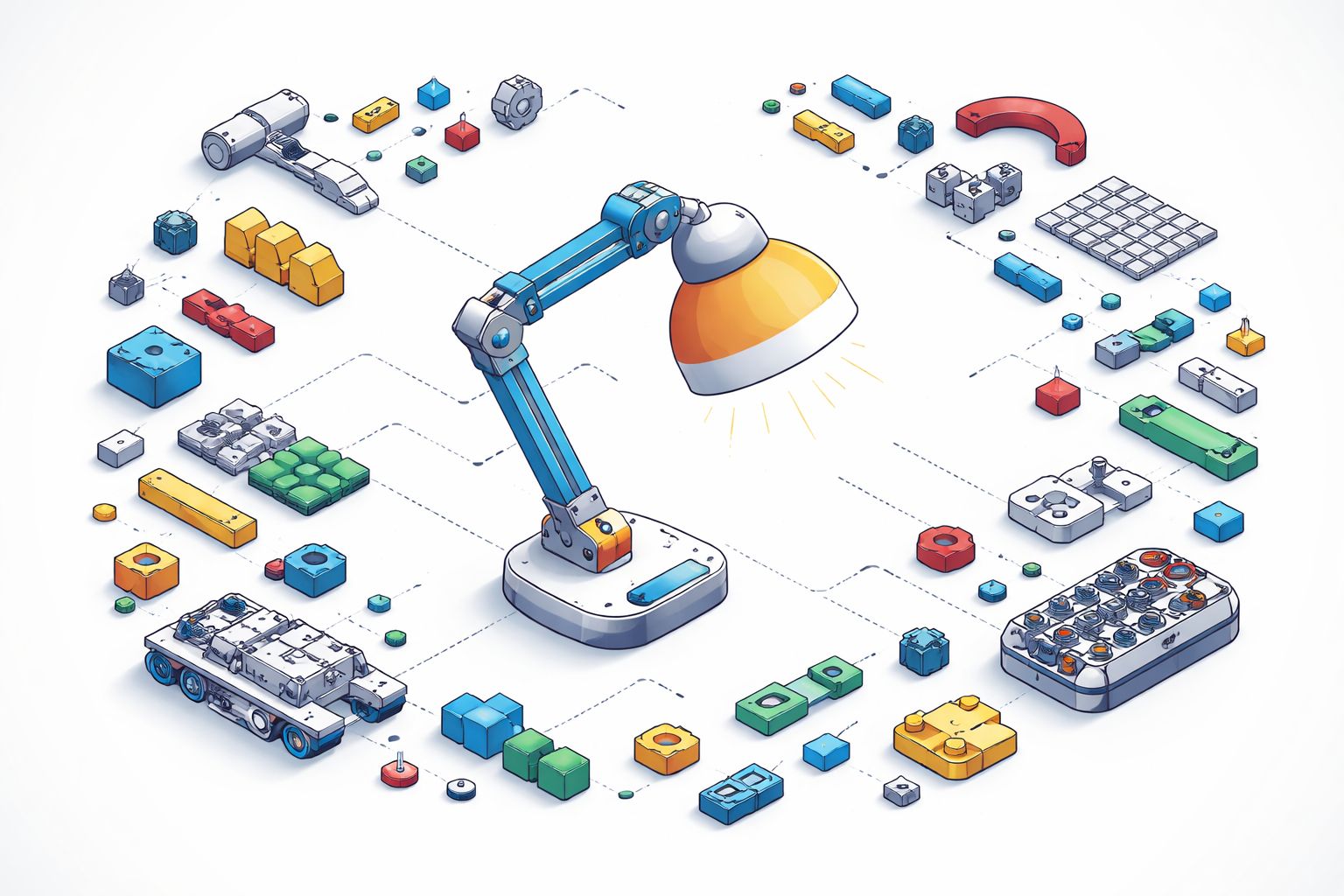
Design education must therefore train engineers to think in modules. A module is humble—it does one thing well. But when combined, modules create scale without fragility. This way of thinking is essential for India, where solutions must adapt across languages, climates, incomes, and infrastructures.
Teaching modularity is not abstract. It means asking students to redesign the same system for multiple contexts, learning where interfaces matter more than features.
Chapter 9: MSMEs as Living Design Classrooms
Across India, in places far from campuses, design already happens daily. In Coimbatore, Ludhiana, Rajkot, and Tiruppur, small factories solve problems with ingenuity born of constraint.
An MSME owner does not speak the language of design thinking—but practices it instinctively. Materials are substituted, processes adapted, machines modified. These are not compromises; they are contextual innovations.
Yet engineering education remains distant from these spaces. Germany’s dual system integrates students into SMEs early, allowing theory and practice to mature together. India can do the same. When students learn design inside MSMEs, they encounter reality early—and reality is the best teacher.
Chapter 10: AI, Automation, and the Engineer’s New Craft
Automation is often framed as a threat. In truth, it is a mirror.
When a process is poorly understood, automation exposes its weakness brutally. When a process is deeply designed, automation elevates it to elegance. This is why AI and robotics should enter education not as coding exercises alone, but as design tests.
The future Indian engineer will not compete with machines; he will choreograph them. His value will lie in deciding what should be automated, what must remain human, and where judgment cannot be reduced to data.
Institutions that teach AI without grounding it in physical systems risk creating engineers fluent in abstraction but blind to consequence.
Chapter 11: Ethics as a Design Constraint
Ethics is often taught as a lecture at the end of the curriculum. By then, it is too late.
Every design embeds values—who is included, who is excluded, what fails safely and what fails silently. Aadhaar’s experience showed that technical brilliance cannot compensate for under-designed social interfaces.
Global design schools increasingly treat ethics as a constraint, like cost or material strength. Indian engineering education must do the same. Students should be asked not only can this be built? but who bears the risk when it breaks?
Chapter 12: Measuring Thought, Not Memory
Students learn what they are assessed on. For decades, Indian engineering exams have rewarded recall and speed.
Design demands something else: patience, iteration, judgment. Global universities use portfolios, critiques, and long-form projects to evaluate thinking over time. Failure is documented, reflected upon, and valued.
When assessment changes, behavior follows. When thinking is measured, thinking improves.
Chapter 13: Engineering Aligned with National Missions
India’s greatest engineering moments came when education aligned with purpose—steel plants, dams, space, nuclear energy.
Today’s missions are different: clean energy, resilient cities, affordable healthcare, climate adaptation. Engineering education must plug directly into these challenges, allowing students to contribute meaningfully before graduation.
When students see their work matter beyond grades, motivation deepens. Engineering regains its moral weight.
Chapter 14: The Engineer as a Civilizational Figure
In Indian tradition, the craftsman was respected because he shaped reality with responsibility.
The modern engineer inherits this role. He does not merely optimize systems; he shapes how society functions. Design-focused education restores this dignity by reconnecting skill with purpose.
When engineers learn to design thoughtfully, manufacture responsibly, and automate wisely, they do more than build products. They help a civilization find its balance again.
Epilogue: Books for the Engineer Who Designs, Builds, and Thinks

The Design of Everyday Things — Don Norman
How good design is invisible, humane, and grounded in real human behavior.

Thinking in Systems — Donella H. Meadows
A foundational book for seeing feedback loops, delays, and unintended consequences.

The Toyota Production System — Taiichi Ohno
Manufacturing as philosophy, discipline, and continuous learning.

Skunk Works — Ben R. Rich
How radical engineering happens when design, manufacturing, and trust align.

Zen and the Art of Motorcycle Maintenance — Robert M. Pirsig
A meditation on quality, craft, and the unity of thinking and making.

The Lean Startup — Eric Ries
Why iterative design, rapid prototyping, and learning loops matter.

Design Thinking — Tim Brown
Human-centered design as a repeatable discipline.

How Engineers Think — Louis L. Bucciarelli
What real engineers actually do when solving complex, messy problems.
Engineering a Better World — David Munro
Ethics, responsibility, and systems-level impact of engineering decisions.
India’s Techade — Various Authors
Contextualizing design, manufacturing, and technology for India’s future.
These books do not teach tools alone. They shape judgment.
An engineer who reads them learns not just how to build, but what deserves to be built.