

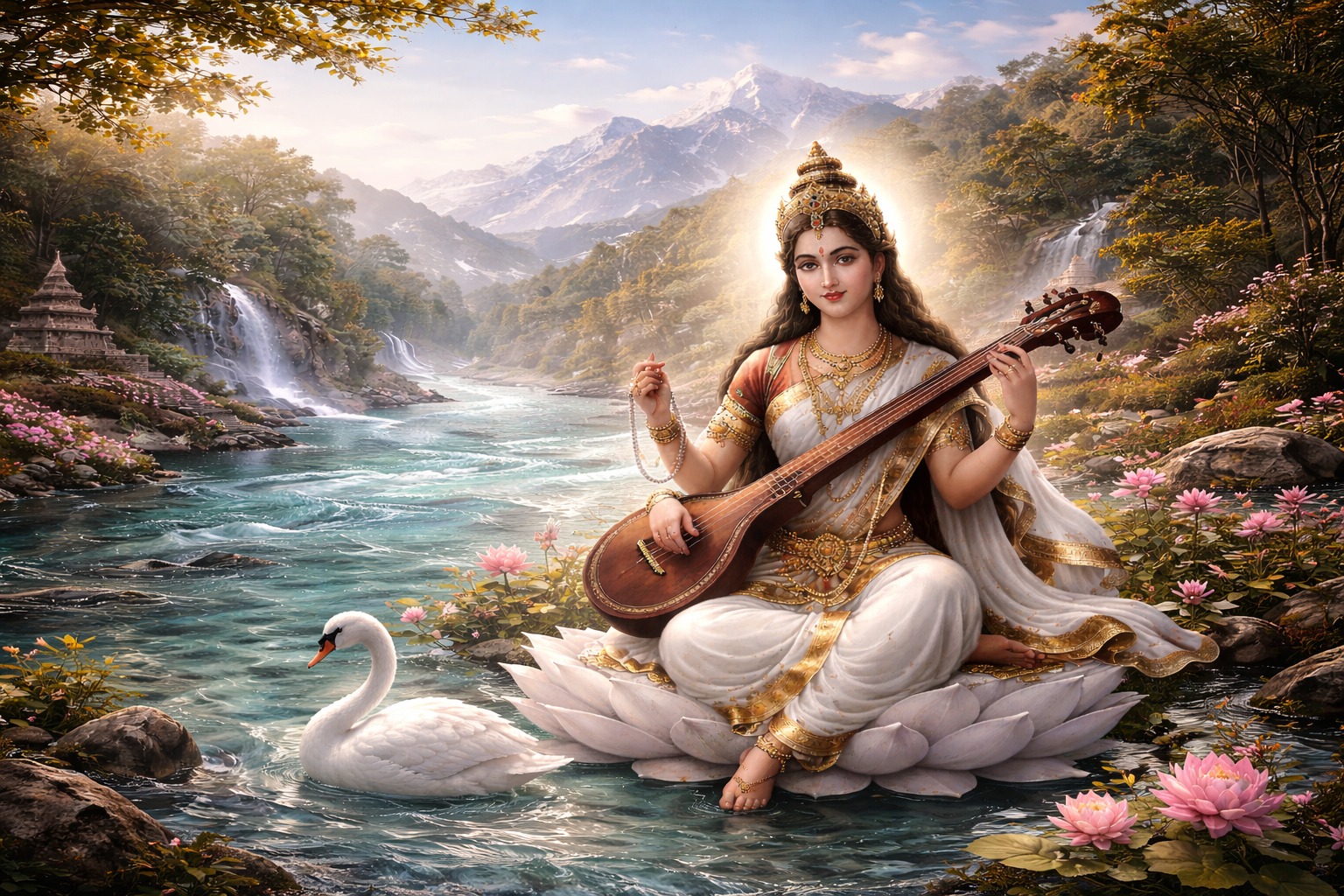
The Saraswatī River is not only a spiritual symbol; it also has a tangible historical footprint. Ancient Indian texts such as the Rigveda describe Saraswatī as a great river flowing from the mountains to the sea, nurturing civilization along its banks. For centuries, scholars believed this was purely mythological. But modern research has revealed strong evidence that a major river once existed in the northwestern part of the Indian subcontinent, now largely dry or diverted.
Geological studies and satellite imagery have traced ancient river channels in the Haryana–Rajasthan–Punjab region, showing the path of a once-mighty river system that fits the description of Saraswatī. Archaeologists have also found numerous Indus Valley Civilization sites clustered along these ancient channels, suggesting that this river was a cradle of urban development. The decline of this river likely contributed to the shift of civilizations toward the Indus and Ganges basins.
This historical evidence turns Saraswatī from a poetic idea into a real, living river that shaped human history. The river’s disappearance is a reminder of how nature and civilization are intertwined, and how a river’s fate can change the destiny of entire cultures. Saraswatī is thus both a lost geography and a preserved memory—flowing in texts, rituals, and the human imagination.
1. The First Flow
There is a river that does not begin at a spring or glacier. It begins at the moment the mind first notices itself. Saraswatī is not merely a river; she is the idea of a river—the living symbol of flow, learning, and clarity. When a child first learns to speak, it is like a new tributary forming. When a scholar writes a sentence that illuminates a truth, it is another stream joining the main current. Saraswatī is the river of beginnings, the first movement from silence to sound.
This river is also the oldest story in human history. Every civilization has built its earliest cities along water because water is not only survival—it is memory. The river is the first teacher, the first calendar, the first map. Saraswatī’s legend is not only about geography; it is about the human impulse to name and understand what flows through us. The river becomes a mirror: when it is clear, the world reflects. When it is muddy, the world becomes confused.
In the body, the first flow is the breath. Before thoughts arrive, the breath arrives. The rhythm of inhalation and exhalation is the original river. Every spiritual tradition recognizes this: a calm breath is a calm mind. Saraswatī, as a concept, teaches us that learning is not only an intellectual act—it is a bodily act. The mind learns when the body is steady, when the breath is gentle, and when the heart is open enough to let knowledge move through it like water through a channel.
2. The Vanishing and the Memory
Saraswatī is a river that vanished and yet never vanished. This is the paradox that has haunted poets, historians, and archaeologists. How can something disappear from maps and still remain alive in culture? The answer is that the river did not vanish only from geography; it vanished from human attention. When societies shift their focus, rivers shift their names, their courses, and even their existence in the collective imagination.
History is the study of what survives attention. The river’s disappearance is a lesson in how human societies change the environment and then rewrite the story to make sense of the loss. The ancient people of the Indus Valley knew Saraswatī as a life-giving force. When the river changed, they did not simply migrate; they transformed their culture. They took the river into their rituals, their myths, their songs. Even today, Saraswatī is invoked in ceremonies as if she is still flowing, because the human mind cannot accept the death of what once shaped its life.
There is also a hidden lesson in this vanishing: the body also contains rivers that dry up when we neglect them. The inner river of focus dries when we are constantly distracted. The inner river of creativity dries when we stop playing. Saraswatī’s disappearance reminds us that what we lose is not always gone—sometimes it is only waiting for our attention to return.
3. The Hidden Course
Geography teaches us that rivers do not simply flow—they choose. They carve their path through rock and sand, bending around obstacles, changing course when the terrain demands it. Saraswatī is a geography of the mind. She is the path of least resistance for wisdom. She flows where there is space for clarity. When the soil of our life becomes dense with fear or greed, the river finds a new route. When the heart is open, the river becomes wide.
This is also a lesson in ecology. Rivers are not isolated; they are part of a network. Saraswatī’s course was not only a single line on the map but a system of streams that supported villages, forests, and civilizations. In the same way, knowledge is never isolated. It flows through communities, through teachers, through stories, through language. A river does not survive alone; it survives because it has tributaries and branches.
The hidden course also appears in the body. The three channels of energy—Iḍā, Piṅgalā, and Suṣumṇā—are not physical veins but pathways of life force. They represent how the body moves between the left and right, between intuition and action, between calm and intensity. Saraswatī is the subtle current that keeps these channels balanced. When the triad is aligned, the river flows. When one channel dominates, the river becomes turbulent.
4. The River of Speech
Saraswatī is the goddess of speech, but speech is not only sound. Speech is the shaping of thought into form. It is the transformation of the invisible into the visible. When we speak, we carve the air with our intentions. A single word can heal or wound. Saraswatī teaches that speech is sacred because it is the first step of creation. The world begins when someone names it.
Art is also speech in another form. A painting is a silent sentence. A melody is a spoken emotion. When an artist captures a moment, they are not only expressing; they are translating the river of experience into a medium that others can share. This is why Saraswatī is worshipped not only by scholars but by musicians, poets, and painters. The river of creativity flows through all of them.
On a deeper level, speech is the bridge between consciousness and the world. The mind is like a river, always moving. Speech gives the river banks. Without language, the river would flood, spreading into confusion. With language, the river becomes a channel that can be directed, shaped, and understood. Saraswatī is the goddess who gives the river its banks.
5. The Cosmic Current
The universe is not a random scatter of stars; it is a cosmic river. Astronomers describe vast filaments of galaxies, connected like threads of light across darkness. These cosmic flows are like the largest rivers imaginable—rivers of gravity, energy, and time. The universe itself seems to be a network of channels, where matter moves in patterns that resemble water through valleys.
Saraswatī, then, is not only a river on Earth; she is a metaphor for cosmic order. The same patterns that shape rivers also shape galaxies. The river’s curves, its meanders, its delta—these are echoes of the cosmic web. When we look at the night sky, we are looking at the reflection of the river within us. The same laws that guide rivers guide stars.
The triad appears here too. In the cosmos, there are forces that pull, forces that push, and forces that balance. Gravity, electromagnetic force, and quantum uncertainty form a triad that keeps the universe in motion. Saraswatī is the balance point, the channel where these forces become harmonious. When the triad is aligned, the universe becomes a symphony.
6. The Physics of Flow
A river is a lesson in physics. Water flows because of gravity, pressure, and energy. The faster it moves, the more energy it carries. The slower it moves, the more it deposits. Saraswatī is the physics of the mind: the speed of thought, the pressure of emotions, the energy of focus. When the mind is calm, the river is gentle. When the mind is anxious, the river is turbulent.
But physics also teaches something deeper: rivers are systems of friction and resistance. A river does not flow freely; it is always battling the resistance of the land. This is true of life too. Every learning process involves resistance. The mind resists new ideas because it prefers comfort. Saraswatī’s lesson is that resistance is not a barrier; it is a teacher. The river becomes stronger as it pushes against rocks.
In the body, the flow of blood and the flow of nerves follow similar laws. Blood carries oxygen like a river carries nutrients. Nerves transmit signals like streams of electricity. Saraswatī’s symbol is the nervous system of the soul—how the mind receives information and sends it forward. The physics of flow is the science of life itself.
7. The Chemistry of Memory
Rivers carry minerals, sediments, and nutrients. They change the land by carrying tiny particles across vast distances. Memory works the same way. Every experience deposits a tiny sediment in the mind. Over time, these sediments build the landscape of personality. Saraswatī is the river that carries memory into meaning. Without memory, learning cannot exist. Without meaning, memory is only data.
Chemistry reveals how this happens. The brain stores memories through chemical changes—neurons forming connections, neurotransmitters releasing signals, pathways strengthening through repetition. Saraswatī is the symbol of this biochemical river. The more we practice, the stronger the pathways. The more we neglect, the weaker the flow. The river of learning is a chemical process as much as a spiritual one.
This is why rituals, songs, and stories matter. They are not only culture; they are chemical training. When a child sings a hymn, the brain creates patterns. When a student repeats a formula, the brain builds a channel. Saraswatī is the goddess who watches over these channels, guiding them to become strong and clear.
8. The Geometry of the River
A river is a shape. Its curves, bends, and deltas form a geometry that is both beautiful and functional. Mathematics is the study of patterns, and rivers are patterns. The meandering of a river follows predictable laws. The curves become wider and more gentle over time, because the river seeks the path of least resistance. Saraswatī’s shape is the shape of learning: it begins sharp and direct, then becomes broader and more expansive.
Mathematics also reveals hidden symmetry. The river’s branching pattern resembles fractals—patterns that repeat at every scale. A small stream looks like a river, and a river looks like a delta. This is the same in human life: small habits form the shape of the whole personality. Saraswatī teaches that the smallest actions determine the largest outcomes. The river is not only a metaphor for life; it is a lesson in scale.
The triad is present here too. Geometry is built on three primary elements: point, line, and plane. These three form every shape. Saraswatī’s river is a line that connects points of knowledge. The mind becomes a plane of understanding when the triad of intuition, logic, and action is balanced. The river is the bridge between these elements.
9. The Inner River of Awareness
Consciousness is the most mysterious river. It flows without being seen. It is the current beneath the waves of thought. Saraswatī is the symbol of awareness—the quiet observer that watches the mind. When we meditate, we become aware of the river’s movement. We notice how thoughts rise like bubbles and then disappear. We notice how emotions surge like rapids and then calm.
The inner river also contains the triad. Iḍā is the cool current of intuition, the left channel that carries calm and inward awareness. Piṅgalā is the warm current of action, the right channel that carries energy and outward movement. Suṣumṇā is the central channel, the river that connects both and leads to deeper insight. Saraswatī is the alignment of these channels, the state where awareness becomes a clear flow.
In this chapter, the river becomes a practice. The mind learns to follow the breath, to observe without judgment, to let the river of awareness carry it. This is not passive. It is the most active form of learning, because it trains the mind to recognize itself. Saraswatī is the teacher who does not teach with words, but with presence.
10. The River of Tradition
Culture is a river of inherited values. Traditions flow from one generation to the next, carrying stories, rituals, and symbols. Saraswatī is the guardian of this cultural river. She keeps the river alive by reminding people of their roots. Yet tradition is not meant to be a cage. It is meant to be a channel that guides the river of life.
When traditions become rigid, the river becomes stagnant. Rituals become mechanical, and meaning is lost. The triad teaches balance here too. Tradition must be balanced with reason and compassion. If tradition is only external form, it becomes a desert. If tradition is only personal choice, it becomes a storm. Saraswatī teaches that tradition should be a living river—always moving, always renewing.
This chapter is also a lesson in social history. The river of culture is shaped by migrations, wars, trade, and ideas. The Saraswatī river’s disappearance did not end the culture. It transformed it. The river continued in songs, in scriptures, in festivals, and in the very way people thought about knowledge. The culture became a river that flowed inward, into the mind, rather than outward on the land.
11. The Colour of Water
Water is not colourless. It is a mirror that takes the colour of what it reflects. Saraswatī is the river of colour because she is the river of perception. When the mind is clear, the world is bright. When the mind is clouded, the world becomes grey. Colour is not only a property of light; it is a property of interpretation.
Physics explains this. Light is made of waves, and colour is the wavelength that reaches our eyes. The river of light flows through the world and into the brain. Chemistry explains how the eye converts light into electrical signals. The mind then interprets these signals as colour. Saraswatī is the bridge between perception and reality. She is the river that carries the spectrum into awareness.
In culture, colour becomes symbolism. The white of Saraswatī represents purity and clarity. The blue of the river represents depth and calm. The yellow of knowledge represents illumination. Saraswatī is the goddess who teaches that colour is not only visual—it is emotional. The river of colour flows through the heart as well as through the eyes.
12. The Art of Speech
Art is speech without words. Speech is art with words. Saraswatī is the muse of both. Poetry is the river of language. It takes ordinary words and turns them into a current that moves the soul. Music is the river of emotion. It takes sound and turns it into a wave that carries memory. Saraswatī is the river that makes these transformations possible.
In the body, the voice is an instrument. The vibration of sound travels through the air, and it can heal or harm. This is why words are powerful. A single word can change a life. Saraswatī teaches that speech should be responsible. The river of speech should be clean, not polluted with lies, cruelty, or emptiness.
The triad appears here too. Speech is balanced between truth, intention, and impact. Truth without compassion becomes harsh. Compassion without truth becomes weak. Intention without awareness becomes manipulation. Saraswatī is the alignment of these three, the clear river that flows through the mouth, through the mind, and into the world.
13. The Practice of Inner Flow
Yoga is the practice of aligning the body, breath, and mind. Saraswatī is the symbol of the inner river that yoga awakens. When the body is strong, the river flows. When the breath is steady, the river is calm. When the mind is focused, the river becomes clear. Yoga is not only physical; it is a science of inner flow.
The triad is explicit here. The practice of yoga aims to balance Iḍā and Piṅgalā so that Suṣumṇā becomes dominant. This is the moment when the river becomes straight and direct, no longer wandering. The energy rises through the spine like a river flowing upward. Saraswatī is the inner channel that carries this energy to the mind.
This chapter is also about discipline. Rivers do not form overnight. They take time, patience, and constant movement. Yoga is the training of the river. It teaches us that mastery is not about forcing the flow, but about removing obstacles. Saraswatī is the reward of this practice: clarity, wisdom, and the ability to live with purpose.
14. The River Returns
The final chapter is not an ending. It is a return. Saraswatī’s river disappears, but the river of knowledge never truly ends. It returns in every mind that learns, in every song that is sung, in every river that is born again after rain. The river of Saraswatī is the river of human potential—the potential to think, to create, to love, to understand.
The triad is the final lesson. The world is built on three forces: creation, preservation, transformation. The river of Saraswatī flows through all three. It teaches us that life is not linear. It is a cycle. The river flows, dries, returns, and flows again. This is the nature of existence. The river is the teacher of impermanence and continuity.
The conclusion is simple: Saraswatī is not a myth, not a story, not a memory. She is the living symbol of flow. When we awaken the inner river, we awaken the universe inside us. When we honor the river in the world, we honor the river in ourselves. Saraswatī is the river that connects Earth to sky, body to mind, and mind to the cosmos.
Epilogue — Books for Deeper Flow

The Sacred River — A study of Saraswatī’s history and geography

The Hidden River — Archaeology and lost civilizations

The Inner River — Yoga and the subtle body

The Power of Now — Awareness and consciousness

The Tao of Physics — Science and spirituality connection

The Art of Learning — Flow, practice, and mastery

The Universe in a Nutshell — Cosmic structure and physics