

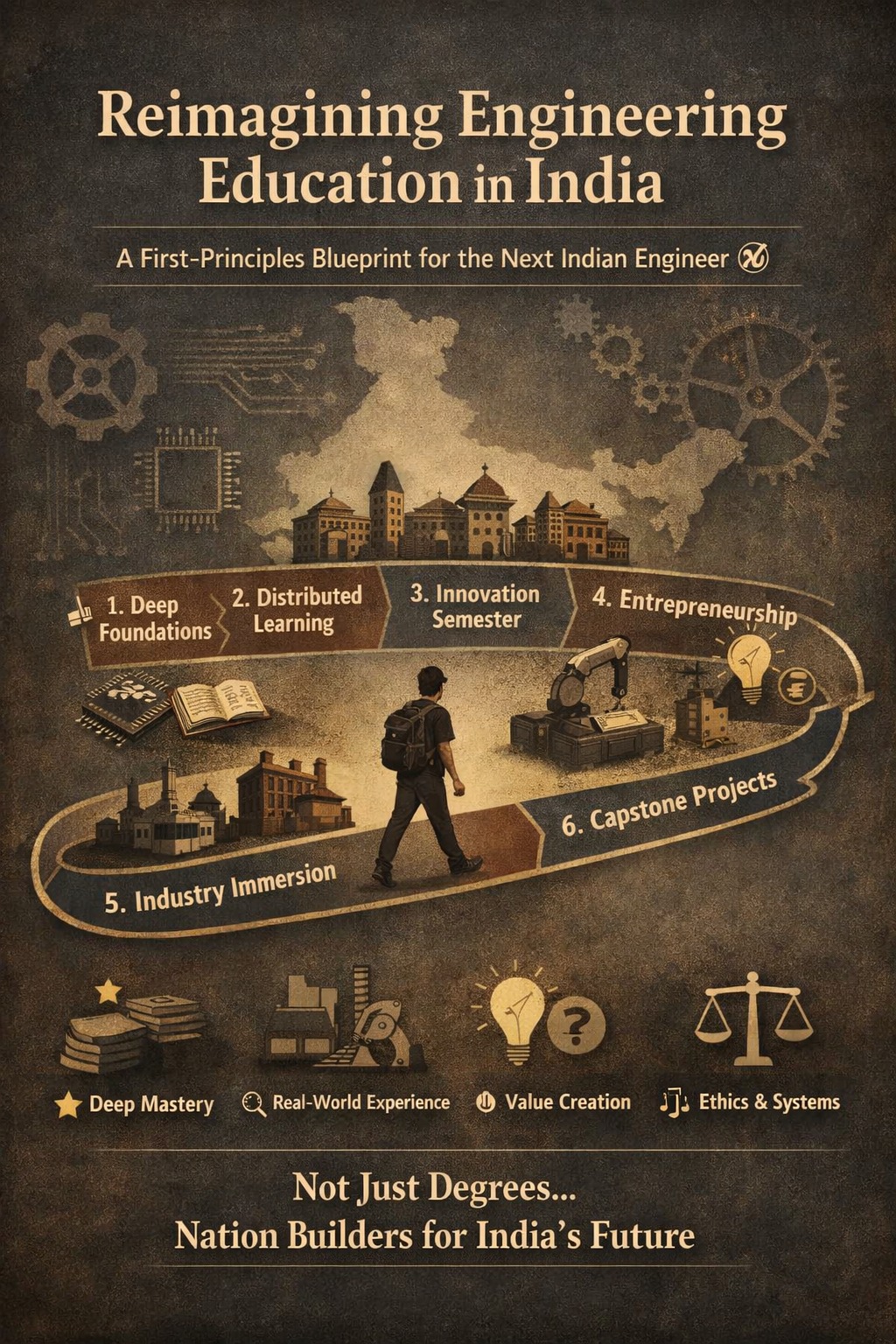
~ A First-Principles Blueprint for the Next Indian Engineer
Engineering education is often discussed in terms of rankings, placements, syllabi, and infrastructure. But these are outputs, not foundations. If we reason from first principles, the true purpose of engineering education is far simpler and far deeper:
to create people who can understand reality, model it clearly, and intervene responsibly.
Everything else—degrees, campuses, exams—is merely an instrument.
From this lens, any effective engineering education system must satisfy a few non-negotiable conditions:
• Exposure to variation — intelligence grows when learners move across cultures, disciplines, and constraints
• Depth before breadth — true adaptability comes from strong fundamentals
• Continuous contact with reality — theory must constantly collide with practice
• Incentives aligned with impact — effort should translate into real value creation
• Judgment and ethics — technology always operates inside human and social systems
India’s current model struggles not because students or faculty lack ability, but because the structure violates these principles. The consequences appear repeatedly—graduates who excel in exams but hesitate when asked to build, design, or lead under uncertainty.
What follows is not a list of reforms, but a structural rethinking, derived directly from these first principles.
★ Learning Has Become Too Insular
Most engineering students spend four formative years inside a single campus, a single academic culture, and a narrow definition of excellence. Comfort replaces adaptability. Yet complex systems—technology, markets, and society—reward those who can function across unfamiliar environments.
Structural response:
Introduce a distributed learning semester, where students spend one semester rotating across three institutions—primarily different IITs, and where appropriate, Ashoka University.
IITs contribute deep technical ecosystems; Ashoka contributes strengths in liberal education, ethics, public policy, and systems thinking. Movement across campuses breaks intellectual silos early and builds a national academic identity, not a local one.
★ Skills Have Become Broad but Shallow
Curricula often chase trends—touching AI, EVs, semiconductors, robotics—without allowing mastery. Students become familiar with vocabulary but lack the depth to design under real constraints.
Structural response:
Re-anchor curricula around core, future-ready skill foundations, pursued deeply rather than superficially:
• VLSI and semiconductor design
• Power electronics, embedded systems, and control theory
• EV systems: batteries, motors, thermal and safety engineering
• Materials science and manufacturing processes
• AI systems engineering, not just algorithms
The goal is simple: produce engineers who can design and build, not just simulate and explain.
★ Innovation Is Discussed More Than Practiced
Innovation has become a word—used in lectures, competitions, and policy documents—while actual product-building remains peripheral.
Structural response:
Create a dedicated Innovation Semester, where students do nothing except build real products.
Focus areas could include EV battery technology, energy storage, medical devices, robotics, defence systems, and climate solutions. Evaluation should reward iteration quality, learning velocity, and resilience—not polish.
This single experience fundamentally changes a student’s self-belief: “I can take an idea and make it real.”
★ Technology Is Separated from Value Creation
Engineering education often treats entrepreneurship and markets as optional extras. As a result, graduates design solutions without understanding customers, costs, or incentives.
Structural response:
Introduce a semester of Indian entrepreneurial projects and case studies, inspired by global models like Wharton/UPenn entrepreneurship, but rooted in Indian realities.
Students study Indian successes and failures—hardware startups, manufacturing ventures, regulated sectors—and simultaneously run mini ventures of their own. Even those who never found startups gain entrepreneurial judgment.
★ Reality Enters Education Too Late
Short internships provide observation, not immersion. Students encounter industrial constraints only after habits are formed.
Structural response:
Mandate one full semester of industry immersion inside startups, manufacturing plants, fabs, utilities, R&D labs, or infrastructure organisations.
Joint evaluation by faculty and industry mentors ensures seriousness. Students return to campus mature, grounded, and purpose-driven.
★ Faculty Knowledge Gradually Drifts from Practice
Without structured exposure to industry or national labs, even strong faculty gradually disconnect from evolving reality.
Structural response:
Institutionalise faculty–industry rotation programs, where faculty periodically spend extended time in industry or research labs.
Living problems flow back into classrooms, research agendas, and student projects—keeping education dynamic rather than archival.
★ Effort Is Measured Instead of Impact
Attendance, exams, and grades dominate evaluation, while real outcomes receive limited recognition.
Structural response:
Shift toward an output-based credit architecture.
Credits are earned through demonstrable outcomes—working products, patents, research publications, open-source contributions, or startup pilots. Time becomes a resource, not a metric.
★ Talent Is Weakly Aligned with National Needs
Student projects often operate in isolation from India’s strategic challenges—energy transition, manufacturing scale-up, healthcare access, defence preparedness.
Structural response:
Launch a National Problem Statements Program, where government and industry issue real challenges annually.
Students work in interdisciplinary, cross-institution teams, learning to solve messy, high-impact problems with incomplete information.
★ Systems and Ethics Are Afterthoughts
Technical optimisation is frequently pursued without understanding social, policy, and ethical consequences.
Structural response:
Integrate humanities and systems thinking deeply into engineering education—economics, public policy, ethics, and Indian social realities.
Here, Ashoka University’s liberal education model plays a central role, ensuring engineers develop judgment alongside intelligence.
★ Alumni Networks Remain Underutilised
Alumni represent accumulated experience, capital, and judgment—but engagement is often informal and fragmented.
Structural response:
Create alumni-led mentorship and capital loops—formal mentoring, design reviews, and micro-funding for student teams.
Campuses evolve into living innovation ecosystems rather than degree factories.
★ Education as National Infrastructure
Engineering education is not a credentialing service. It is national infrastructure.
When learning becomes mobile, deep, and reality-anchored…
When incentives reward impact instead of compliance…
When institutions like the IITs and Ashoka University operate as a connected system…
India moves from producing degree-holders to producing nation builders.
This transformation is not cosmetic. It is structural—and unavoidable.
★ Global Examples
These are the world’s leading engineering ecosystems that India can learn from — not to copy, but to adapt.
1. Stanford University — A Culture of Product Building
Stanford’s ecosystem blends engineering education with entrepreneurship. Its proximity to Silicon Valley creates constant feedback loops between students, startups, investors, and industry. Product-building becomes normal, not exceptional.
2. MIT — Learning by Doing
MIT’s hands-on labs, maker culture, and programs like UROP and Sandbox make innovation part of the environment, not just a course. Students graduate with the habit of building and iterating.
3. ETH Zurich — Fundamentals + Industry Integration
ETH Zurich combines deep foundational teaching with strong industry partnerships in manufacturing, robotics, and precision engineering. Students learn both theory and industrial practice.
4. Imperial College London — Engineering + Public Policy
Imperial integrates technology with public policy in areas such as healthcare, climate, and energy. Students learn how systems work and how technology affects society.
5. TUM (Technical University of Munich) — Industry Immersion
Germany’s technical education model features deep industry collaboration, apprenticeships, and co-op programs. Students graduate with strong applied engineering and manufacturing understanding.
★ Imagining the 8 Semesters (A New Structure)
Here is a complete, first-principles aligned journey for an Indian engineer — eight semesters, each with a clear purpose and real-world outcome.
✦ Semester 1 — Foundation & Building Habit
Purpose: Depth, fundamentals, and early practice.
Structure:
Core courses: Maths, Physics, Basic Programming
Lab: Build a physical project every 2 weeks
Outcome: Portfolio of 4–5 small prototypes
Why this matters:
Builds a habit of making, not just learning.
✦ Semester 2 — Deep Foundations
Purpose: Deep mastery before breadth.
Structure:
Core engineering foundations (circuits, mechanics, materials)
Lab-based learning and early design thinking
Outcome: One major foundational project (e.g., basic robotics)
Why this matters:
Fundamentals become the engine for future innovation.
✦ Semester 3 — Distributed Learning (Rotation 1)
Purpose: Exposure to variation and cross-campus learning.
Structure:
1 semester at IIT or another premier institution
1 set of core subjects + 1 project
Exposure to new teaching style and culture
Outcome:
A student becomes mobile, adaptable, and nationally connected.
✦ Semester 4 — Distributed Learning (Rotation 2)
Purpose: Humanities, ethics, and systems thinking.
Structure:
Semester at Ashoka University or similar
Courses: Ethics, public policy, economics, systems thinking
Outcome: A project connecting technology with society
Why this matters:
Engineering without judgment becomes dangerous.
✦ Semester 5 — Innovation Semester
Purpose: Build real products, not just simulations.
Structure:
Dedicated to innovation projects
No exams, no theory-only courses
Industry mentors + lab access
Outcome: 1 working product + prototype iterations
Why this matters:
Transforms belief from “I can learn” to “I can build.”
✦ Semester 6 — Entrepreneurship & Value Creation
Purpose: Tech + market + incentives.
Structure:
Entrepreneurial projects, case studies, market validation
Students run mini ventures
Outcome: Prototype + business model + pilot
Why this matters:
Engineers become creators of value, not just builders of systems.
✦ Semester 7 — Industry Immersion
Purpose: Reality enters education fully.
Structure:
Full semester inside startups, labs, manufacturing plants, or R&D
Joint evaluation by industry + faculty
Outcome: Real work experience + tangible deliverables
Why this matters:
Students return grounded, practical, and purpose-driven.
✦ Semester 8 — National Problem Statement + Capstone
Purpose: Solve India’s strategic challenges.
Structure:
Interdisciplinary team projects
Real national problem statements
Evaluation by experts + government + industry
Outcome: A real solution, prototype, or policy paper
Why this matters:
Engineering becomes national infrastructure, not a degree.
Epilogue — The Engineer India Needs
If we accept the first-principles purpose of engineering education — to understand reality, model it clearly, and intervene responsibly — then the current system is not merely “in need of reform.” It is asking the wrong question.
The question is not:
How do we produce more engineers?
The question is:
How do we produce more engineers who can reshape India’s future?
Because the truth is simple:
India does not lack talent.
India lacks structured experiences that convert talent into capability.
A nation that builds ships, rockets, trains, and chips does not do so because its students learned to memorize.
It does so because its students learned to make.
The proposed blueprint is not a list of initiatives; it is a new logic of education. It breaks the illusion that learning is an individual journey contained within a campus. It replaces it with a reality that is:
✶distributed (across institutions, regions, cultures)
✶deep (mastery instead of familiarity)
✶real (industry, labs, startups, national problems)
✶value-oriented (impact, not attendance)
✶ethical (human systems are not optional)
This is not just a blueprint for engineering colleges.
It is a blueprint for India’s next generation of nation-builders.
Because the future will not be shaped by those who pass exams.
It will be shaped by those who can build futures.
And that is what this education system must create.

Appendix — Books & Examples (for Implementation + Inspiration)
A. Books (for students, faculty, and policymakers)
1. On Systems Thinking & Complexity
Thinking in Systems — Donella Meadows
The Fifth Discipline — Peter Senge
Complexity: A Guided Tour — Melanie Mitchell
2. On Deep Work, Mastery & Skill
Deep Work — Cal Newport
Peak — Anders Ericsson
The Talent Code — Daniel Coyle
3. On Innovation & Entrepreneurship
The Lean Startup — Eric Ries
Zero to One — Peter Thiel
The Innovator’s Dilemma — Clayton Christensen
The Startup Way — Eric Ries
4. On Engineering & Design
The Design of Everyday Things — Don Norman
How Buildings Learn — Stewart Brand
The Art of Electronics — Paul Horowitz & Winfield Hill
5. On Ethics, Policy & Society
Weapons of Math Destruction — Cathy O’Neil
The Age of Surveillance Capitalism — Shoshana Zuboff
The Ethics of Invention — Sheila Jasanoff
The Argumentative Indian — Amartya Sen
B. Examples of Models to Learn From (Global + Indian)
1. Global Models
Wharton / UPenn Entrepreneurship Programs — Emphasizes market validation, team formation, business models, and execution, showing that entrepreneurship is not only about technology but about building sustainable systems.
MIT’s D-Lab — Hands-on engineering for global development.
Stanford d. school — Design thinking integrated with engineering.
Caltech’s “Project-based Learning” — Building real products with mentorship.
2. Indian Models
IIT Bombay’s “SINE” — Startup incubator + mentorship + funding.
IIT Madras Research Park — Industry-academia collaboration.
IISc Bangalore’s “Centre for Product Design and Manufacturing” — Deep engineering + manufacturing.
IIT Kanpur’s “Rural Technology and Innovation” — Solving India’s real problems.
IIT Delhi’s “E-Cell” and “Startup Incubation” — Student-led ventures with real market exposure.
C. The Future This Blueprint Enables
If India adopts this structure, it creates engineers who can:
✦design chips and build manufacturing ecosystems
✦build EV batteries and manage energy grids
✦create medical devices and solve healthcare access
✦lead large systems with ethics and judgment
✦build businesses that scale India’s economy
It creates not just engineers…but engineers who can build India.