

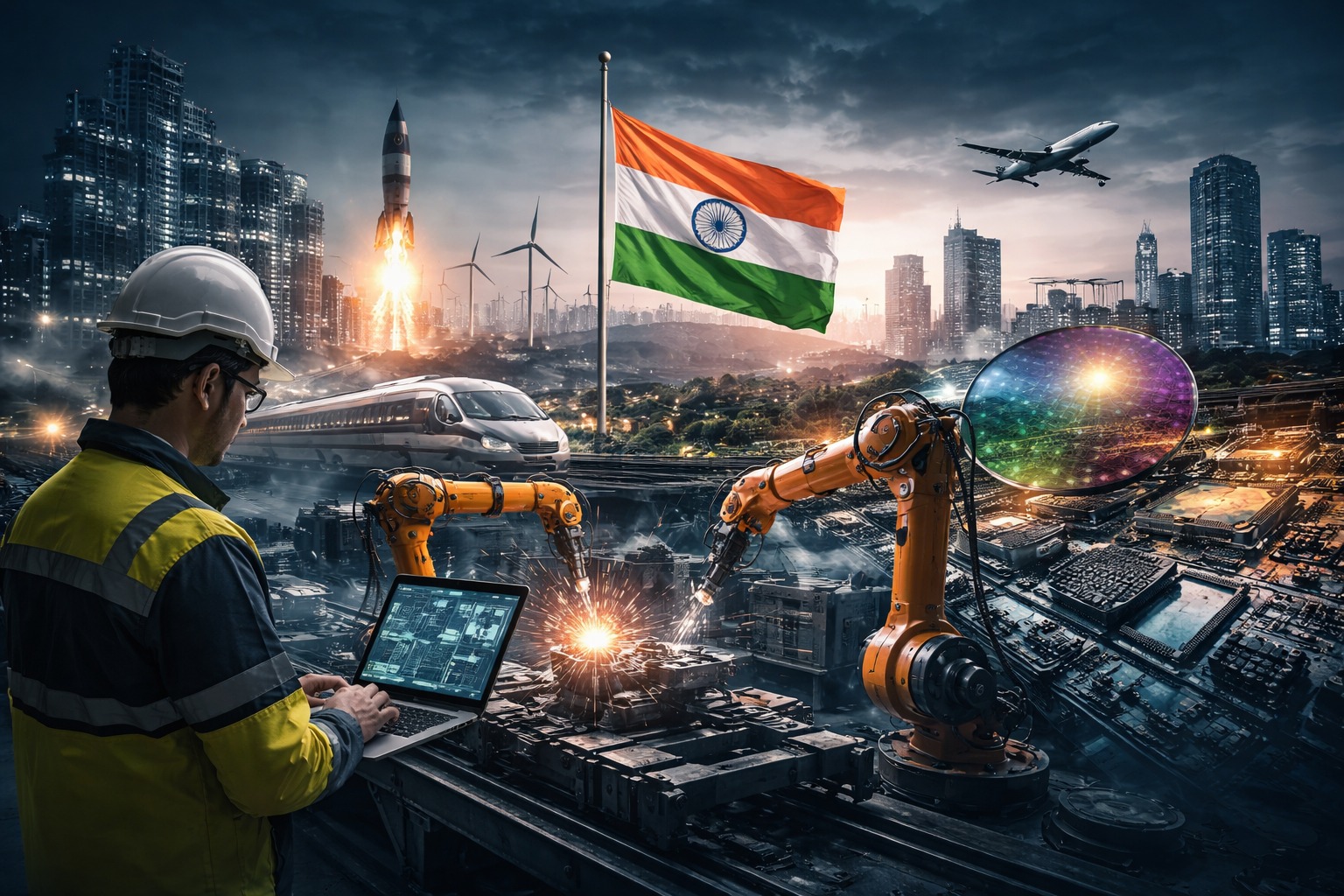
~ A 14-Chapter Blueprint for Accelerated Growth
Chapter 1 — The World Has Changed Quietly
India’s growth debate often starts with numbers—GDP, rankings, forecasts. But the deeper shift is structural. The global economy is no longer organized around free-flowing efficiency; it is reorganizing around resilience, security, and scale. China understood this early. India is only now beginning to internalize it.
Countries do not “grow fast” by accident anymore. They grow because they build systems—industrial, financial, technological—that reinforce each other over decades. China’s manufacturing surge is not cyclical; it is engineered. India’s opportunity arises precisely because this system is now creating global imbalance and backlash.
India’s task is not to copy China’s volume play, nor to rely on services alone. Its task is to build a distinct growth engine rooted in complexity, reliability, and execution discipline.
Additional →

Market-shaping demand policies are essential; scale without disciplined demand creates inefficiencies.
Chapter 2 — Scale Is No Longer Enough
For decades, India assumed scale would come naturally—large population, large market, large workforce. But scale without capability has diminishing returns.
China’s lesson is stark: scale works only when paired with process excellence, capital depth, and brutal competition. India has scale but lacks consistency—factories that deliver on time, suppliers that meet global standards, clusters that work as ecosystems.
Accelerated growth will not come from “Make in India” slogans but from Make with Precision—fewer sectors, deeper mastery. India must stop chasing everything and start winning selectively.
Additional →
Manufacturing must be treated as a national security asset (defense, critical minerals, energy systems) not just an economic objective.
Chapter 3 — Manufacturing Must Become Strategic, Not Sentimental
Manufacturing is often defended emotionally—as a job creator or a national aspiration. China treats it strategically—as a macroeconomic stabilizer, geopolitical tool, and learning engine.
India must do the same.
Manufacturing should be used to:
→ Absorb labour productively
→ Anchor supply chains
→ Generate export discipline
→ Build technological learning curves
This means accepting uncomfortable truths: margins will be thin, failures frequent, and patience essential. Manufacturing growth is earned, not announced.
Additional →
Public procurement strategies must be aligned with strategic sectors to de-risk early production.
Chapter 4 — The Real Bottleneck Is Capability
India’s constraint is not demand, policy intent, or even capital—it is capability.
Capability means:
→ Technicians who can run machines
→ Supervisors who enforce process discipline
→ Engineers who design for manufacturability
→ Managers who understand cost curves
India produces engineers at scale but lacks shop-floor excellence. Accelerated growth requires rebalancing skills—from degrees to competence, from certificates to output.
Without this, incentives leak, investments stall, and productivity remains shallow.
Additional →
A standardized, globally recognized skill-credentialing system is needed to certify real-world competence.
Chapter 5 — Clusters, Not Corridors
India loves mega-projects: corridors, highways, industrial parks. China’s real strength lies elsewhere—in dense industrial clusters where suppliers, labs, toolmakers, logistics, and workers co-evolve.
Clusters create:
→ Fast iteration
→ Informal knowledge transfer
→ Cost compression
→ Quality enforcement
India must prioritize cluster depth over geographic spread. Five globally competitive clusters are better than fifty underperforming zones. Accelerated growth requires choosing locations where ecosystems can actually thicken.
Additional →
Clusters must include digital supply chain integration and shared testing infrastructure.
Chapter 6 — Capital Must Become Patient
One of the most underappreciated behavioral differences between China and India is capital. China tolerates losses in pursuit of scale and learning. India demands returns too early.
Advanced manufacturing needs:
→ Long gestation periods
→ Iterative failures
→ Continuous reinvestment
India’s financial system is improving, but it remains risk-averse toward manufacturing. Accelerated growth demands patient capital—from development banks, pension funds, and strategic public finance—focused on capability creation, not quick exits.
Additional →
Risk-sharing mechanisms (co-investment, guarantees, milestone-based grants) are critical to attract private capital into deep tech manufacturing.
Chapter 7 — Public Procurement Is a Silent Superpower
China used domestic demand ruthlessly. Its firms learned by supplying railways, power grids, EV fleets, and cities—before exporting.
India underuses this lever.
Public procurement can:
→ Anchor demand
→ Enforce standards
→ De-risk early production
→ Build reference customers
This requires redesign—away from lowest-price tendering toward performance-based contracting. If India wants globally competitive firms, it must first become a demanding domestic customer.
Additional →
Procurement must be tied to local supply-chain development with quality benchmarks, not just lowest cost.
Chapter 8 — Export Discipline Is Non-Negotiable
Export success is not about incentives; it is about discipline.
China forced its firms to face global markets early. Losses were tolerated, excuses were not. India, by contrast, often shields firms from competition while hoping exports will magically follow.
Accelerated growth requires:
→ On-time delivery
→ Process reliability
→ Quality certification
→ Cost transparency
Exports should be treated as a test of seriousness, not a reward. Firms unable to export competitively should not be endlessly protected.
Additional →
Build export-ready supply chains with global compliance ecosystems, logistics, and certification readiness.
Chapter 9 — Technology Focus Must Be Engineering-Heavy
China’s success is often mistaken for frontier science. In reality, it is engineering excellence at scale.
India should focus on:
→ Power electronics
→ Industrial automation
→ Precision manufacturing
→ Advanced materials
→ Battery systems
→ Capital goods
These are not glamorous but they are compounding technologies. They embed learning into factories, not labs alone. India’s strength will come from mastering production engineering, not chasing every AI headline.
Additional →
Invest in metrology, standards, and testing infrastructure that enforce quality at scale.
Chapter 10 — MSMEs Are the Weak Link and the Multiplier
India’s manufacturing future will fail or succeed with its MSMEs.
They suffer from:
→ Low digital adoption
→ Poor access to testing
→ Weak management systems
→ Credit constraints
But they are also flexible, entrepreneurial, and numerous.
Accelerated growth requires turning MSMEs into process-driven suppliers, not informal job shops. Shared infrastructure—testing labs, tool rooms, digital platforms—can lift entire ecosystems without massive subsidies.
Additional →
Standardized vendor-development programs can elevate MSMEs into globally competitive suppliers.
Chapter 11 — Infrastructure Now Means Reliability
India has built roads, ports, and airports at speed. The next phase is subtler.
Global manufacturing depends on:
→ Power quality
→ Logistics reliability
→ Customs predictability
→ Standards compliance
One missed shipment can destroy trust built over years. Accelerated growth demands obsessing over last-mile execution, not just headline projects.
Additional →
Infrastructure must be data-driven (real-time tracking, customs transparency, predictive logistics).
Chapter 12 — States Will Decide India’s Growth Path
Central policy sets direction, but states determine outcomes.
States that offer:
→ Policy stability
→ Skilled labour
→ Administrative responsiveness
→ Industrial depth
will capture investment. Others will be bypassed.
India’s growth will become asymmetric—and that is acceptable. The priority is not uniformity, but excellence. Successful states should be studied, copied, and empowered—not dragged down to the mean.
Additional →
States should adopt competitive federalism with measurable industrial performance metrics.
Chapter 13 — Avoid the China Trap
China’s model is powerful—but it comes with costs: overcapacity, deflationary pressure, global backlash.
India must avoid:
→ Excessive subsidization
→ Ignoring profitability forever
→ Exporting instability
India’s advantage lies in selective scale, democratic legitimacy, and global trust. Accelerated growth should not sacrifice balance for speed. Sustainability—economic, social, and political—matters.
Additional →
Avoid overreliance on debt and protectionist isolationist strategies.
Chapter 14 — The Real Focus: Execution Culture
All growth today is about execution culture.
Not plans.
Not announcements.
Not targets.
Execution means:
→ Showing up every day
→ Fixing small failures
→ Learning faster than competitors
→ Compounding competence quietly
India’s moment is real—but it will not last forever. Accelerated growth will belong to a country that chooses discipline over drama, capability over slogans, and patience over shortcuts.
India can be that country—if it decides to be.
Appendix — State Goals in Cutting-Edge Tech/Product (with stars)

Andhra Pradesh — Quantum computing hardware ecosystem
Karnataka — Semiconductor design + chip packaging
Tamil Nadu — EV powertrain + battery manufacturing
Gujarat — Industrial automation + robotics
Maharashtra — Aerospace components + advanced materials
Telangana — Data-centre manufacturing + AI hardware
Uttar Pradesh — Precision engineering + defence manufacturing
Haryana — Drone manufacturing + avionics
Punjab — Agri-tech equipment + precision farming machines
Rajasthan — Solar manufacturing + energy storage systems
West Bengal — High-precision machine tools + industrial software
Odisha — Critical minerals refining + battery recycling
Kerala — Biotech manufacturing + pharmaceutical automation
Bihar — Textile-tech cluster (high-quality fibers + smart textiles)
Jharkhand — Mining-tech + green steel manufacturing
References
→ Made in China 2025 — Evaluating China’s Performance
→ The New Era of Chinese Manufacturing (CCBC / Duviter, June 2024)
→ Reimagining Manufacturing — India’s Roadmap to Global Leadership in Advanced Manufacturing (NITI Aayog)
→ India 2026 — A DNB Perspective Report (DNB Co. India)
→ Mitsui Global Strategic Studies Institute Report (Fujishiro)
Budget Action Points / Ideas (Aligned to the Blueprint)
1) Create a “Manufacturing Capability Fund”
Allocate ₹10,000–₹15,000 crore to support capability creation in manufacturing
Focus on process discipline, automation, and quality systems
Fund should be disbursed based on output milestones, not inputs
2) National Skill Credentialing Budget
₹5,000 crore to create a national skill certification system
Certification must be aligned to global manufacturing standards
Tie certification to MSME credit access and procurement eligibility
3) Cluster Deepening Program
₹20,000 crore for deepening 10–12 high-potential clusters
Funding for shared testing labs, tool rooms, industrial R&D, and digital supply chain platforms
Conditional on state performance metrics
4) Patient Capital Window
Create a “Long-Term Manufacturing Growth Fund”
Use pension funds, sovereign funds, and development finance to provide 10–15-year capital
Provide co-investment and guarantee mechanisms
5) Procurement Reform Budget
₹3,000 crore for procurement modernization
Implement performance-based procurement pilots in defense, railways, power, and public utilities
Create “reference customers” for Indian manufacturing
6) Export Readiness Program
₹4,000 crore for export-compliance infrastructure
Subsidize global certification, packaging, logistics, and export training
Only for firms that demonstrate export capability
7) Standards & Metrology Upgrade
₹6,000 crore to modernize labs, metrology infrastructure, and testing capacity
Mandatory compliance for industrial clusters and MSMEs
Link to export eligibility
MSME Digital Upgrade Fund
₹5,000 crore to subsidize digital adoption for MSMEs
Includes ERP systems, automation, and quality management systems
Linked to vendor development programs
9) IIT–Industry Tech Translation Fund
₹5,000–10,000 crore to support IITs and research institutes in partnering with industry
Fund joint labs, prototype-to-production projects, and job-linked internships
Tie funding to measurable production and employment outcomes
10) Next-Gen Startup Scale-Up Fund
₹3,000–5,000 crore to support startups in AI, semiconductors, robotics, quantum, biotech
Provide capital for manufacturing readiness, testing, and scaling production
Fast-track government procurement and pilot programs for successful startups