

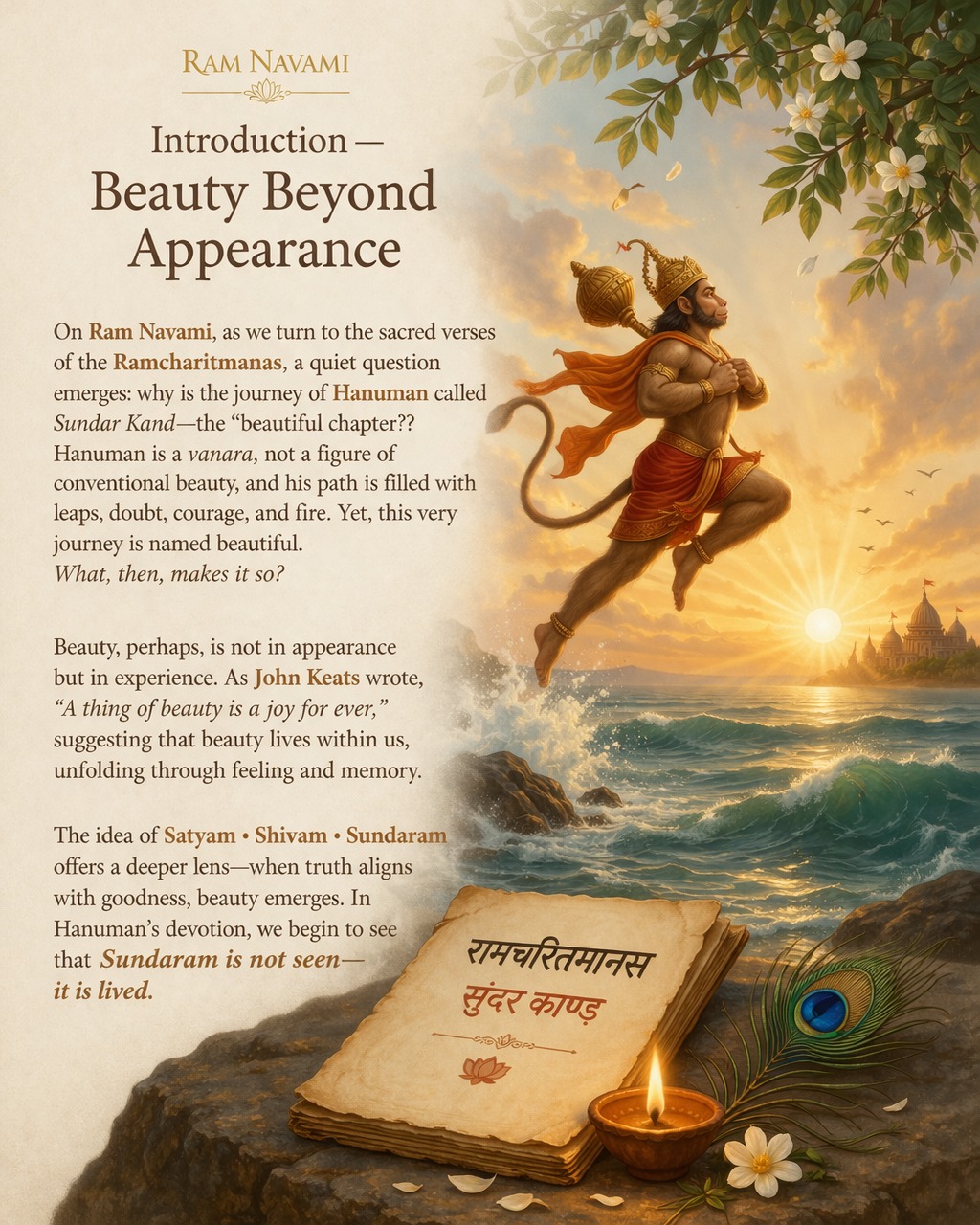
Introduction — Beauty Beyond Appearance
On Ram Navami, as we turn to the sacred verses of the Ramcharitmanas, a quiet question emerges: why is the journey of Hanuman called Sundar Kand—the “beautiful chapter”? Hanuman is a vanara, not a figure of conventional beauty, and his path is filled with leaps, doubt, courage, and fire. Yet, this very journey is named beautiful. What, then, makes it so?
Beauty, perhaps, is not in appearance but in experience. As John Keats wrote, “A thing of beauty is a joy for ever,” suggesting that beauty lives within us, unfolding through feeling and memory. The idea of ‘Satyam – Shivam – Sundaram’ offers a deeper lens—when truth aligns with goodness, beauty emerges. In Hanuman’s devotion, we begin to see that Sundaram is not seen—it is lived.
Chapter 1 — The Question of Beauty
“A thing of beauty is a joy for ever,” wrote John Keats—and yet, the line raises more questions than it answers. What is this “thing”? And why does its joy endure? A mountain at dawn, a quiet face in thought, a line of poetry remembered years later—beauty appears across forms, yet resists definition. If beauty were purely in the object, it would affect everyone equally. But it does not. The same painting that moves one person may leave another untouched.
This suggests that beauty does not sit still in objects; it moves through perception. Consider a child watching rain for the first time—each drop feels like wonder. An adult, distracted, barely notices. The rain has not changed; attention has. Beauty, then, seems to arise in a meeting point—a subtle interaction between the world and the way we receive it. The question shifts: beauty is not what we see, but how seeing happens.
Chapter 2 — When Seeing Becomes Feeling
There are moments when seeing deepens into something more—when the eyes pause and the mind softens. A melody heard casually one day suddenly brings tears another day. What changed? Not the melody, but the listener. George Santayana called beauty “objectified pleasure,” pointing toward this inward dimension. Beauty is not merely perceived; it is felt into existence.
Think of standing before the sea at twilight. The horizon blurs, the light dims, and for a brief moment, thought slows down. Memory, emotion, and perception begin to weave together. Beauty arises not from the sea alone, but from this quiet synthesis. As Immanuel Kant suggested, it is a harmony within us—a free play of faculties. Beauty, therefore, is not a property we detect; it is an experience we enter.
Chapter 3 — The First Alignment
Sometimes, without warning, the inner and outer worlds fall into alignment. You hear a sentence that says exactly what you could not express. You meet someone whose presence feels immediately familiar. In such moments, there is no effort—only recognition. This is perhaps the first glimpse of beauty as alignment.
A well-written line, a perfectly timed pass in a game, or even the rhythm of daily rituals—these carry a sense of “rightness.” Nothing feels forced; nothing feels excessive. This is not coincidence but coherence. Beauty begins to appear when things fit—not mechanically, but meaningfully. It is less about perfection and more about resonance.
This alignment becomes the bridge between perception and philosophy. It suggests that beauty is not random. It follows a pattern—a deeper structure waiting to be understood.
Chapter 4 — Satyam: The Quiet Power of Truth
Truth has a peculiar beauty. A clear idea, a simple explanation, or a scientific law often feels elegant—not because it is decorative, but because it fits reality without excess. When Albert Einstein spoke of theories, he often admired their simplicity. A beautiful theory, for him, was one that explained much with little.
Consider how a complex problem suddenly becomes clear through one insight. The mind relaxes. Confusion dissolves. There is a quiet satisfaction in this clarity. Truth removes distortion, and in doing so, reveals structure. This revelation has an aesthetic quality—it feels light, almost luminous.
Thus, Satyam is not merely correctness. It is alignment with reality. And wherever such alignment appears, beauty begins to take root—not loudly, but with quiet certainty.
Chapter 5 — Shivam: The Grace of Goodness
If truth clarifies, goodness deepens. A truthful statement may be precise, but a kind act carries warmth. When someone helps without expectation, listens without interruption, or forgives without display, something in us recognizes it as beautiful. Not visually—but ethically.
Elaine Scarry suggests that beauty often inspires a desire to protect and care. We see this in everyday life—a teacher staying back for a struggling student, a stranger offering help during difficulty. These acts are not grand, yet they linger in memory. Their beauty lies in their intention.
Shivam introduces direction. It asks: toward what are we aligned? Beauty without goodness can become hollow. But when action is guided by care and balance, beauty acquires depth. It becomes something we not only admire, but trust.
Chapter 6 — Sundaram: The Emergence
When truth and goodness come together consistently, something begins to appear—not deliberately, but naturally. That appearance is Sundaram. Beauty, here, is not pursued; it is revealed.
A well-lived life often carries this quality. There is no need for display. The person who speaks truthfully and acts with care begins to reflect a quiet grace. Similarly, in design or art, the most compelling forms are often those where function, purpose, and integrity align. In The Shape of Green, beauty is described as the outcome of such integration.
This kind of beauty does not demand attention. It feels inevitable—as though it could not have been otherwise. It is not constructed from the outside. It emerges from within.
Chapter 7 — Beauty in Simplicity
Simplicity is often mistaken for lack. But in truth, it is refinement—the careful removal of the unnecessary so that the essential can stand clearly. A single line of poetry can sometimes hold more depth than an entire page. A quiet gesture can speak louder than elaborate words.
Think of a handwritten letter, a clean mathematical proof, or a moment of silence between two people who understand each other. These are simple, yet profound. They carry a sense of completeness without excess. This is why simplicity often feels beautiful—it allows meaning to breathe.
As we move forward, this insight becomes crucial. Beauty is not found by adding more, but by seeing clearly, acting rightly, and allowing things to align. In that alignment, the simplest forms begin to glow—and we begin to understand why beauty feels, as Keats said, a joy forever.
Chapter 8 — Beauty in Tension
We often imagine beauty as harmony, ease, and completion. Yet, some of the most powerful experiences of beauty arise not from perfection, but from tension—from the unfinished, the uncertain, the striving. A cracked voice in a song, a painting with visible strokes, a life in the midst of struggle—these carry a depth that polished surfaces often lack. Beauty, here, is not despite tension, but because of it.
Consider a storm at sea. It is not calm, not gentle, yet it holds a fierce, compelling beauty. The waves rise and fall in restless energy, the sky darkens, and everything seems in motion. What we witness is intensity—life refusing to be still. Similarly, in human life, moments of conflict, doubt, and incompleteness often sharpen perception. They bring out clarity, courage, and authenticity.
Beauty in tension reminds us that alignment is not static. It is achieved, tested, and sometimes broken. And in that very process of striving toward balance, something deeply human—and deeply beautiful—emerges.
Chapter 9 — The Aesthetic Mind
Beauty is not received passively; it is constructed through the interplay of perception, emotion, and cognition. The mind does not merely register forms—it interprets, associates, and feels. This integration creates what we call the aesthetic experience.
A piece of music, for instance, is not just sound. It becomes meaningful through memory, expectation, and emotional resonance. A familiar melody can transport us to another time, another place. Similarly, a line of poetry can evoke layers of meaning far beyond its words. This suggests that beauty is not located in the object alone, but in the dynamic process of engagement.
Immanuel Kant described this as a “free play” of faculties—a harmonious interaction between imagination and understanding. The aesthetic mind, then, is not a passive observer. It is an active participant, shaping and being shaped by what it encounters.
Chapter 10 — The Ethics of Beauty
Beauty, when deeply experienced, rarely remains neutral. It moves us—not just to admire, but to respond. A beautiful act of kindness inspires imitation. A moving piece of art evokes reflection. In this way, beauty carries an ethical force.
Elaine Scarry argues that beauty awakens in us a desire to protect and preserve. When we encounter something truly beautiful, we do not wish to harm it; we wish to sustain it. This instinct extends beyond objects to people and relationships. Beauty becomes a quiet guide toward care.
In everyday life, this can be seen in small acts—a person choosing honesty over convenience, or kindness over indifference. These choices may go unnoticed, yet they carry a profound aesthetic quality. Beauty, here, is not separate from goodness. It is its visible expression.
Chapter 11 — The Forgotten Strength
As we enter Sundar Kaand of the Ramcharitmanas, we encounter a striking idea: strength that has been forgotten. Hanuman, despite possessing immense power, stands in hesitation—unaware of his own potential. It is only through reminder and reflection that his strength begins to reawaken.
This moment is deeply symbolic. It suggests that beauty is not always something to be acquired. Often, it is something already present, waiting to be realized. The hesitation before the leap is as important as the leap itself. It is the space where doubt confronts possibility.
There is a quiet beauty in this awakening. It is not dramatic or loud. It is the gentle recognition of what one is capable of. And in that recognition, the journey truly begins.
Chapter 12 — The Leap of Devotion
When Hanuman finally leaps across the ocean, the act is not merely physical—it is existential. It is the moment where intention becomes action, where faith overcomes hesitation. The beauty of this leap lies not in its scale, but in its clarity.
Every significant action in life carries such a moment—a point where we must move beyond doubt. A student choosing to persist despite uncertainty, a person choosing truth despite difficulty—these are leaps of devotion. They are acts where alignment is tested and affirmed.
In this sense, devotion is not passive. It is active commitment. It brings together purpose, courage, and trust. And when these converge, action acquires an aesthetic quality. It feels right—not because it is easy, but because it is true.
Chapter 13 — The Fire that Illuminates
In Lanka, Hanuman’s actions reach their most intense expression. Strength is displayed, but never without control. Even in destruction, there is purpose—not chaos. This is where power and restraint meet, creating a rare form of beauty.
Fire, in this context, is not merely destructive. It illuminates. It reveals what is hidden, exposes what is unjust, and clears the way for renewal. The burning of Lanka becomes symbolic—not of anger, but of clarity.
In life, too, there are moments when intensity is necessary—when truth must be asserted, when injustice must be confronted. The beauty of such moments lies in balance. Power without restraint becomes violence; restraint without power becomes passivity. But when both align, action becomes precise—and profoundly beautiful.
Chapter 14 — Ram Navami: Becoming Sundar
The journey culminates in a quiet yet profound realization. Beauty is not something external to be admired; it is something internal to be cultivated. On Ram Navami, the birth of Lord Rama is celebrated. But beyond the ritual lies a deeper meaning—the birth of alignment within.
To become Sundar is not to attain perfection, but to live in coherence. It is to let truth guide perception, goodness guide action, and allow beauty to emerge naturally. This is not a single moment, but a continuous process.
In the end, beauty returns to where it began—not in objects, but in being. It is found in the way we see, the way we act, and the way we align with what is true and good. And perhaps that is the deepest insight of all: beauty is not something we seek. It is something we become.

Appendix — Beauty as an Emergent Reality
I. Beauty as Truth → (Satyam → Sundaram)
Critique of Judgment — Immanuel Kant
Beauty does not reside in objects; it arises from the harmonious play of perception and understanding.
→ Beauty = alignment of inner faculties
The Sense of Beauty — George Santayana
“Beauty is objectified pleasure.”
→ When inner feeling resonates with the outer world, beauty emerges
II. Beauty as Goodness → (Shivam → Sundaram)
On Beauty and Being Just — Elaine Scarry
Beauty awakens care, justice, and the desire to repair.
→ Beauty as moral movement
The Sovereignty of Good — Iris Murdoch
Attention dissolves ego and reveals reality.
→ Seeing clearly becomes an ethical act
III. Beauty as Emergence from Structure
The Aesthetic Mind: Philosophy and Psychology — interdisciplinary work
Beauty emerges from the interaction of perception, emotion, and cognition.
→ A system-level phenomenon
The Shape of Green — Lance Hosey
When form, function, and sustainability align, beauty appears.
→ Structure → alignment → emergence
IV. Beauty as Simplicity & Depth (Science & Mathematics)
Research on mathematical beauty (various scholars)
Beauty arises from simplicity revealing deep connections.
→ Simple form + profound meaning = aesthetic experience
V. Beauty as Experience of Harmony (Everyday Life)
The Architecture of Happiness — Alain de Botton
We find beauty where the outer world reflects inner psychological needs.
→ Beauty as resonance
VI. Beauty as Paradox & Tension
Aesthetic Theory — Theodor W. Adorno
Beauty often emerges from contradiction, struggle, and incompleteness.
→ Tension itself becomes aesthetic
VII. Indian Aesthetic Foundations
Natya Shastra — Bharata Muni
Rasa theory: beauty emerges when emotion is fully realized and experienced.
→ Aesthetic experience as lived feeling
Dhvanyaloka — Anandavardhana
Beauty lies in suggestion (dhvani), not direct expression.
→ Beauty is not stated—it is evoked