

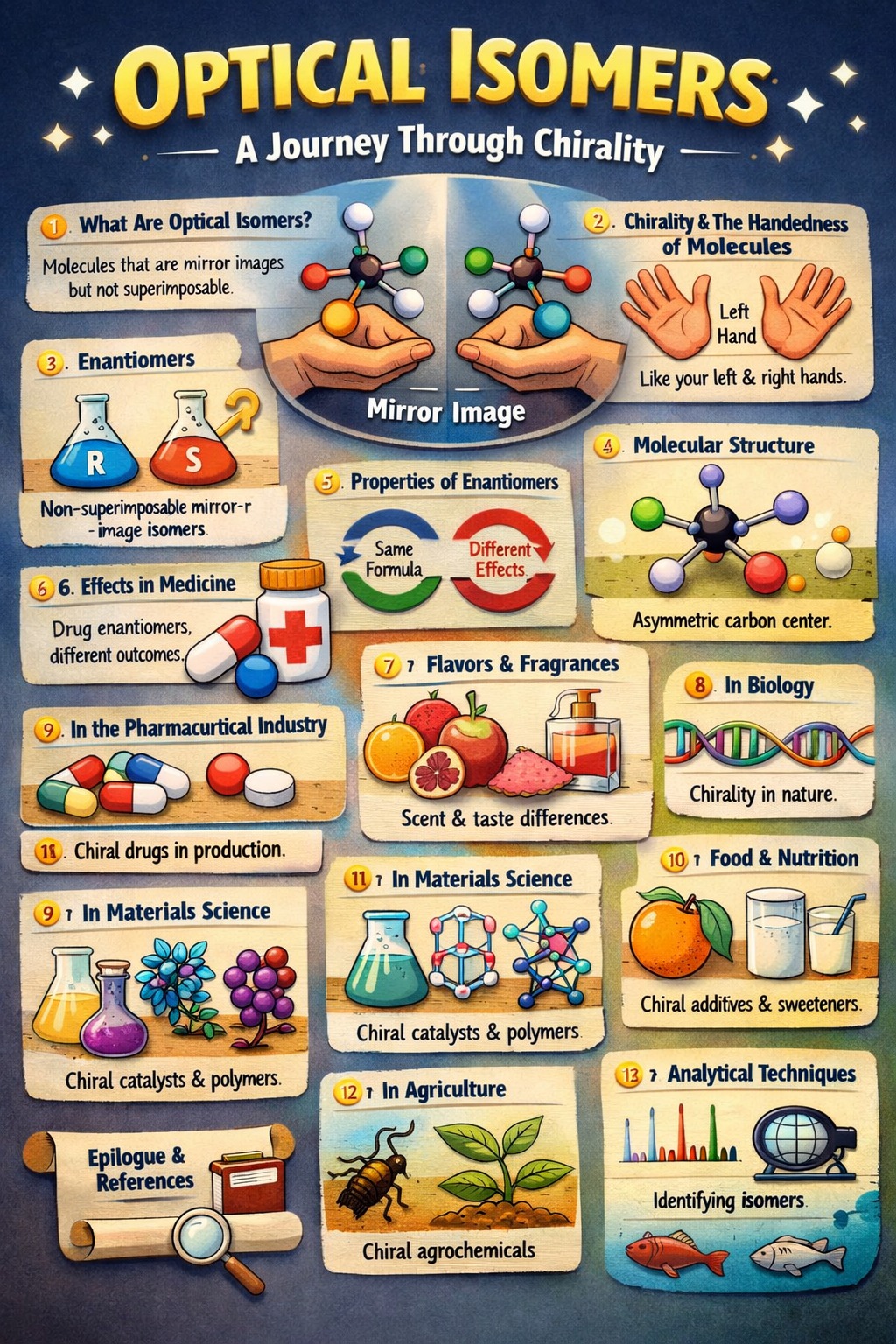
★ Chapter 1: The Mirror We Cannot See
We use mirrors every day without thinking much about them. But chemistry hides a much quieter mirror—one that cannot be seen, touched, or photographed, yet decides how life behaves. These mirrors are optical isomers, also called enantiomers.
Two molecules may have the same atoms, the same bonds, and the same formula. Still, they can behave like two very different people. The reason is simple but profound: they are mirror images that cannot be placed on top of each other—like your left and right hands.
Biology is extremely sensitive to this difference. Cells, enzymes, receptors, and DNA are all chiral. They recognize shape, direction, and orientation. A tiny molecular twist can therefore decide whether something heals or harms.
★ Example: ★ Thalidomide’s two mirror forms—one therapeutic, one teratogenic—changed global drug safety forever.
★ Chapter 2: Chirality – Why Life Chooses Sides
Chirality comes from the Greek word cheir, meaning hand. A chiral molecule exists in two mirror-image forms that are not superimposable. On paper, the difference may look small. In living systems, it is decisive.
Life is not symmetric. Proteins fold in one direction. DNA twists only one way. Enzymes act like locks that accept only one correctly shaped key. As a result, organisms respond differently to each enantiomer of the same molecule.
★ Example: ★ Almost all amino acids in the human body are L‑amino acids. ★ Natural metabolism prefers D‑sugars such as glucose. ★ Artificial D‑amino acids resist digestion and are used to design longer‑lasting drugs.
★ Chapter 3: Medicine – One Cures, One Harms
Nowhere is optical isomerism more important than in medicine. Two enantiomers may share the same name and formula, yet produce entirely different effects in the body.
Earlier, many drugs were sold as racemic mixtures. Experience taught medicine a hard lesson: the body does not treat mirror images equally.
★ Example: ★ Thalidomide: One enantiomer reduced morning sickness; the other caused severe birth defects. ★ Ibuprofen: Only the S‑enantiomer relieves pain; the R‑form is far less active. ★ L‑DOPA treats Parkinson’s disease; D‑DOPA is biologically inactive.
Modern pharmaceuticals increasingly use single‑enantiomer drugs to improve safety and precision.
★ Chapter 4: Taste – Sweet, Bitter, and Molecular Direction
Taste receptors are chiral. They can distinguish between mirror-image molecules with astonishing accuracy.
This is why two molecules that look identical on paper may taste completely different.
★ Example: ★ Carvone: One enantiomer tastes like spearmint; the other like caraway. ★ Aspartame loses sweetness if its stereochemistry is altered. ★ Glucose is sweet and nutritious; its mirror image is poorly metabolized.
Food chemistry depends heavily on correct stereochemistry.
★ Chapter 5: Smell – Memory Written in Chirality
Smell is closely tied to emotion and memory. Our noses, like our tongues, are stereoselective.
A tiny change in molecular orientation can trigger a completely different sensory experience.
★ Example: ★ Limonene: One enantiomer smells like oranges; the other like lemons. ★ Menthol: Only one form produces the familiar cooling sensation. ★ Many musk fragrances lose their character if chirality changes.
Perfumery is chemistry guided by molecular handedness.
★ Chapter 6: Agriculture – Protecting Crops, Protecting Nature
Many pesticides, herbicides, and fungicides are chiral. Often, only one enantiomer does the intended job.
Using racemic mixtures can increase toxicity and environmental persistence.
★ Example: ★ Pyrethroids: One enantiomer is insecticidal; the other adds unnecessary pollution. ★ Metalaxyl fungicide: Only one form controls fungal growth effectively. ★ Enantiopure agrochemicals reduce harm to soil and water.
Chirality supports sustainable farming.
★ Chapter 7: Nutrition – The Body’s Selective Appetite
Nutrition is not just about quantity. It is about molecular compatibility.
The body recognizes and processes nutrients based on stereochemistry.
★ Example: ★ L‑amino acids build proteins; D‑forms are poorly used. ★ Vitamin C functions only in its natural chiral form. ★ Racemic supplements often show reduced biological effectiveness.
Good nutrition respects molecular direction.
★ Chapter 8: The Brain – Direction Matters in the Mind
Neurotransmitters interact with highly specific, chiral receptors in the brain. As a result, the brain responds differently to each enantiomer.
★ Example: ★ One form of ketamine acts as an antidepressant; the other causes dissociation. ★ Adrenaline activity depends on correct stereochemistry. ★ Chiral anesthetics reduce neurological side effects.
Mental health treatment increasingly depends on enantiomer‑specific design.
★ Chapter 9: Industry – Efficiency, Cost, and Responsibility
Modern chemical industry has moved from racemic synthesis to asymmetric synthesis.
This shift saves energy, reduces waste, and improves product quality.
★ Example: ★ Chiral catalysts lower energy consumption. ★ Single‑enantiomer synthesis reduces purification steps. ★ Green chemistry relies on stereoselective reactions.
Chirality is now an industrial advantage.
★ Chapter 10: Law and Regulation – Chemistry Meets Justice
Regulatory agencies treat enantiomers as separate chemical entities.
Drug approval today requires detailed stereochemical analysis.
★ Example: ★ Thalidomide led to stricter global testing laws. ★ FDA guidelines demand enantiomer‑specific studies. ★ Drug patents distinguish racemic and enantiopure forms.
Chemistry here directly shapes public safety.
★ Chapter 11: Evolution – Why Nature Picked One Hand
Why did life choose one chirality over the other? The question remains unanswered, but clues exist.
★ Example: ★ Meteorites contain amino acids with enantiomeric excess. ★ Circularly polarized light may bias molecular formation. ★ Once selected, chirality reinforces itself through replication.
Life’s asymmetry may have cosmic roots.
★ Chapter 12: Technology – Seeing with Polarized Light
Chiral materials interact differently with polarized light. This property is used in modern technology.
★ Example: ★ Optical sensors measure enantiomeric purity. ★ Chiral liquid crystals improve display screens. ★ Enantioselective membranes enable advanced separations.
Future technologies may rely heavily on chirality.
★ Chapter 13: Education – Why Chirality Must Be Taught Well
Chirality trains spatial thinking and scientific responsibility.
Ignoring it has caused real‑world mistakes.
★ Example: ★ Medical errors due to stereochemical neglect. ★ Food chemistry failures from incorrect isomers. ★ Better education reduces costly errors.
Understanding chirality is foundational science.
★ Chapter 14: A Small Twist That Shapes Life
Optical isomers teach a powerful lesson: small differences matter.
A twist invisible to the eye can decide healing or harm, flavor or foulness, safety or disaster.
Example: ★ One mirror image heals. ★ The other harms. ★ Wisdom lies in knowing the difference.
✦ Epilogue: References and Further Reading ✦
★ Clayden, Greeves, Warren – Organic Chemistry
★ Eliel & Wilen – Stereochemistry of Organic Compounds
★ Morrison & Boyd – Organic Chemistry
★ FDA Guidelines on Chiral Drugs
★ Nobel Lectures on Asymmetric Catalysis (Knowles, Noyori, Sharpless)
★ March’s Advanced Organic Chemistry
★ Journal of Medicinal Chemistry (Chirality Studies)