

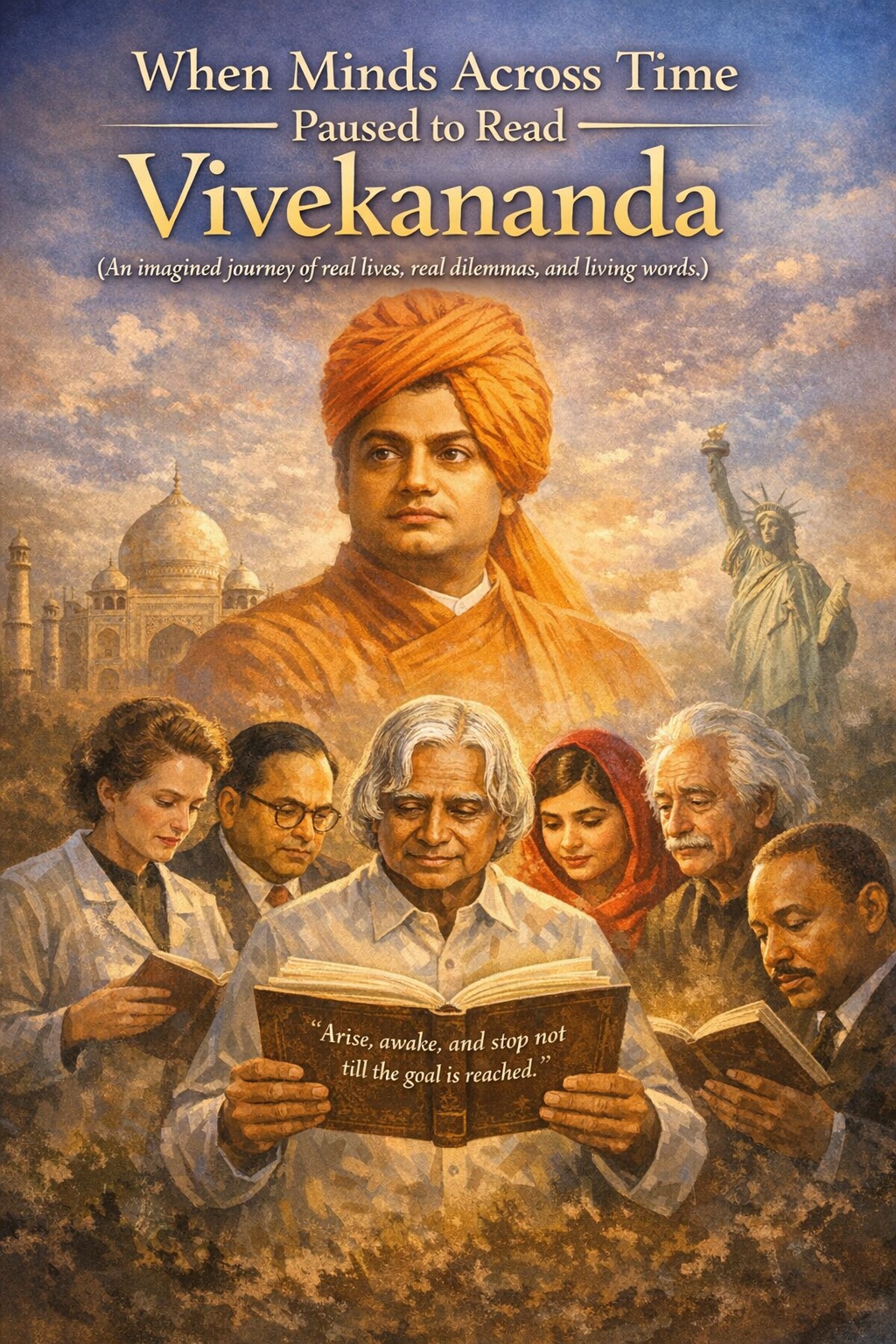
~ (An imagined journey of real lives, real dilemmas, and living words)
This is an imagined work. The meetings never happened in time or space—but the struggles did, and the words did.
★ A. P. J. Abdul Kalam — “Arise, awake, and stop not till the goal is reached.”
In July 1979, India watched silently as the SLV-3 mission failed. The rocket veered off course and plunged into the Bay of Bengal. For A. P. J. Abdul Kalam, the failure was not public embarrassment alone; it was personal responsibility. He was the project director. Young scientists had trusted him. Their faces that evening carried confusion, disappointment, and quiet fear about what the future held.
Kalam returned home late, exhausted, unable to sleep. In his small room, among notebooks filled with equations and sketches, he wrote down a line that had followed him since his student days—one he had heard repeatedly attributed to Swami Vivekananda:
“Arise, awake, and stop not till the goal is reached.”
That night, the words lost all ornamental beauty. Arise meant standing before his team the next morning and owning the failure. Awake meant studying every error without defensiveness. Stop not meant refusing the comfort of excuses. Kalam did exactly that. He shielded his team from blame and absorbed the pressure himself.
When the same rocket succeeded a year later, Kalam stepped aside and let his colleague address the nation. The quote had done its work—not by motivating him, but by disciplining him.
★ B. R. Ambedkar — “You cannot believe in God until you believe in yourself.”
Born into a society that treated him as untouchable, B. R. Ambedkar learned early that faith could be weaponized. He saw religion used to justify humiliation, exclusion, and silence. Even as he rose academically—earning doctorates from Columbia and the London School of Economics—he remained aware that society expected submission, not self-respect.
At a time when many urged him to find consolation in divine justice, Ambedkar encountered a line from Swami Vivekananda that struck him with uncomfortable clarity:
“You cannot believe in God until you believe in yourself.”
For Ambedkar, this was not anti-religious. It was anti-submission. The quote dismantled the idea that dignity must wait for divine approval. It insisted that self-belief was not arrogance—it was a moral prerequisite.
This idea shaped his life’s work. When drafting the Indian Constitution, Ambedkar did not appeal to inherited sanctity or ancient authority. He built legal structures that forced society to confront equality as a right, not a gift. Later, when he chose Buddhism, it was not escape—it was assertion.
The quote helped Ambedkar reverse a dangerous logic: before worship, self-worth; before faith, dignity.
★ Malala Yousafzai — “Take risks in your life. If you win, you can lead; if you lose, you can guide.”
In Pakistan’s Swat Valley, speaking about girls’ education was not bravery—it was defiance. Malala Yousafzai was a teenager writing a blog under a pseudonym, aware that words could invite violence. The danger was not abstract. It was visible in shut schools, armed men, whispered warnings.
After she was shot in 2012, the world expected fear to replace her voice. During recovery, Malala reflected on a line from Swami Vivekananda that framed risk not as recklessness, but as responsibility:
“Take risks in your life. If you win, you can lead; if you lose, you can guide.”
She had lost something—her anonymity, her childhood, her physical safety. But the quote reframed loss. Losing did not mean silence. It meant testimony. Guidance.
Malala returned to public life not as a victim, but as a witness. She did not claim certainty. She claimed experience. Her leadership came not from invulnerability, but from survival.
Vivekananda’s words transformed risk into continuity: whether victory or injury, the obligation to speak remained.
★ Helen Keller — “All power is within you; you can do anything and everything.”
Blind and deaf by the age of nineteen months, Helen Keller grew up in a world without sound or sight. Language came late, painfully, through relentless effort. Even after mastering communication, she faced another barrier: society’s quiet assumption that disability meant dependence.
Keller read widely and drew strength from spiritual thinkers across cultures. Vivekananda’s assertion resonated deeply with her lived experience:
“All power is within you; you can do anything and everything.”
She did not interpret this as denial of limitation. She understood power as will organized through discipline. When critics claimed her achievements were exaggerated or guided entirely by others, she did not argue defensively. She wrote. She lectured. She persisted.
Helen Keller became a global advocate—not despite her disabilities, but without allowing them to define her ceiling. The quote did not promise ease. It demanded responsibility: if power was within, excuses had to be abandoned.
Her life became evidence that power is not sensory—it is intentional.
★ Marie Curie — “The greatest religion is to be true to your own nature.”
As a young Polish woman in Paris, Marie Curie lived at the edge of acceptance—foreign, poor, and female in a scientific world dominated by men. Long before recognition arrived, she worked in improvised laboratories, stirring pitchblende in iron cauldrons, driven not by ambition but by an inner necessity to understand nature. When she and Pierre Curie began uncovering the mysteries of radiation, there was no guarantee of success—only exhaustion, doubt, and isolation.
Amid professional suspicion and social hostility, Vivekananda’s line captured what Curie practiced instinctively:
“The greatest religion is to be true to your own nature.”
Curie did exactly that. She did not soften her seriousness, nor did she retreat when scandal and gossip surrounded her after Pierre’s death. She returned to her workbench. Her integrity was scientific, not social.
In 1903, she became the first woman to win a Nobel Prize, sharing the Nobel Prize in Physics for research on radiation. In 1911, she won the Nobel Prize in Chemistry, this time alone, for discovering and isolating polonium and radium—becoming the only person in history to win Nobel Prizes in two different natural sciences.
She never treated these honors as identity. Her religion remained fidelity to work. The quote did not inspire her—it described her.
★ Jawaharlal Nehru — “In a conflict between the heart and the brain, follow your heart.”
As independence approached, Jawaharlal Nehru found himself torn between two loyalties. His mind was trained in law, reason, and modern governance. His heart, however, remained deeply bound to the emotional pulse of India—its poverty, its humiliation, its hunger for dignity. Partition negotiations, cabinet debates, and constitutional dilemmas demanded cold calculation, yet every statistic concealed human suffering.
In his private reflections, Nehru was drawn to a line of Swami Vivekananda that refused to simplify leadership:
“In a conflict between the heart and the brain, follow your heart.”
This was not an argument against reason. It was a warning against soulless rationality. Nehru’s insistence on secularism, scientific temper, and public education emerged from this balance. He chose heavy investment in institutions not because it was politically convenient, but because he believed India deserved long-term dignity over short-term applause.
When critics accused him of idealism, Nehru accepted the charge. He knew that nations collapse not from emotional excess, but from moral emptiness. The quote helped him place compassion at the center of policy, even when calculation urged retreat.
★ Mahatma Gandhi — “Strength is life; weakness is death.”
In South Africa, Gandhi was thrown off a train for refusing to leave a first-class compartment. Humiliated and shivering at Pietermaritzburg station, he confronted a question that would shape his life: Was submission safer than resistance? His body urged caution. His conscience refused silence.
Years later, Gandhi repeatedly returned to Swami Vivekananda’s uncompromising declaration:
“Strength is life; weakness is death.”
To Gandhi, this dismantled a common misunderstanding. Nonviolence was not avoidance. It was strength under discipline. Weakness disguised as humility would rot the soul. Strength restrained by conscience would liberate it.
This understanding hardened his satyagraha. He demanded courage from his followers, not pity. When beaten, they were to stand upright. When jailed, they were to remain self-respecting. Gandhi’s fasting was not weakness—it was a test of inner force.
The British Empire failed to read this correctly. They mistook restraint for fragility. Vivekananda’s words gave Gandhi clarity: life expands where fear contracts.
★ Martin Luther King Jr. — “We are what our thoughts have made us; so take care about what you think.”
During the civil rights movement, Martin Luther King Jr. faced constant provocation—hate mail, threats, public humiliation. Violence tempted many around him. Anger felt justified. Yet King understood that resentment, once internalized, becomes policy.
He often reflected on Swami Vivekananda’s warning about the mind:
“We are what our thoughts have made us; so take care about what you think.”
For King, this was strategic as much as spiritual. A movement shaped by hatred would reproduce the very injustice it opposed. He disciplined not only marches, but minds. Nonviolence was not a tactic; it was mental hygiene.
When criticized for being too soft, King replied that bitterness corrupts clarity. His speeches trained people to imagine freedom before claiming it. His refusal to demonize opponents was not moral vanity—it was psychological insight.
The quote reinforced his belief that the future of a nation begins in its inner dialogue. Change that, and laws will follow.
★ Rabindranath Tagore — “Each soul is potentially divine.”
Rabindranath Tagore lived between worlds—poet and reformer, mystic and educator. He rejected narrow nationalism but loved India fiercely. Critics accused him of being impractical, detached from political struggle. Tagore disagreed quietly.
Swami Vivekananda’s line echoed his own humanism:
“Each soul is potentially divine.”
For Tagore, this was not theology. It was pedagogy. At Santiniketan, he refused rigid classrooms. He placed children under trees, among birds and seasons, because divinity, he believed, unfolded best in freedom. Education was not filling vessels; it was revealing dignity.
Tagore’s resistance to blind nationalism came from this belief. If every soul carried divinity, then no ideology had the right to erase individuality. His poetry, music, and essays defended the human spirit against uniformity.
The quote justified his refusal to shout slogans. He chose cultivation over confrontation, trusting that awakened individuals would eventually reshape society.
★ Albert Einstein — “Truth can be stated in a thousand different ways, yet each one can be true.”
Albert Einstein spent much of his life misunderstood. His theories bent time, space, and certainty itself. Many rejected them not because they were false, but because they disrupted comfort. Einstein never demanded agreement—only openness.
He found resonance in Vivekananda’s expansive view of truth:
“Truth can be stated in a thousand different ways, yet each one can be true.”
This aligned with Einstein’s scientific humility. Newton was not wrong—he was incomplete. Classical physics was not false—it was limited. Einstein’s work did not destroy previous truths; it reframed them.
Beyond science, this quote shaped his ethics. Einstein resisted dogma—political, religious, or nationalistic. He believed rigid certainty breeds cruelty. Plural truth breeds patience.
The quote gave language to his intuition: reality is richer than any single description. Wisdom lies not in final answers, but in tolerance for complexity.
★ Vikram Sarabhai — “The world is the great gymnasium where we come to make ourselves strong.”
When Vikram Sarabhai began arguing that a newly independent, impoverished India should invest in space science, many dismissed the idea as indulgent. The country struggled with food shortages, illiteracy, and fragile institutions. Rockets and satellites, critics said, were luxuries for wealthy nations.
Sarabhai did not deny India’s weaknesses. He reframed them. Swami Vivekananda’s line guided his thinking:
“The world is the great gymnasium where we come to make ourselves strong.”
To Sarabhai, hardship was not an excuse for retreat; it was resistance training. India would not become capable by waiting for prosperity. Capability would create prosperity. Space science, remote sensing, and communication satellites were not vanity projects—they were instruments of self-strengthening.
He built institutions patiently: ISRO, PRL, IIM Ahmedabad. Failures were treated as workouts, not verdicts. The gymnasium metaphor mattered: muscle grows by stress, not comfort.
Sarabhai’s legacy is not only technological. It is philosophical. He taught India that strength is cultivated by engaging difficulty directly, not avoiding it.
★ Mother Teresa — “Serve the poor, the weak, the sick—that is worshipping God.”
In the narrow lanes of Calcutta, Mother Teresa encountered suffering that could not be solved by theory. Bodies lay unattended. Diseases carried stigma. Dignity was often the first casualty of poverty. Many asked why she did not aim higher—policy, reform, systemic change.
Her answer was lived, not argued. Swami Vivekananda’s line gave language to her instinct:
“Serve the poor, the weak, the sick—that is worshipping God.”
She did not separate spirituality from sanitation, prayer from wound-cleaning. Worship was not an escape from reality—it was immersion in it. When asked how she endured endless suffering, she replied not with optimism but with presence.
Critics accused her of glorifying poverty. She rejected that. Poverty, she believed, was an evil. But ignoring the poor while debating solutions was worse. Service was not the end; it was the beginning of human contact.
The quote shaped her scale of action. She did not aim to fix the world. She aimed to touch one life at a time—with reverence.
★ J. Krishnamurti — “Talk to yourself once in a day, otherwise you may miss meeting an intelligent person in this world.”
J. Krishnamurti rejected gurus, systems, and spiritual hierarchies. Ironically, millions gathered to hear him speak. He insisted that truth could not be handed down—it had to be discovered inwardly, without authority.
Among Vivekananda’s many statements, one captured Krishnamurti’s insistence on self-inquiry:
“Talk to yourself once in a day, otherwise you may miss meeting an intelligent person in this world.”
Krishnamurti interpreted this not as self-admiration, but as radical honesty. Most people, he believed, live in noise—opinions borrowed, fears inherited, beliefs absorbed unconsciously. Silence with oneself was revolutionary.
He urged listeners to observe their thoughts without judgment, to see conditioning in action. Intelligence, he argued, was not accumulation of knowledge but clarity of perception.
The quote reinforced his refusal to become a leader. He wanted individuals to encounter themselves directly, without intermediaries. Meeting oneself truthfully, he believed, was the beginning of freedom.
★ Ratan Tata — “Do not wait for anybody or anything. Do whatever you can, build your hope on none.”
When Ratan Tata took over the Tata Group, skepticism followed him relentlessly. He was considered too soft, too understated, not aggressive enough for a competitive corporate world. Many doubted whether he could lead an empire built by stronger personalities.
Rather than respond defensively, Tata acted. Swami Vivekananda’s directive aligned with his temperament:
“Do not wait for anybody or anything. Do whatever you can, build your hope on none.”
Tata invested boldly—in steel, automobiles, global acquisitions—often against advice. The Nano project, though commercially flawed, reflected this philosophy: attempting what others dismissed as impossible.
He did not rely on applause. Some ventures failed. Others redefined Indian industry. Through it all, Tata avoided spectacle. He acted first, explained later.
The quote justified his independence from consensus. Hope, he believed, was not something to borrow from markets or media. It was something to enact through decision and responsibility.
★ Nelson Mandela — “The fire that warms us can also consume us; it is not the fault of the fire.”
After decades of imprisonment, Nelson Mandela emerged into a South Africa charged with rage. The anger of the oppressed was justified. Revenge was tempting. Many expected Mandela to unleash it.
He understood the danger. Anger is fire—it can illuminate injustice or burn the future. Vivekananda’s insight captured this duality precisely:
“The fire that warms us can also consume us; it is not the fault of the fire.”
Mandela did not deny anger. He disciplined it. Hatred could energize resistance, but if left unchecked, it would poison reconciliation. The responsibility lay not with emotion, but with its direction.
By choosing forgiveness without forgetting, Mandela converted fire into warmth. Truth and Reconciliation was not amnesia—it was containment. Fire used for light, not arson.
The quote articulated his hardest lesson: moral leadership is not the absence of passion, but mastery over it.
★ Kalpana Chawla — “Be fearless. Fear is death, fear is sin, fear is hell.”
For Kalpana Chawla, fear was never dramatic—it was quiet and persistent. A girl from Karnal dreaming of space had to cross invisible boundaries: geography, gender, accent, expectation. Every application to NASA carried the risk of rejection. Every flight carried real danger. Space does not forgive hesitation.
Kalpana often spoke about courage not as boldness, but as continuity. Vivekananda’s uncompromising line reflected this inner stance:
“Be fearless. Fear is death, fear is sin, fear is hell.”
Fear, she understood, could end a journey long before disaster. It could stop a form from being filled, a question from being asked, a dream from being attempted. She refused that death.
Even after the Columbia mission’s risks were known, she did not dramatize them. Fearlessness, for her, was professional clarity—knowing the risks and proceeding anyway. She did not see fear as evil emotion, but as paralysis.
Kalpana’s life affirmed Vivekananda’s warning: fear kills possibility before reality ever gets a chance. Her legacy is not tragedy—it is the audacity to step beyond fear repeatedly.
★ Sardar Vallabhbhai Patel — “Purity, patience, and perseverance are the three essentials to success.”
When India became independent, it was not a single nation—it was a fragile idea surrounded by over 560 princely states, each with its own ambitions, insecurities, and egos. Sardar Vallabhbhai Patel faced the monumental task of integration. Force alone would have failed. Appeasement would have fractured the country.
Patel relied on a quieter strength shaped by Vivekananda’s triad:
“Purity, patience, and perseverance are the three essentials to success.”
Purity meant clarity of intention—no personal glory, no ideological vanity. Patience meant endless negotiations, listening to fears, absorbing insults. Perseverance meant continuing even when compromise looked impossible.
Patel did not rush unity. He built it methodically. Some states joined willingly. Others resisted. Patel endured criticism from both extremes—those calling him harsh and those calling him weak.
The quote described his method perfectly. Success was not dramatic. It was cumulative. Patel’s patience did not mean delay; it meant durability. India’s territorial integrity remains his quiet monument.
★ Steve Jobs — “Anything that makes you weak physically, intellectually, and spiritually, reject as poison.”
Steve Jobs lived intensely—sometimes destructively. His early success bred arrogance. His dismissal from Apple nearly broke him. Yet exile forced reflection. He stripped his life to essentials: learning, design, intuition.
Vivekananda’s warning resonated deeply with Jobs’ evolving philosophy:
“Anything that makes you weak physically, intellectually, and spiritually, reject as poison.”
Jobs began rejecting mediocrity with ruthless clarity—unnecessary features, diluted vision, half-hearted products. But the quote also turned inward. He rejected habits that dulled curiosity. He simplified his life to protect focus.
When he returned to Apple, his leadership was not gentler—but it was clearer. He demanded excellence not for dominance, but coherence. Weakness, he believed, crept in disguised as compromise.
The quote validated his instinct that strength must be holistic. A weak mind produces weak products. A weak spirit tolerates ugliness. Jobs’ legacy reflects Vivekananda’s principle: elimination is as important as creation.
★ Sachin Tendulkar — “You will be nearer to Heaven through football than through the study of the Gita.”
As a young boy practicing endlessly at Shivaji Park, Sachin Tendulkar did not think of spirituality. He thought of timing, balance, repetition. Critics later questioned obsession with sport in a country burdened with poverty and exams.
Vivekananda’s provocative statement reframed effort itself as sacred:
“You will be nearer to Heaven through football than through the study of the Gita.”
Sachin understood this instinctively. Discipline, surrender to practice, humility before skill—these were spiritual acts, even without scripture. The pitch became his monastery. Repetition became meditation.
When fame arrived, he remained grounded in routine. Losses humbled him. Success disciplined him. He never treated sport as entertainment alone—it was responsibility.
The quote defended his life’s choice: sincere action purifies more deeply than borrowed holiness. Sachin’s greatness lay not in records, but in devotion to craft. Sweat, not sermon, carried him closer to heaven.
★ Savitribai Phule — “Education is the manifestation of the perfection already in man.”
In 19th-century India, teaching girls—especially from oppressed castes—invited abuse, isolation, and violence. Savitribai Phule walked to school with stones and insults thrown at her. Society did not fear ignorance; it feared awakened minds.
Swami Vivekananda’s insight articulated what she practiced daily:
“Education is the manifestation of the perfection already in man.”
Savitribai did not see her students as empty vessels. She saw buried dignity. Education was not charity—it was revelation. When girls learned to read, they stood differently. When they questioned, they unsettled hierarchies.
Savitribai did not argue philosophy. She lived it. She opened schools, trained teachers, and endured humiliation without retreat. Perfection, she believed, was not elite—it was universal.
The quote affirms her life’s work: education does not manufacture worth; it uncovers it. Savitribai’s legacy is not reform—it is awakening.
★ Epilogue
Swami Vivekananda (1863–1902) was not only a spiritual luminary but also a relentless advocate for human potential, courage, and social reform. His teachings bridged the sacred and the practical, urging individuals to act with discipline, self-belief, and responsibility.
Beyond inspiring words, Vivekananda left a rich legacy of works that continue to guide thinkers, leaders, and ordinary people alike:

Complete Works of Swami Vivekananda — a nine-volume collection published by Advaita Ashrama, containing lectures, letters, essays, poems, interviews, and class notes from his lifetime. This is considered the authoritative source of his thought, capturing the depth and range of his philosophy.
Raja Yoga – exploring the mind, meditation, and self-discipline.
Jnana Yoga – the path of knowledge and understanding of the self.
Karma Yoga – duty, action, and selfless service as spiritual practice.
Bhakti Yoga – devotion as a force for personal and social transformation.
Letters of Swami Vivekananda – revealing his thoughts on India, humanity, and spiritual life.