
1. The Blank Canvas
Bhrigu stood in his studio as soft golden sunlight warmed his face and made the white canvas glow like fresh milk. The air drifting through the open window smelled of last night’s Holika smoke mixed with sweet gulaal, and children’s laughter rang outside like tiny bells. A sparrow hopped onto the window grill and chirped sharply. Its wings fluttered against the still air. Down below, a street dog barked as children ran past, their wet slippers slapping the ground with bright splashes.
He took a sip of tea. It tasted slightly bitter. The clay cup felt cool and smooth in his palm. The canvas looked too clean. Too silent. His fingers felt stiff around the wooden brush. “Today I will paint something important,” he whispered, hearing his voice echo in the quiet room. A cow mooed lazily from the lane, and the earthy sound made the morning feel real and alive.
2. The First Stroke
He dipped the brush into thick blue paint and smelled its sharp, oily scent. The bristles grew heavy. When the brush touched the canvas, it made a soft scratching sound. A long blue line stretched across the white space like a calm river seen from the sky. Sunlight reflected on the wet paint, and it shimmered before his eyes.
His wrist trembled slightly. He felt the tiny shake travel up his arm. He almost wiped the line away. Instead, he added a pale golden wash above it. The color spread slowly and warmed the sky. Outside, a monkey ran across a terrace and knocked over a metal bucket with a loud clang. Children laughed louder at the crash. Inside, the studio smelled of paint and dust, and the growing sky felt steady beneath his careful hand.
3. Flow Arrives Quietly
The brush moved again and again. It made gentle swish sounds that blended with the cooing of pigeons. Pink and orange melted into each other like sweet syrup. Warmth spread through his chest as the colors deepened. The river shimmered with silver streaks. He almost felt cool water brushing his skin just by looking at it.
Then doubt arrived. It tasted sour. Will people like this? he wondered. A goat bleated sharply outside, and the sudden sound made him blink. He remembered reading in Big Magic that fear can sit beside you but must not hold your brush. He inhaled slowly. The paint smelled strong and real. He added a small ripple to the river. The uneven line felt brave under his fingers.
4. The Door Opens
A quick knock tapped against the wooden door. The sharp sound startled a myna bird into flight. Before Bhrigu could answer, the door creaked open and Aastha stepped inside. Her cheeks glowed pink and yellow like bright flowers. Her hair smelled faintly of coconut oil and colored powder. Her wet slippers squeaked on the cool floor.
“Uncle, can I see?” she asked softly. Her voice sounded light and curious.
He hesitated. The brush pressed into his palm. Then he nodded. Warm air brushed his arm as she entered. A butterfly fluttered near the window, its wings flashing orange and black. Aastha stared at the canvas with wide shining eyes.
“It’s quiet,” she said while distant drums thumped from the street.
“It’s peaceful,” Bhrigu replied, smelling faint sweetness in the air.
“But today is Holi,” she said with a small laugh. Outside, a water balloon burst with a loud splash.
5. The Red Handprint
Someone called Aastha’s name from outside. She turned quickly. Her braid swung against her back. Her foot slipped on a damp patch, and she gasped as cool water touched her toes. Her small hand, bright with red powder, shot forward to steady herself. Her palm pressed against the canvas with a soft thud.
Scarlet bloomed across the gentle river like crushed strawberries spreading over cream. The red smelled sweet and dusty as it mixed with wet paint. Bhrigu’s heart pounded loudly in his ears. A crow cawed harshly outside.
“No!” he cried. His voice felt hot and sharp.
Aastha froze. Tears gathered in her wide eyes. “I’m sorry,” she whispered. Her breath felt warm and shaky. The river no longer looked calm. It looked wild and loud. Anger burned in his chest like biting into a green chili.
6. The Pause
Silence filled the studio. It felt heavy and warm. Bhrigu stared at the red mark while pigeons flapped noisily from a nearby roof. He imagined scrubbing the paint away. He could almost hear the rough scrape of cloth against canvas. The smell of mixed colors felt stronger now.
Outside, a dog barked happily as children threw handfuls of powder into the wind. Laughter drifted inside like bright music. He remembered reading in The Subtle Art of Not Giving a F*ck that not everything deserves your anger. The thought cooled him slightly, like shade on a hot afternoon.
“Are you very angry?” Aastha asked softly. Red dust fell from her fingers like tiny grains of sand.
“I was,” he admitted quietly. His shoulders relaxed a little. The red streak glowed boldly under the light. It looked alive.
7. The Second Stroke
Instead of reaching for a cloth, Bhrigu dipped his brush into the same bright red. The color swirled thickly like spicy chutney. The sharp smell of paint filled his nose. Aastha watched silently. Her breathing was quick and warm.
He touched the brush to the edge of the handprint and pulled the red upward across the sky. The bristles glided smoothly against the canvas. The streak rose boldly. He added golden lines beside it. They shone like sparks from a bonfire. Outside, a horse neighed loudly from a nearby stable. The strong sound felt grand and wild.
The river now seemed to dance instead of sleep. The whole painting glowed brighter before his eyes. Aastha stepped closer. Her slippers squeaked softly.
“It looks happier,” she said as a koel sang sweetly from a tree outside.
Warmth spread through Bhrigu’s chest like sunlight soaking into skin. He looked at her red-stained fingers. Then he looked at the glowing canvas.
“Do you want to add something?” he asked gently.
Outside, colors burst into the air again. Birds fluttered. Children laughed.
The painting shimmered in the light. It was ready for more.
8. Aastha’s Turn
Aastha looked at Bhrigu with wide, shining eyes. Her fingers were still dusty red. The powder smelled sweet and dry.
“Can I really?” she asked, her voice soft but excited.
Bhrigu nodded. The brush felt lighter in his hand as he passed a smaller one to her. Outside, a parrot screeched sharply from a neem tree, and distant drums thumped like a happy heartbeat.
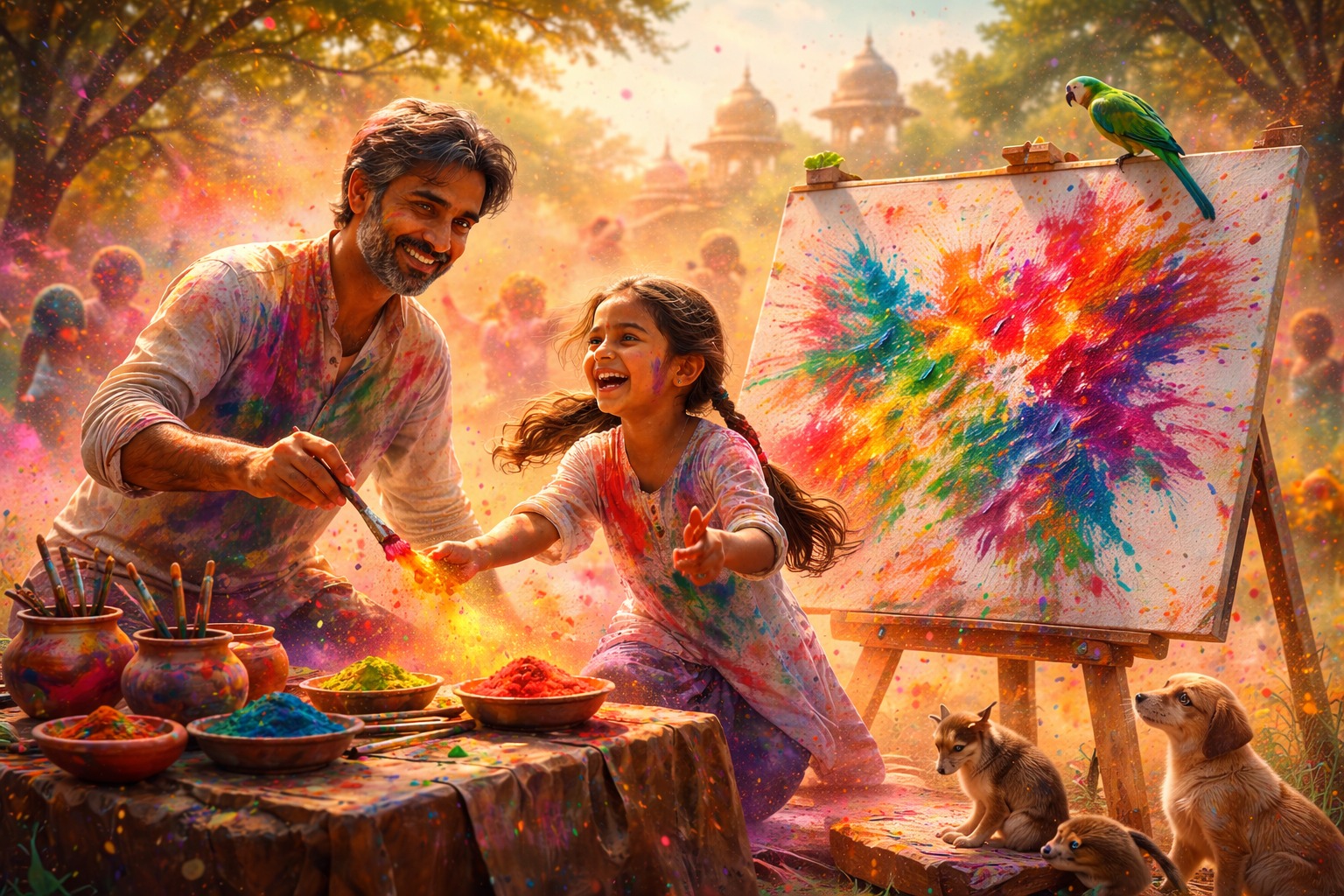
Aastha dipped the brush into bright yellow. The color glowed like mango pulp in sunlight. She did not pause. She pressed the brush onto the canvas and made round dots near the red streak. The paint spread thick and warm.
Bhrigu felt a quick jump of fear in his stomach. But he stayed quiet. He listened to the gentle scratch of her brush.
She added green next. Then a splash of blue. The river lost its neat edges. The sky began to dance.
A squirrel ran along the window ledge, its tiny claws clicking lightly. The painting felt less serious now. It felt playful.
9. When Control Melts
The horizon slowly disappeared under layers of color. Pink crossed gold. Green touched red. Nothing stayed separate.
Bhrigu smelled paint and dust mixing in the warm air. He heard children shout as another bucket of water splashed loudly outside.
“This is messy,” he murmured, watching colors collide.
Aastha smiled. “Holi is messy,” she said, giggling as a drop of blue landed on her cheek.
He stepped back. His eyes blinked at the brightness. The canvas no longer looked like a quiet sunrise. It looked like movement. Like music.
He remembered a line from Steal Like an Artist — nothing is completely original; everything is remixed.
Maybe this was not destruction. Maybe this was remix.
A cow’s bell jingled faintly from the street. The ordinary sound felt comforting.
10. The Hidden Figure
In the middle of the colors, the small figure he had painted earlier was almost gone. Only a faint outline remained.
Bhrigu leaned closer. He could still see it. Barely. The little person no longer looked lonely. It looked surrounded.
A koel sang a long, sweet note from the mango tree. The sound felt like a blessing.
“It’s not alone anymore,” Aastha said quietly, touching the edge of the canvas with careful fingers.
Bhrigu felt warmth rise in his chest. He remembered The Alchemist — when you follow what feels alive, the world changes around you.
The painting no longer belonged only to him. It felt shared. It felt fuller.
11. The White Light
“Something is missing,” Aastha whispered, squinting at the canvas.
Bhrigu dipped his brush into white paint. It looked thick and cool like cream. He flicked tiny drops across the surface. The splashes landed softly, making faint tapping sounds.
Aastha laughed as a tiny drop landed on her hand. It felt cold and slippery.
The white streaks shone like sparks in the middle of the bright storm. They looked like light breaking through color.
Outside, pigeons flapped suddenly into the sky. Their wings made a rush of air.
Bhrigu felt calm now. The fear tasted faint, almost gone. The painting felt brave.
12. Stepping Back
They both stepped back together. The floor smelled of damp powder. Their fingers were sticky with drying paint.
The canvas glowed. It was wild. It was loud. It was alive.
“It doesn’t look like before,” Aastha said, tilting her head.
“No,” Bhrigu replied softly. “It looks better.”
He remembered reading in The Gifts of Imperfection that imperfection creates connection. He could feel that truth now in his chest.
A stray puppy wandered into the doorway, sniffing the air curiously. It wagged its tail at the bright colors.
Bhrigu laughed. The sound felt free in his throat.
13. Evening Fire
That evening, as the sky turned orange and cool wind brushed his skin, Bhrigu stood near the Holika bonfire. The flames crackled loudly. Smoke smelled sharp and warm.
Aastha stood beside him, her face glowing in firelight. Children circled the fire, their bangles jingling and feet crunching dry leaves.
“What did the fire burn this year?” she asked.
Bhrigu watched sparks rise into the dark sky. “Maybe my need to control everything,” he said quietly.
The fire popped loudly, and a shower of tiny sparks flew upward like stars.
He felt lighter. The night air tasted cool and fresh.
14. The Exhibition
A week later, the painting hung on a plain white wall in a small exhibition hall. The room smelled faintly of polish and fresh paint.
People stood before it for a long time. Some leaned closer. Some smiled softly.
“It feels joyful,” one woman whispered.
“It feels like Holi,” a man said, nodding slowly.
Bhrigu could hear his heartbeat, steady and calm. The canvas shone under bright gallery lights.
Aastha stood near him, her fingers clean this time but her eyes just as bright.
“Are you glad I slipped?” she asked with a shy grin.
Bhrigu laughed gently. “Yes,” he said, feeling warmth spread through him again. “I am.”
The painting had started as control. It had become celebration.
And both of them could feel it.
Epilogue — Open Books on Spontaneity, Joy & Holi

The Book of Joy — by Dalai Lama & Desmond Tutu
A warm, playful conversation between two spiritual friends on how to cultivate joy even in suffering. It blends wisdom, humor, neuroscience, and lived experience — reminding us that joy is a choice strengthened through compassion and perspective.
The Art of Possibility — by Rosamund Stone Zander & Benjamin Zander
A perspective-shifting book that encourages you to move from scarcity thinking to possibility thinking. Through stories from music, leadership, and daily life, it shows how reframing situations unlocks creativity and spontaneous action.
Big Magic — by Elizabeth Gilbert
A spirited guide to living creatively without fear. Gilbert invites readers to treat ideas as living companions and to approach life with curiosity rather than perfectionism.
Steal Like an Artist — by Austin Kleon
Short, practical reflections on creative courage. It encourages beginners to start messy, borrow wisely, share their work, and embrace playful experimentation.
The Courage to Be Disliked — by Ichiro Kishimi & Fumitake Koga
A dialogue-style exploration of Adlerian psychology. It emphasizes personal responsibility, freedom from others’ approval, and the boldness required to live authentically.
Flow — by Mihaly Csikszentmihalyi
A foundational psychology book explaining the state of deep absorption where skill meets challenge. It shows how structured engagement paradoxically creates effortless joy.
Play — by Stuart Brown
A scientific yet heartwarming exploration of why play is essential for creativity, relationships, and emotional resilience — in children and adults alike.
Man’s Search for Meaning — by Viktor Frankl
A profound memoir and psychological reflection on finding meaning in suffering. Frankl argues that even in the darkest conditions, we retain the freedom to choose our attitude.
Holi — by Badri Narayan
A cultural and historical study of Holi’s evolution across regions and communities in India. It explores its social symbolism, folk traditions, and the festival’s role in dissolving hierarchies through color and laughter.
Holi: Festival of Colors — by Shobha Viswanath
A beautifully illustrated retelling of Holi’s legends for young readers. It captures the sensory delight, mythic roots, and communal joy of the festival in a simple, celebratory tone.
15 Action Points for Spontaneity & Joy
(Drawn from the spirit of the books that shaped Bhrigu’s transformation)
1. Give Fear a Name — But Not Authority.
Write down what you’re afraid of before starting. Acknowledge it. Then begin anyway. (Inspired by Big Magic.)
2. Do Morning Brain-Dumps for 7 Days.
Fill three pages with uncensored thoughts each morning. Don’t reread. Just release. (From The Artist’s Way.)
3. Reduce One Unnecessary Worry.
Ask: Does this truly matter in five years? If not, consciously let it go. (From The Subtle Art of Not Giving a F*ck.)
4. Make 3 “Bad” Creations on Purpose.
Paint badly. Write awkwardly. Sing off-key. Train your nervous system to survive imperfection.
5. Build a “Curiosity List,” Not a Goal List.
Write 10 things you’re curious about — not achievements, just interests. Explore one this month. (From The Alchemist spirit of following aliveness.)
6. Share Something Unfinished.
Show a draft, not the final piece. Let vulnerability strengthen connection. (From The Gifts of Imperfection.)
7. Remix an Idea You Love.
Take a favorite poem, design, or concept and reinterpret it in your own way. (From Steal Like an Artist.)
8. Replace “What If I Fail?” With “What If I Learn?”
Write both questions down. Notice which one feels lighter in your body.
9. Prototype Your Dream Small.
Instead of planning the perfect future, test a tiny version this week. (From Designing Your Life.)
10. Schedule One “Unproductive” Hour Weekly.
No goals. No results. Just exploration. Let play retrain seriousness.
11. Choose One Value to Care Deeply About.
Focus your energy there. Let the rest be background noise.
12. Create Before Consuming.
Each day, make something small before scrolling or reading. Train output before input.
13. Redefine Mistakes as Material.
When something goes wrong, ask: How can this become part of the art?
14. Practice Public Courage.
Ask a sincere question. Express a real opinion. Show up honestly once this week.
15. End Each Week With Reflection, Not Judgment.
Ask: Where did I feel most alive? Then design next week around that answer.