

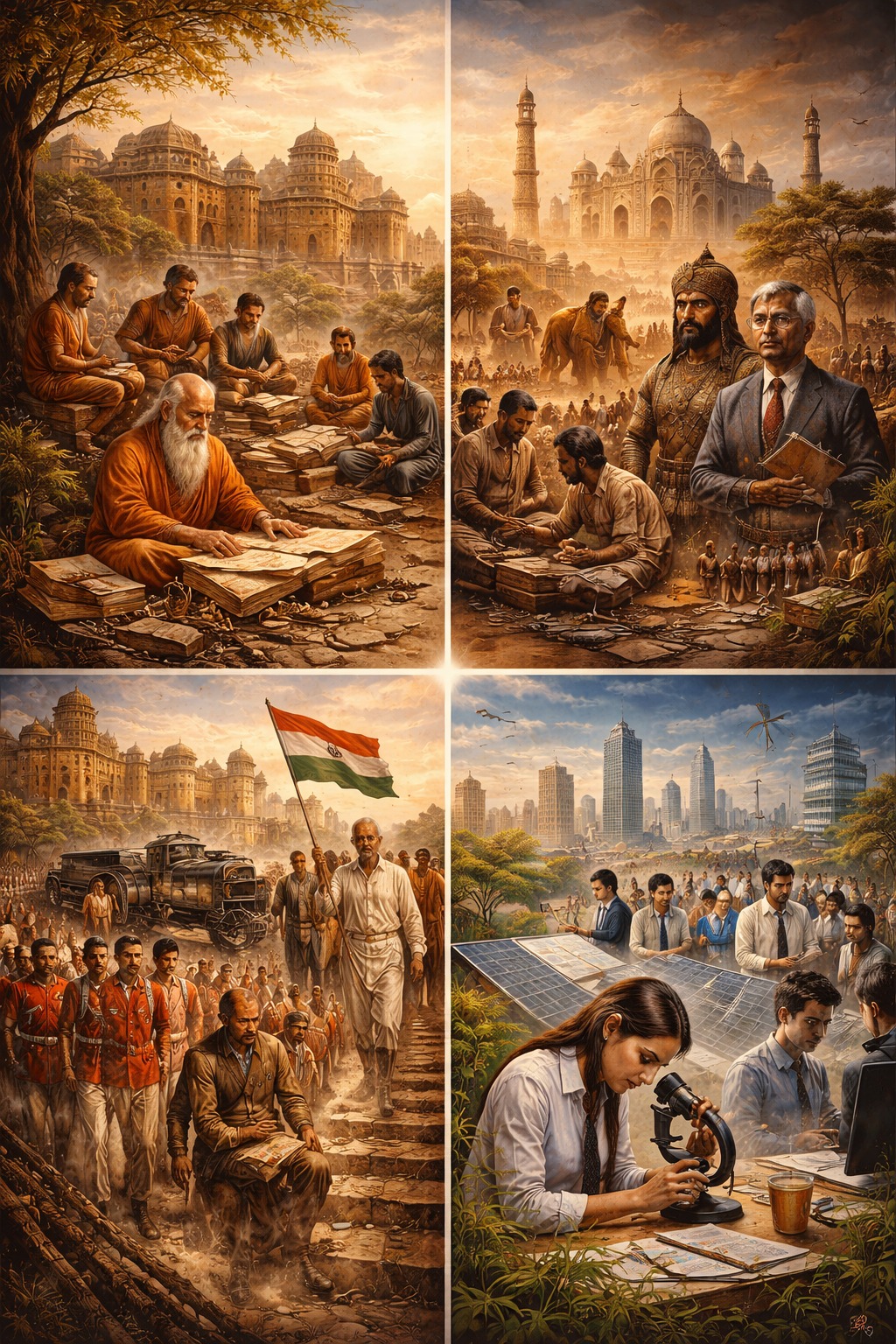
Introduction — Why History Must Be Read as Warning
History is often approached as memory: dates, dynasties, victories, defeats. But for civilizations, history is something more demanding—it is a diagnostic tool. It reveals not only what happened, but why similar mistakes return wearing new clothes. Events change. Human behavior rarely does.
India’s past is vast, creative, and resilient. Yet within this continuity lie repeating patterns—social rigidity hardening into hierarchy, women’s contributions fading into invisibility, scientific inquiry giving way to unquestioned authority, and internal divisions weakening collective strength. These were not isolated failures. They were habits, practiced slowly, normalized quietly, and paid for heavily.
This work reads Indian history not to accuse, but to understand repetition. It draws lessons from ancient, medieval, colonial, and modern periods to identify fault lines that repeatedly slowed progress: caste over merit, power over justice, reverence over reasoning, nostalgia over reform. The aim is not to reject tradition, but to distinguish between living wisdom and preserved error.
History does not repeat itself mechanically. It repeats choices. And until those choices are examined honestly, history will continue to whisper warnings—patiently, persistently—waiting to be heard.
Chapter 1: Fragmentation Before the Fall
When Mahmud of Ghazni crossed the Indus repeatedly, he did not encounter a unified subcontinent standing alert. Instead, he met a patchwork of rival courts—each guarding its own hill, fort, and pride. Rajput rulers fought with extraordinary bravery, yet rarely together. Alliances were temporary. Distrust was permanent. Victory was imagined as individual, never collective.
The invader learned faster than the invaded. He studied routes, seasons, and rivalries. One kingdom fell; neighbors watched. Another raid followed; others waited. No shared military doctrine emerged. No united political imagination formed. India’s borders were defended, but its mind remained divided.
Centuries later, Plassey repeated the pattern. Siraj-ud-Daulah did not lose because the British were militarily superior. He lost because betrayal had already hollowed trust from within. History shows again and again: fragmentation does not cause sudden collapse—it slowly trains a civilization to fall without resistance.
Chapter 2: The Caste Freeze
Early Indian society was not static. Roles shifted, skills moved, and individuals could rise through learning or ability. Over centuries, however, flexibility hardened into hierarchy. Occupation became inheritance. Birth replaced aptitude. The social ladder stopped moving.
Chinese traveler Xuanzang admired India’s intellectual life, yet observed invisible walls separating people. A gifted child born into the “wrong” caste rarely crossed social boundaries. Talent stagnated where it was born. Society slowly lost its internal circulation of intelligence.
This freeze had consequences beyond morality. When Europe later dismantled rigid guilds and rewarded skill, India preserved hierarchy as stability. Innovation slowed. Institutions aged prematurely. Inequality disguised itself as tradition. History warns clearly: societies that lock talent into birth eventually outsource power to those who do not.
Chapter 3: Birth Over Merit
In the later Mughal period, administration increasingly revolved around families rather than competence. Positions were inherited, favors traded, performance overlooked. Efficiency did not collapse overnight; it quietly eroded. Corruption grew not from malice alone, but from complacency.
Meanwhile, the East India Company—exploitative and ruthless—ran on a different logic. Officers were evaluated. Promotion followed results. Systems rewarded competence even when morality was absent. That organizational advantage mattered more than numbers.
History repeatedly confirms this uncomfortable truth: loyalty sustains institutions briefly; merit sustains them across generations. Societies that fear open competition protect mediocrity unknowingly. Decline then arrives not with noise, but with routine failure. Empires rarely fall because enemies are brilliant; they fall because internal standards quietly decay.
Chapter 4: Women as Invisible Backbone
Ancient Indian texts remember women like Gargi and Maitreyi—debating metaphysics, questioning sages. Yet as centuries passed, women’s visibility shrank. Their labor remained essential, but their voices faded from records.
Women farmed fields, preserved oral culture, sustained households, raised generations. Yet education retreated from them. Property rights narrowed. Mobility reduced. When Mirabai sang, society celebrated devotion—but resisted equality. Spiritual admiration did not translate into social reform.
History elsewhere moved differently. Societies that educated women early expanded creativity, productivity, and resilience. India delayed this expansion for centuries. The cost was not only injustice—it was lost imagination. A civilization that sidelines half its population does not merely oppress; it shrinks its own future.
Chapter 5: Knowledge Without Access
Nalanda and Takshashila were once living crossroads—monks, scholars, skeptics debating freely across sects and regions. Knowledge breathed openly. Disagreement was method, not threat.
Later, learning retreated into guarded languages and closed circles. Sanskritized knowledge excluded masses. Education became symbolic rather than social. Under colonial rule, English replaced Sanskrit—different gatekeepers, same exclusion.
Each contraction widened ignorance. Superstition filled gaps left by inaccessible learning. Fear replaced curiosity. History shows this pattern clearly: when knowledge narrows, power centralizes; when learning becomes elite, society becomes fragile. Knowledge locked away does not remain pure—it slowly disappears, leaving myths in its place.
Chapter 6: Law as Hierarchy
Ancient legal codes prescribed different punishments for identical crimes—depending on caste. Justice was not blind; it was calibrated. Law reinforced hierarchy rather than fairness.
Colonial rule altered the face of authority but preserved inequality. Race replaced caste. Privilege changed language, not logic. Law served rulers before subjects. Trust never fully formed.
People obey laws not because they fear punishment, but because they feel protected. When justice appears selective, obedience becomes temporary. History shows again and again: unequal law does not enforce order—it postpones unrest. Stability without justice is merely delayed instability.
Chapter 7: Romanticising an Unequal Past
The Gupta age shines brightly in memory—science, art, administration. Less remembered are the shrinking rights of women and the hardening of caste hierarchies. Mughal India dazzles with architecture and poetry, while feudal extraction fades quietly from narrative.
Selective nostalgia edits discomfort out of history. Pride remains; learning disappears. Societies begin celebrating symptoms while ignoring causes.
History warns that civilizations decline fastest when they stop being honest with themselves. Memory without critique becomes myth. Myth without correction becomes repetition. A mature society honors achievements and confronts exclusions without fear.
Chapter 8: Rigidity Against Change
When printing transformed Europe, India hesitated. Literacy remained limited. Knowledge stayed oral, sacred, guarded. Stability felt virtuous. Change felt disruptive.
Rajput courage became legendary—but strategy stagnated. Firearms altered warfare; honor resisted adaptation. Valor could not compensate for outdated methods.
Rigidity often disguises itself as cultural preservation. But history teaches the opposite: flexibility preserves tradition better than rigidity ever can. Civilizations that refuse to bend early end up breaking late—often in ways they never anticipated.
Chapter 9: Division as Habit
The revolt of 1857 ignited across regions—peasants, soldiers, princes rising simultaneously. Yet coordination never emerged. Each group imagined a different future. Each fought alone.
The British response was unified, centralized, disciplined. Courage faced command. Fragmented resistance faced organized power.
Division was not created in 1857; it was revealed. Pressure exposes habits already learned. A society accustomed to internal separation cannot suddenly manufacture unity under stress. History shows: unity practiced daily matters more than unity invoked in crisis.
Chapter 10: Ignored Reformers
Buddha challenged caste hierarchy; society absorbed his image but resisted his structure. Kabir mocked ritualism; his verses survived, his warnings didn’t. Truth was admired poetically, not implemented socially.
Jyotirao Phule wrote plainly about inequality. Ambedkar warned with precision: caste would destroy democracy if left intact. Their words were acknowledged slowly, often reluctantly.
History carries a pattern that is difficult to ignore: reformers speak early, societies listen late, and consequences arrive on time. Ignored reform does not disappear—it returns, louder and more costly.
Chapter 11: From Inquiry to Authority
Early Indian thought was fearless in questioning. The Upanishads are not sermons; they are conversations. Buddhists argued with Vedantins, Charvakas mocked metaphysics, and debate was considered intellectual hygiene.
Over time, answers hardened into authority. What began as exploration turned into inheritance. Texts were revered but not re-examined. Teachers became guardians of correctness rather than facilitators of inquiry.
When authority replaces curiosity, knowledge stops growing. History across civilizations shows the same arc: questioning cultures innovate; obedient cultures preserve—and then stagnate. India did not lose intelligence; it lost permission to ask.
Chapter 12: The Fading of Scientific Temper
Aryabhata calculated planetary motion with stunning precision. Indian metallurgists produced rust-resistant iron. Surgeons performed cataract operations centuries early.
Yet these achievements became monuments, not methods. Experimentation slowed. Observation was replaced by reverence. Science turned into heritage rather than habit.
While Europe institutionalized experimentation, India ritualized knowledge. Pride replaced process. History warns: science survives only when it is practiced continuously. Past brilliance does not protect future relevance. Civilizations decline not when they lack knowledge—but when they stop updating it.
Chapter 13: Skill Without Systems
Indian craftsmen were legendary—textiles, metallurgy, architecture. Skills passed through families, perfected over generations.
But skill remained personalized. Systems were weak. Guilds resisted scaling. Knowledge stayed tacit rather than documented.
Europe industrialized skills; India preserved them. When machines arrived, individual mastery could not compete with organized production. Talent without systems became vulnerable. History teaches that brilliance needs structure to endure. Skill alone cannot defeat coordinated knowledge.
Chapter 14: Ignoring Evidence
When observation contradicted belief, belief often won. Astrology dominated astronomy. Traditional medicine resisted controlled experimentation.
Evidence that challenged authority was inconvenient. Correction felt like disrespect. Over time, error became tradition.
Scientific temper demands humility—the courage to revise. History shows that civilizations fall behind when they treat truth as fixed rather than provisional. Ignored evidence does not vanish; it accumulates quietly, then overwhelms belief systems unprepared to adapt.
Chapter 15: Fear of New Ideas
Printing, mass education, new military tactics—each arrived as threat, not tool. Disruption felt dangerous.
Reformers proposing change were accused of corruption or betrayal. Innovation became suspect. Comfort felt safer than curiosity.
History consistently rewards societies that absorb disruption early. Fear delays adaptation—but multiplies cost later. Change denied does not disappear; it arrives uninvited.
Chapter 16: Education as Ritual
Learning increasingly became memorization. Texts were repeated, not questioned. Understanding mattered less than accuracy.
Students were trained to preserve answers, not explore problems. Curiosity became deviation.
Education systems that produce obedience create stability—but not growth. History shows that innovation emerges from discomfort, not conformity. When education loses inquiry, societies lose creativity. The cost appears decades later.
Chapter 17: Institutions Without Autonomy
Universities, courts, and scholarly centers depended heavily on rulers’ favor. Autonomy was fragile.
When power shifted, institutions weakened. Knowledge became vulnerable to politics. Scholars adjusted truth to survive.
History shows that civilizations endure when institutions outlast individuals. India often relied on personalities rather than protected systems. When personalities fell, continuity collapsed.
Chapter 18: Moral Certainty Without Humility
Cultural confidence slowly turned into moral certainty. Self-correction felt unnecessary.
Civilizations that believe they are inherently right stop listening. They stop learning. They stop improving.
History across continents confirms this pattern: arrogance precedes irrelevance. Humility is not weakness—it is adaptive intelligence. Without it, decline becomes inevitable.
Chapter 19: Falling Behind the World
While Europe questioned nature systematically, India preserved answers. The gap widened slowly—then decisively.
Global relevance faded not through invasion alone, but through intellectual isolation. Curiosity became local. Knowledge became inward-looking.
History teaches that civilizations survive by engaging the world, not retreating into memory. Global ignorance is the most expensive form of pride.
Chapter 20: History’s Final Warning
Every decline arrived with denial. “This time is different,” they said. It never was.
History does not punish nations. It repeats lessons until they are learned. Decline begins not with enemies, but with habits—social rigidity, ignored reform, silenced inquiry.
The warning is quiet but persistent. Civilizations do not collapse suddenly. They stop listening first.
Epilogue — Books That Help Us Hear History’s Warnings

Core Histories of India

Romila Thapar — Early India: From the Origins to AD 1300
Romila Thapar — The Past as Present
Upinder Singh — A History of Ancient and Early Medieval India
R.S. Sharma — India’s Ancient Past
Satish Chandra — History of Medieval India
Bipan Chandra et al. — India’s Struggle for Independence
Ramachandra Guha — India After Gandhi
Caste, Social Order, and Inequality
B.R. Ambedkar — Annihilation of Caste
Gail Omvedt — Dalits and the Democratic Revolution
Kancha Ilaiah Shepherd — Why I Am Not a Hindu
Suraj Yengde — Caste Matters
Christophe Jaffrelot — India’s Silent Revolution
Women, Power, and Erasure
Uma Chakravarti — Gendering Caste
Iravati Karve — Yuganta
Gerda Lerner — The Creation of Patriarchy
Amrita Basu — Violent Conjunctures in Democratic India
Science, Reason, and Temper
Jawaharlal Nehru — The Discovery of India
Amartya Sen — The Argumentative Indian
Meghnad Saha — Science and Society (selected writings)
Carl Sagan — The Demon-Haunted World
C.P. Snow — The Two Cultures
Civilizations, Decline, and Repetition
Arnold Toynbee — A Study of History
Will Durant — The Story of Civilization
Jared Diamond — Collapse
Yuval Noah Harari — Sapiens
Francis Fukuyama — Political Order and Political Decay