
✦ Introduction — Writing After the Arrival of Machines
Every generation believes it is standing at the edge of a revolution. Ours happens to be linguistic. For centuries, writing was considered one of the most human acts possible—slow, intimate, shaped by memory, struggle, and silence. A sentence carried the fingerprint of its maker. Now, for the first time at scale, machines can produce paragraphs, arguments, poems, and even something that looks like thought.
This has created both excitement and panic. Some call it liberation; others call it the death of authorship. We hear phrases like “AI slop,” “prompt engineering,” and “the end of writers.” But the real question is deeper than whether artificial intelligence can write well. The real question is: what is writing in the first place?
Is writing merely the arrangement of correct words, or is it the architecture of thought? Did words come after thought, or do words themselves create thought? If AI can generate language, what remains uniquely human—judgment, imagination, doubt, taste, responsibility?
This article is not really about technology alone. It is about language, reading, imagination, brevity, and authorship. It asks whether a writer is someone who produces sentences or someone who sees what deserves to be said. It argues that grammar is useful but imagination is sovereign; that brevity is intelligence; that AI must remain a servant, never a master.
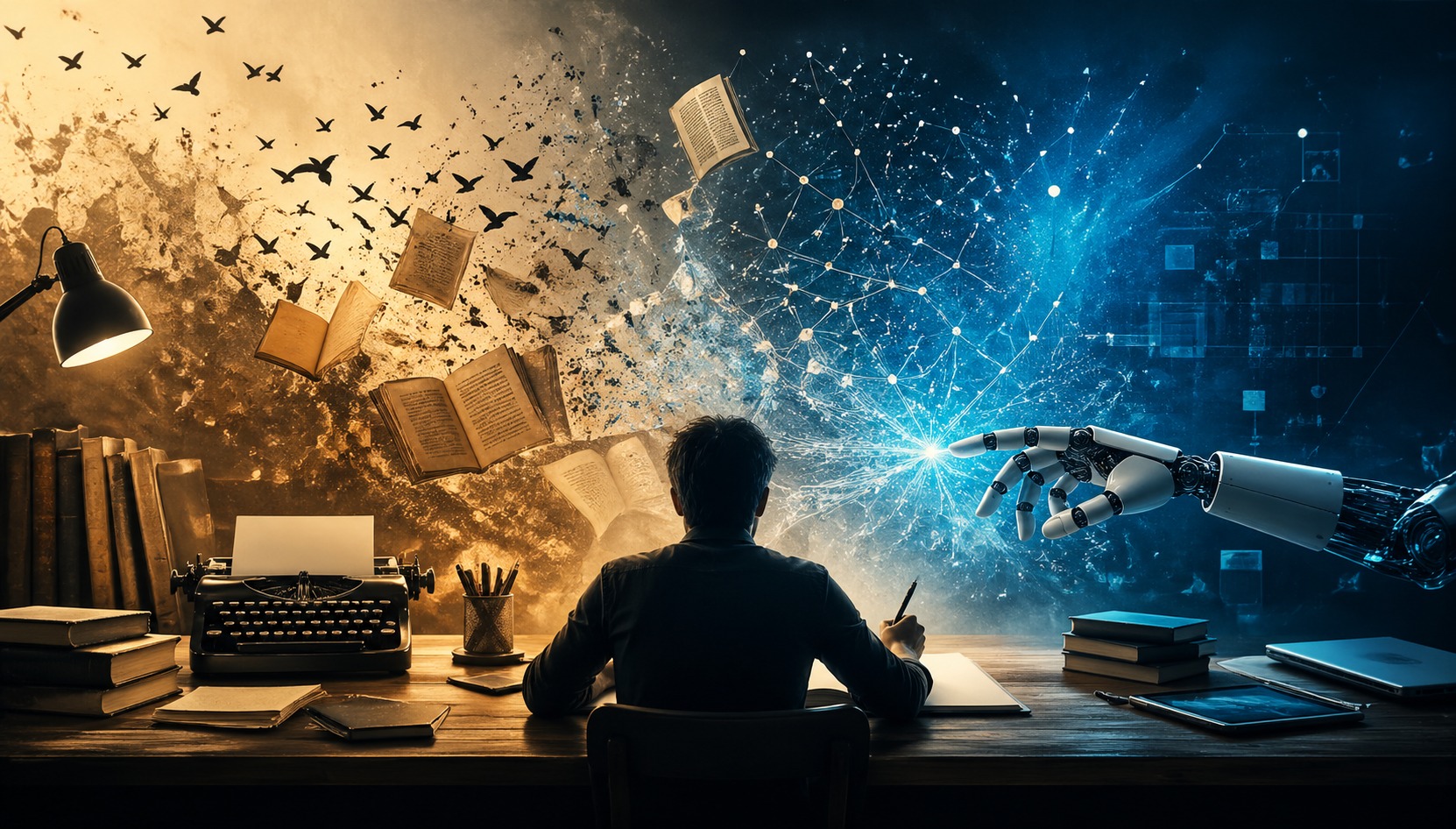
Writing may be changing from bricklaying to architecture. The machine may place many of the bricks, but humans must still decide what kind of building deserves to stand. In that decision lies the future of authorship—and perhaps the future of thought itself.
✦ Chapter 1 — Did Thought Come First, or the Word?
Did humans first feel fear, love, hunger, and wonder—and then create words for them? Or did words themselves sharpen those feelings into something clearer? Ludwig Wittgenstein, in Philosophical Investigations, suggests that language is not just a tool for expression; it shapes the boundaries of our world. We often do not know what we think until we try to say it.
Ancient Indian thought understood this too. In the Bhagavad Gita, words are never casual—they carry duty, action, and consequence. Speech is treated almost as moral architecture. A child feels sadness before learning the word “sad,” but once he learns it, he can organize the storm inside him.
Writing begins here. It is not decoration after thought; it is often the birthplace of thought itself. AI can generate language, but the responsibility of meaning still belongs to us.
✦ Chapter 2 — No Word Means the Same Thing to Everyone
Take the word “freedom.” For someone shaped by Das Kapital, freedom may mean liberation from economic exploitation. For someone deeply formed by the Bhagavad Gita, freedom may mean freedom from attachment and ego. Same word, entirely different universe.
Ngũgĩ wa Thiong’o, in Decolonising the Mind, writes about how language carries memory, identity, and power. A word is never just a dictionary definition. “Home” for one person is warmth; for another, it is exile. “Love” may mean sacrifice to one, danger to another.
This is why writing matters. A sentence is never received exactly as it is sent. Readers bring their childhood, philosophy, and wounds to every paragraph. AI can predict usage patterns, but it cannot fully know the private history standing behind a single word.
✦ Chapter 3 — Not Every AI Text Is AI Slop
Today, people dismiss weak machine writing with one phrase: “AI slop.” Certainly, much of it deserves the criticism—long, polished paragraphs saying nothing. But bad writing existed before AI. The real danger is not machine-generated text; it is outsourced thinking.
Co-Intelligence argues that AI works best not as replacement but as collaboration. If you hand over your judgment, the result feels empty. If you use AI to challenge assumptions, test arguments, and improve clarity, the result can be excellent. The machine amplifies the mind using it.
A calculator did not destroy mathematics; it exposed who understood mathematics and who only memorized steps. AI does the same for writing. If the thought is yours, the tool can help. If the thinking is absent, even beautiful sentences collapse. Slop is not created by AI alone. It is created by indifference.
✦ Chapter 4 — Brevity: The Missing Virtue of AI Writing
The greatest weakness of AI writing is often not inaccuracy—it is excess. It explains too much, repeats too often, and expands what should remain sharp. Good writing respects the reader’s time. AI often mistakes helpfulness for length.
On Writing Well teaches that brevity is not shortness; it is clarity. Blaise Pascal once wrote, “I would have written a shorter letter, but I did not have the time.” Compression requires more thought than expansion.
AI prefers abundance because it is trained to complete patterns. But strong writing depends on omission. Sometimes one clean sentence carries more force than five polished paragraphs. The writer’s job is not merely to generate language but to remove what does not deserve survival. Generation is easy. Deletion is art. Brevity is intelligence under discipline.
✦ Chapter 5 — I Write With AI to Read
I often feel less like a writer and more like a reader. I write with AI to read—to see possibilities, to test thoughts, to notice what feels false and what feels alive. The real work begins after the text appears.
Jorge Luis Borges once imagined paradise as a kind of library. Many writers secretly belong there first. Reading is the hidden root of writing. AI simply makes that process visible. It produces options; I respond with judgment.
Bird by Bird reminds writers that messy drafts are normal. With AI, the draft arrives faster, but authorship remains in selection. What do I keep? What do I reject? What do I rewrite completely?
The writer becomes an editor of possibilities. Typing is no longer the center. Recognition is. Good writing begins not with speaking, but with knowing what deserves to be heard.
✦ Chapter 6 — Oxford Comma and Dashes, My Foot
Writers love small wars—Oxford commas, em dashes, semicolons, British spelling versus American spelling. Entire reputations are defended with punctuation marks. These things matter, but only to a point. If the thought reaches the reader honestly, the sentence has already done its most important work.
The Elements of Style is useful, but sometimes writers begin worshipping rules more than meaning. A perfect comma cannot rescue an empty idea. A flawed sentence carrying truth often survives far longer than grammatical perfection.
Fyodor Dostoevsky is a powerful example. His prose can feel messy, repetitive, even emotionally excessive—yet readers return to him because beneath that roughness lies psychological truth. Crime and Punishment is remembered not for punctuation discipline, but for its terrifying understanding of guilt and conscience.
Of course, punctuation can prevent confusion. “Let’s eat, Grandma” is kinder than “Let’s eat Grandma.” But obsession with technical purity often becomes vanity disguised as professionalism. AI is excellent at grammatical polish, and that polish can deceive.
Correctness is not depth. Grammar is a servant, not a king. Readers remember truth, not commas. Thought must lead; punctuation can walk quietly behind.
✦ Chapter 7 — Writing With AI Is a Skill, Not a Shortcut
People imagine AI writing as pressing a button and receiving brilliance. Reality is messier. You prompt, redirect, reject, clarify, and sometimes delete everything and begin again. It feels less like magic and more like supervising a talented but overconfident intern.
Co-Intelligence makes this clear: collaboration requires judgment. Sometimes AI takes you exactly where you did not want to go—toward cliché, over-explanation, or emotional dishonesty. Pulling it back takes precision.
Many times, I have spent more words controlling AI than I would have spent writing alone. The machine is fast, but speed without direction becomes delay. Writing with AI is not automation; it is negotiation.
A weak writer asks for paragraphs. A strong writer asks for possibilities. The skill lies not in generating text, but in steering thought. Good collaboration is harder, not easier.
✦ Chapter 8 — Imagination Is the Writer’s Greatest Power
People often think writing is mainly about grammar, vocabulary, or craft. These matter, but they are not the engine. Imagination is. A writer does not begin by saying, “Let me be correct.” He begins by saying, “Let us imagine.”
Albert Einstein said imagination is more important than knowledge. Before equations, he imagined riding beside a beam of light. That image changed physics. Writers work the same way. Before plot comes possibility.
Zen in the Art of Writing celebrates this creative fire—the strange first spark that arrives before structure. AI can polish, expand, and decorate, but it rarely originates that first irrational leap.
Grammar refines. Craft organizes. But imagination creates the world itself. Without it, writing becomes furniture arranged inside an empty room. The true power of a writer is not sentence-making. It is world-making.
✦ Chapter 9 — A Writer Begins With: Let Us Imagine
Every real writer opens a door with the same quiet phrase: let us imagine. Imagine a city where memories can be bought. Imagine a scientist who falls in love with a star. Imagine a classroom where failure is celebrated. Writing begins not with certainty, but with possibility.
Letters to a Young Poet speaks of writing as inner necessity, not performance. The first movement is not technical—it is visionary. Before structure comes desire. Before language comes permission.
This applies beyond fiction. Martin Luther King Jr. moved people not only with policy but with imagination: “I have a dream.” Vision persuades before logic organizes.
AI can assist here by testing alternate paths and hidden consequences, but the first leap still belongs to the human mind. The machine responds; it does not long for anything. Writing begins where longing meets imagination.
✦ Chapter 10 — Art Evolves With Technology
Every generation fears its new technology will destroy art. When printing arrived, people feared memory would weaken. When typewriters spread, some believed intimacy would disappear. When computers came, many thought serious writing would die inside glowing screens. Yet literature survived all of them.
Friedrich Nietzsche reportedly noticed that his writing changed after he began using a typewriter. Tools do not simply assist expression—they reshape it. The form changes; the human need remains.
Amusing Ourselves to Death reminds us that every medium influences thought itself. AI is another such moment, though larger. It participates in composition, not just delivery.
The question is not whether art will change—it always does. The real question is what must remain unsurrendered: judgment, imagination, responsibility. Technology evolves. Human meaning must keep pace.
✦ Chapter 11 — Make AI Your Servant, Not Your Master
Every useful tool carries a hidden temptation: dependence. Pens extended memory, calculators reduced arithmetic strain, computers outsourced recall. AI extends language itself. That power is useful—but dangerous if it quietly becomes authority instead of assistance.
George Orwell warned against ready-made language because it allows thoughtlessness. AI may be the greatest ready-made language machine ever built. If you stop asking, “Do I believe this?” and only ask, “Does this sound good?” authorship has already shifted.
Voice is not decoration; it is judgment. It includes awkward but honest sentences, strange rhythms, and personal stubbornness. AI prefers smoothness. Human writing often lives in useful roughness.
The principle is simple: AI must remain a servant. It may carry the luggage, but it must never choose the destination. Fluency is not wisdom. The writer must remain morally and intellectually awake.
✦ Chapter 12 — The Brain Learns to Coexist
Humans adapt faster than they fear. We once resisted calculators, typewriters, and computers too. Each tool looked like a threat to intelligence; eventually it became part of ordinary life. AI is another such moment.
The Shallows warns that technology changes attention itself. That warning matters. Convenience can quietly weaken capability. But adaptation is also real. The brain learns to coexist, and often to master what first frightened it.
Pens changed memory. Computers changed research. AI changes composition. The question is not whether our minds will adjust—they will. The question is whether we guide that adjustment consciously.
Tools should increase depth, not replace it. If AI helps us think better, it becomes progress. If it teaches us to avoid thinking, it becomes dependency. Human history suggests both are possible. Mastery depends on intention.
✦ Chapter 13 — The Next Generation Must Learn Harder Lessons
People assume AI will make learning easier. In some ways, it will. Answers arrive instantly. Drafts appear in seconds. Summaries replace struggle. But convenience hides a danger: the loss of difficulty.
Make It Stick shows that real learning often depends on effortful retrieval and frustration. You remember the mathematics problem that made you struggle, not the one instantly solved for you. Difficulty is not the enemy of learning—it is often the teacher.
If AI can do average work, humans must become stronger in originality, judgment, and endurance. Deep Work argues that focused effort is becoming rarer and therefore more valuable.
The next generation will need sharper minds, not softer habits. Easy tools raise the bar. The future rewards those who still choose hard lessons, even when shortcuts are available everywhere.
✦ Chapter 14 — From Bricklayer to Architect
Writing is changing. Earlier, the writer often worked like a bricklayer—placing each sentence carefully, building paragraph after paragraph by hand. Now AI can handle much of that labor. The writer increasingly becomes the architect.
Framework matters more than volume. Structure, argument, tension, and meaning become more valuable than manually drafting every line. In many forms of writing, authorship shifts from typing to design.
But bricklaying still matters—especially for beginners. Children must still learn to write sentence by sentence, just as musicians still practice scales despite digital production tools. Neural growth happens through effort. Outsourcing too early weakens the foundation.
The Talent Code reminds us that mastery grows through repetition and difficulty. So the future is not either-or. One must do both: learn to place bricks and learn to design buildings. The writer must remain both craftsman and visionary.
✦ Epilogue — The Writer Remains
Perhaps the greatest mistake in conversations about AI writing is that we speak as if writing were only typing. As if authorship were merely the physical act of placing one word after another. But writing was never just that. Writing was always selection, judgment, silence, imagination, and responsibility. The hand was only one part of the process; the mind was always the true workshop.
A machine can now produce paragraphs in seconds. It can imitate tone, structure, elegance, even emotion. It can sound wise without having suffered, and sound intimate without having loved. This is impressive—but imitation is not consciousness. Fluency is not meaning. A sentence may be grammatically perfect and still morally empty.
The writer’s work, then, does not disappear. It becomes sharper. The responsibility increases. In a world overflowing with generated language, discernment becomes a moral act. To decide what is true, what is necessary, what is beautiful, and what should remain unsaid—this is authorship.
The future writer may type less and think more. He may become less of a bricklayer and more of an architect, designing the structure while machines assist with construction. But even the best architect once learned by carrying stones. Foundations still matter. Difficulty still matters. The slow apprenticeship of thought cannot be outsourced without consequence.
The next generation will inherit extraordinary tools. Their challenge will not be access to information, but depth of attention. Not speed of production, but seriousness of judgment. They must learn how to remain human in the presence of effortless fluency.
Perhaps that is the final lesson: AI does not ask us to defend writing; it asks us to define it. If writing is only arrangement, machines will surpass us. If writing is imagination, conscience, and the courage to say what has not yet been said, then the writer remains irreplaceable.
The tool has changed. The responsibility has not.
✦ Appendix —  Books Behind This Article
Philosophical Investigations — Ludwig Wittgenstein
On how language shapes thought, reality, and the limits of understanding.
Bhagavad Gita — traditionally attributed to Vyasa
For the philosophical depth of words like duty, action, freedom, and detachment.
Das Kapital — Karl Marx
For understanding how words like labor, freedom, and justice carry social and economic meaning.
Decolonising the Mind — Ngũgĩ wa Thiong’o
On language as identity, memory, and power.
On Writing Well — William Zinsser
A masterclass in clarity, brevity, and respect for the reader’s time.
On Writing — Stephen King
Practical lessons on discipline, revision, and honest writing.
Bird by Bird — Anne Lamott
For messy drafts, imperfect beginnings, and the emotional reality of writing.
Several Short Sentences About Writing — Verlyn Klinkenborg
A deep lesson in brevity and sentence-level clarity.
The Elements of Style — William Strunk Jr. and E. B. White
Classic guidance on grammar and style—useful, and sometimes worth arguing with.
Zen in the Art of Writing — Ray Bradbury
Pure creative fire—on imagination, energy, and the joy of making worlds.
The War of Art — Steven Pressfield
On resistance, discipline, and creative courage.
Letters to a Young Poet — Rainer Maria Rilke
Reflections on inner necessity and why writing must come from within.
Steering the Craft — Ursula K. Le Guin
Craft taught through imagination rather than rigid formulas.
Co-Intelligence — Ethan Mollick
How to work with AI without surrendering judgment or authorship.
The Shallows — Nicholas Carr
How technology changes attention, focus, and the quality of thought.
Amusing Ourselves to Death — Neil Postman
On how media shapes thinking, seriousness, and public discourse.
The Second Machine Age — Erik Brynjolfsson and Andrew McAfee
Understanding how technological shifts transform work and creativity.
Make It Stick — Peter C. Brown, Henry L. Roediger III, and Mark A. McDaniel
Why difficulty and struggle are essential for real learning.
Deep Work — Cal Newport
On focus, concentration, and serious intellectual labor.
Atomic Habits — James Clear
How small repeated actions shape long-term mastery.
The Talent Code — Daniel Coyle
Why mastery grows through repetition, difficulty, and deliberate practice.