

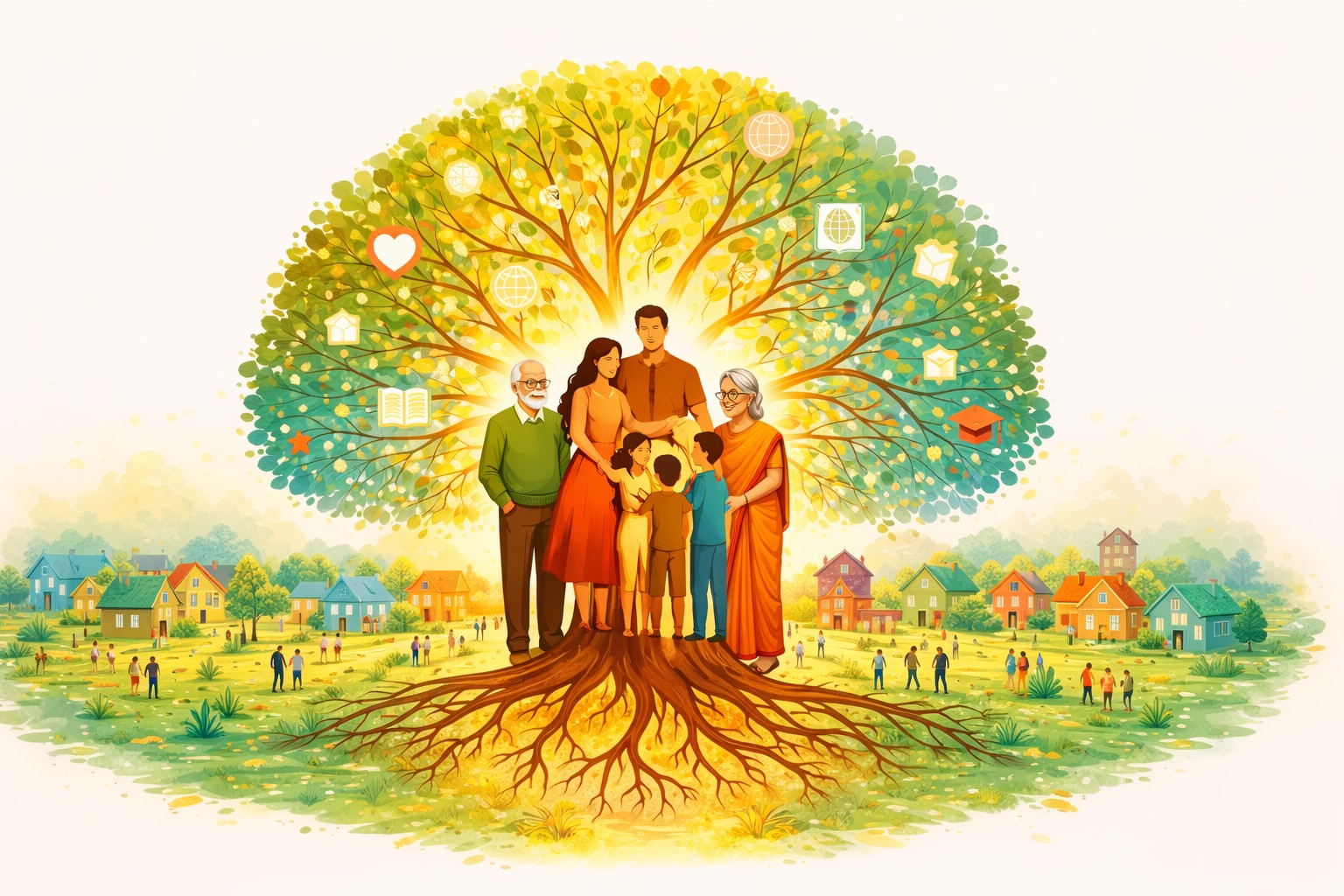
✦ Chapter 1 — The First Room We Enter
Family is the first room we ever step into—long before school, society, or success. It is where the nervous system learns whether the world is safe or sharp. A child doesn’t analyze love; he absorbs it. The tone of voices, the pauses at dinner, the way mistakes are handled—these quietly wire the future adult.
What we call “personality” often begins as atmosphere. Calm homes raise calm reflexes. Chaotic homes teach vigilance. Neither is chosen; both are learned early.
That is why family matters not as an institution, but as an environment. It is not about rules or roles. It is about the emotional climate in which a human being first learns how it feels to exist.
✦ Chapter 2 — Belonging Before Becoming
Before a person can dream, he needs ground beneath his feet. Family provides that ground. It whispers, you belong, even before the world asks, what can you do?
People who feel securely held at home dare more outside it. They fail without collapsing. They explore without panic. Achievement grows best when it is not burdened with proving worth.
This is why belonging precedes ambition. A child who feels loved does not chase validation desperately; he carries quiet confidence.
Family, at its best, gives permission to become—not by pushing, but by standing steady. It says: you may go far, but you are not exiled if you fall.
✦ Chapter 3 — Love Is Not One Language
Families fracture not because love is absent, but because it is untranslated. One person shows care through action. Another waits for words. A third needs time, not advice.
When love is offered in the wrong language, it feels invisible. A hardworking parent may feel unappreciated; a lonely child may feel uncared for—while both believe they are loving deeply.
Strong families learn this humility: my way of loving is not the only way love is felt.
The work of family is not intensity, but attunement. To notice how the other receives care. To adjust without resentment. Love becomes durable when it is flexible.
✦ Chapter 4 — The Quiet Power of Ritual
Families are not held together by big moments, but by small repetitions. Dinner at the same hour. A story before sleep. A shared prayer. A familiar joke.
These rituals are not habits; they are anchors. They tell the nervous system: life has a rhythm. Even in chaos, something remains stable.
Years later, people don’t remember advice. They remember these moments—the smell of food, the sound of laughter, the silence that felt safe.
Rituals turn time into memory. And memory into belonging. This is how family outlives circumstance.
✦ Chapter 5 — Conflict Is a Sign of Closeness
Conflict does not mean family is failing. It means people care enough to collide. Distance avoids friction; intimacy invites it.
What matters is not the presence of conflict, but the way it is handled. Homes that allow disagreement without humiliation raise adults who can argue without cruelty.
In unhealthy families, conflict becomes power. In healthy ones, it becomes information.
Children learn here whether anger destroys love—or whether love can hold anger without breaking. This lesson quietly shapes every future relationship.
✦ Chapter 6 — Listening Is the First Repair
Most family wounds deepen not because someone was wrong, but because no one felt heard. Advice is cheap. Presence is costly.
Listening requires suspension of ego. It means staying with discomfort without fixing it immediately. It tells the other person: your inner world matters.
When listening disappears, silence fills with assumption. And assumption slowly hardens into resentment.
Families heal less through solutions and more through attention. A listening home does not eliminate pain—but it prevents pain from turning poisonous.
✦ Chapter 7 — Children Learn What Is Lived
Children do not inherit values from speeches. They inherit them from mornings, from stress, from how adults behave when tired.
They learn generosity by watching sharing. They learn respect by observing disagreement. They learn love by seeing repair.
This is why family is the most powerful moral teacher—not because it tries to teach, but because it cannot help but demonstrate.
Everyday life is the curriculum. And every adult at home is already teaching—whether consciously or not.
✦ Chapter 8 — The Long Work of Forgiveness
Families last only because forgiveness keeps happening—often imperfectly, often without ceremony. Without it, memory becomes a burden no one can carry.
Forgiveness in families is rarely dramatic. It looks like continuing to cook. Continuing to ask. Continuing to sit in the same room despite unresolved hurt.
This does not mean forgetting harm. It means choosing relationship over permanent withdrawal. Over time, this choice teaches a crucial lesson: love is not fragile.
Children raised with forgiveness learn that mistakes are survivable. That relationships can bend without breaking. This becomes their inner resilience long after home is left behind.
✦ Chapter 9 — When Illness Enters the Room
Mental illness does not arrive alone; it reshapes the entire household. Roles blur. Patience is tested. Love becomes quieter and heavier.
Families often discover their depth here—not through heroism, but through endurance. Showing up repeatedly. Accepting limits. Learning compassion without control.
In such homes, perfection dissolves. What remains is care. Sometimes exhausted. Sometimes confused. Still present.
These families teach a rare truth: strength is not loud. It is the willingness to stay when solutions are absent. That lesson stays with children forever.
✦ Chapter 10 — Tradition: Shelter and Shadow
Tradition offers continuity. It gives families roots, language, and shared meaning. Festivals, customs, and stories stitch generations together.
But tradition can also become rigid—demanding obedience instead of understanding. When tradition stops listening, it turns from shelter into shadow.
Healthy families do not abandon tradition; they converse with it. They ask what to preserve and what to release.
In doing so, they teach children discernment: respect the past without becoming trapped by it. This balance is one of family’s greatest gifts.
✦ Chapter 11 — Presence Over Provision
Families often mistake providing for being present. But children rarely remember what was bought; they remember who was there.
Presence is not time measured in hours, but attention without distraction. A shared walk. An unhurried conversation. A moment of full listening.
Provision keeps bodies safe. Presence keeps souls steady.
When families prioritize presence, they communicate a powerful message: you matter more than outcomes. This becomes the child’s inner voice in moments of doubt.
✦ Chapter 12 — Flexibility Is Family Strength
Life changes people—roles shift, responsibilities reverse, power redistributes. Families that survive are those that adapt without humiliation.
Children grow. Parents age. Certainty erodes. Rigid families crack under this pressure.
Flexible families adjust with dignity. They allow leadership to change hands. They permit vulnerability.
From such homes emerge adults who do not panic at change. They have seen love remain intact even as structure transformed.
✦ Chapter 13 — Family as Society’s First Draft
What is practiced at home gets exported into the world. Power dynamics, conflict styles, care patterns—all are rehearsed first in family life.
Homes that normalize shouting create louder societies. Homes that normalize listening create calmer ones.
This is why family is not private—it is foundational. It quietly shapes institutions, workplaces, and nations.
When families function with respect and responsibility, society inherits those habits without legislation.
✦ Chapter 14 — Carrying Home Forward
Strong families do not bind; they equip. Children raised with security do not escape home—they carry it within them.
Home becomes an internal compass. A way of relating. A memory of how it feels to be held during uncertainty.
Even when families are imperfect, what matters is repair. That love can return after rupture.
This is the final gift of family: not protection from pain, but the capacity to endure it without losing oneself.
✦ Epilogue — What Family Quietly Does
Family does not promise happiness. It offers something subtler and stronger.
It teaches how to stay. How to forgive. How to listen. How to belong without disappearing. It prepares human beings for a world that will not always be kind.
Long after names fade and houses change, the emotional grammar learned at home continues to shape every relationship.
Family is not about controlling life.
It is about learning how to hold life—together.

Books for Further Reading — Family as a Living Unit

The Five Love Languages — Gary Chapman
How care, affection, and attention are received differently within families—and why translation matters more than intention.
The Seven Principles for Making Marriage Work — John Gottman
Research-backed insights into communication, repair, and emotional safety—the invisible architecture of stable families.
Raising Grateful Kids in an Entitled World — Kristen Welch
On cultivating gratitude, responsibility, and empathy within everyday family life.
It Takes a Family — Rick Santorum
A social and cultural argument for why families matter—not just privately, but for the health of society.
Little Women — Louisa May Alcott
A timeless literary portrait of siblinghood, moral growth, and love shaped by hardship and tenderness.
A Place for Us — Fatima Farheen Mirza
A deeply human novel about tradition, fracture, forgiveness, and the ache of belonging within a family.
Em and the Big Hoom — Jerry Pinto
A quiet, devastatingly compassionate exploration of family, mental illness, endurance, and care.
Far from the Tree — Robin Benway
On identity, adoption, and how family is sometimes found rather than inherited.
The Corrections — Jonathan Franzen
A modern examination of family dysfunction, generational tension, and the difficulty of repair.
Apples Never Fall — Liane Moriarty
A contemporary look at marriage, parenting, secrets, and the stories families tell themselves.
✦ 10 Actionable Ways Families Shape the World Quietly
✩ Create one non-negotiable daily ritual
A shared meal, evening walk, or 10 minutes of conversation—something that happens regardless of mood or schedule.
✩ Translate love consciously
Ask each family member how they feel most cared for, then act in that language for one week.
✩ Practice repair out loud
Apologize clearly when you’re wrong. Let children hear adults say, “I messed up.”
✩ Listen once without fixing
When someone shares a problem, respond only with understanding—no advice, no solutions.
✩ Normalize gratitude verbally
Say “thank you” for ordinary efforts: cooking, helping, showing up. Make appreciation audible.
✩ Protect distraction-free time
Phones away during meals or conversations. Attention is the currency of care.
✩ Hold one family story alive
Regularly retell a story of struggle, kindness, or resilience from your family history.
✩ Argue with rules
No insults. No bringing up the past. Pause when voices rise. Children learn conflict from this.
✩ Adjust roles when life changes
Let responsibility shift naturally during illness, stress, or transition—without shame.
✩ Show presence in small moments
Sit beside someone when they’re quiet. Stay instead of asking questions. Sometimes that’s enough.