
Introduction — A Light That Refused to Dim
When people speak about great scientists, one name shines with quiet brilliance: Marie Curie. Her life is one of the most powerful reminders of what determination can achieve even in the face of deep barriers.
Marie Curie was born in Warsaw in 1867 at a time when women were largely excluded from higher education. She could not initially study at a university in her own country because many institutions simply did not admit women. To pursue knowledge, she worked as a governess for years, saving money so she could eventually move to Paris and study at the University of Paris (the Sorbonne). Life there was harsh. She lived in a tiny attic room, often studying late into freezing nights, sometimes too poor to afford proper heating or food.
Yet curiosity carried her forward. Together with her husband Pierre Curie, she began investigating mysterious rays emitted by certain minerals. Their research led to the discovery of two new elements — Polonium and Radium — and opened the door to the science of radioactivity.
Her achievements were extraordinary. In 1903 she shared the Nobel Prize in Physics with Pierre Curie and Henri Becquerel. Later, in 1911, she received the Nobel Prize in Chemistry for discovering radium and polonium. She remains the only person in history to win Nobel Prizes in two different scientific fields — physics and chemistry.
But beyond the medals and discoveries lies a deeper story. Marie Curie worked in primitive laboratory conditions, stirring heavy vats of ore by hand and exposing herself unknowingly to radiation. She also faced skepticism and prejudice simply because she was a woman in a male-dominated scientific world.
Her life illustrates a truth that resonates deeply with the spirit of International Women’s Day: the pursuit of knowledge and excellence often demands courage not only against nature’s mysteries, but also against society’s expectations.
As Marie Curie once said:
“Nothing in life is to be feared, it is only to be understood.”
This article celebrates the journeys of women across history — thinkers like Gargi Vachaknavi, reformers, scientists, artists, athletes, and everyday heroes — whose courage continues to expand the possibilities for generations to come.
Chapter 1 — Before the Dawn: The Hidden Half of History
For centuries, history books mostly recorded the deeds of kings, generals, and rulers. Yet behind these visible stories stood another force — women whose work sustained families, traditions, and communities. They preserved songs, languages, medicines, and rituals that quietly shaped culture across generations.
Historians now note that women’s labour formed a vast but invisible foundation of society. Even today, studies show that women perform about three times more unpaid domestic work than men in India, according to national time-use surveys. Much of civilization continues to run on work that is rarely acknowledged.
As historian and writer Gerda Lerner once wrote:
“Women have been active participants in history all along, but they have been denied access to the interpretation of it.”
Books such as Women, Gender and History in India encourage us to re-examine history through everyday life — kitchens, fields, classrooms, and courtyards — where much of the real story of civilization unfolds.
Chapter 2 — The Weight of Tradition: Understanding Patriarchy
Patriarchy is not only about authority; it is about patterns that slowly shape expectations. Over centuries, customs regarding inheritance, marriage, and family roles gave men greater control over property and public decision-making.
These norms became deeply embedded in society. For example, according to recent surveys, female labour force participation in India has often remained around 25–30%, partly due to social expectations about domestic responsibilities. Such patterns show how cultural assumptions influence economic realities.
Writer and activist Gloria Steinem once observed:
“The story of women’s struggle for equality belongs to no single feminist nor to any one organization, but to the collective efforts of all who care about human rights.”
The book Patriarchy explains that patriarchy survives most effectively when it appears ordinary — when unequal roles feel like tradition rather than constructed systems.
Chapter 3 — The First Questions: Early Reformers Challenge the Norm
Every transformation begins with someone asking a difficult question. In the 19th century, reformers and educators in India began challenging practices that restricted women’s education and independence.
One of the earliest pioneers was Savitribai Phule, who helped establish the first school for girls in India in 1848. At a time when educating girls was widely opposed, she walked daily to school while facing harassment from those who believed women should remain uneducated.
Savitribai Phule wrote words that still inspire:
“Awake, arise and educate. Smash traditions — liberate.”
Histories like The History of Doing show how such early questions slowly ignited a larger movement for women’s education and dignity.
Chapter 4 — The Revolution of Education
Education quietly transforms societies. When women gain access to knowledge, they acquire tools to question, innovate, and lead.
The expansion of education has already produced dramatic results. According to census data, female literacy in India rose from about 8–9% in 1951 to over 70% today. Each generation of educated girls reshapes expectations for the next.
Astronaut Kalpana Chawla once said:
“The path from dreams to success does exist. May you have the vision to find it.”
Education does more than prepare people for careers. It cultivates curiosity, confidence, and independence — the qualities that allow individuals to imagine a different future.
Chapter 5 — Voices That Refused Silence
As women gained education and awareness, many began organizing collectively. Women’s associations, journals, and social movements emerged across the country during the late 19th and early 20th centuries.
By the time India gained independence in 1947, women were already active in politics, social reform, and the freedom struggle. Today, women represent about 14–15% of members in India’s Parliament, a number that continues to grow with new reforms and representation efforts.
Former Prime Minister Indira Gandhi once reflected on leadership:
“You cannot shake hands with a clenched fist.”
Stories collected in We Also Made History reveal how women from marginalized communities organized movements that combined the fight against caste oppression with the struggle for gender equality.
Chapter 6 — Many Struggles, Many Realities
The experiences of women are shaped by many factors — caste, class, region, and access to resources. A rural agricultural worker, an urban professional, and a student may face very different challenges.
In India today, women constitute nearly 43% of the agricultural workforce, yet many still lack land ownership rights. Such realities highlight the gap between contribution and recognition.
Writer Arundhati Roy once wrote:
“Another world is not only possible, she is on her way. On a quiet day, I can hear her breathing.”
Books like Borders and Boundaries: Women in India’s Partition and The Other Side of Silence remind us that historical events such as Partition affected women in deeply personal ways, often leaving stories that remained unheard for decades.
Chapter 7 — Stepping into the Public World
Over time, women began entering fields that had once been almost entirely male-dominated — science, engineering, medicine, journalism, and administration. Their journeys reshaped institutions and expectations.
Today, women make up around 43% of students in STEM education in India, one of the highest proportions globally, although representation in senior research positions still needs improvement.
Biochemist Kiran Mazumdar-Shaw once said:
“I want to demonstrate that women can lead large and complex businesses.”
Stories in Lilavati’s Daughters highlight the persistence of women scientists who followed curiosity even when institutional support was limited. Each breakthrough quietly widened the path for those who followed.
Chapter 8 — Claiming the Streets
One of the most visible markers of freedom is the ability to move freely. Yet for many women, walking alone at night, travelling in public transport, or simply sitting in a park can still feel unsafe. Surveys across Indian cities have repeatedly shown that a majority of women report feeling unsafe in public spaces after dark, which influences where they work, study, and travel. According to national crime data, tens of thousands of crimes against women are reported each year, reminding us that safety is still a central concern.
The struggle for safe public spaces is therefore not just about crime but about equal citizenship. When women claim streets, parks, and public transport without fear, society begins to redefine what normal freedom looks like. Access to safe mobility also affects economic opportunity — many women decline jobs or educational opportunities because travel feels unsafe.
Writer and activist Kamla Bhasin expressed this powerfully:
“Freedom without safety is not freedom.”
The book Why Loiter? Women and Risk on Mumbai Streets argues that women should not only move with purpose — going to work or school — but also have the right to simply exist, relax, and enjoy public space.
Chapter 9 — Wisdom from the Ancients: Women in the Upanishads
India’s philosophical traditions also contain powerful examples of women thinkers. In the Brihadaranyaka Upanishad, the philosopher Gargi Vachaknavi debates the sage Yajnavalkya in the court of Janaka, asking profound questions about the nature of reality and the universe.
Her questions move beyond rituals and reach the foundations of metaphysics — asking what the cosmos itself is woven upon. Such debates show that intellectual participation of women existed in ancient philosophical traditions, even if later historical periods limited women’s educational opportunities.
Another scholar from the same text, Maitreyi, famously asks Yajnavalkya:
“What should I do with that which will not make me immortal?”
Her question reminds us that women were not only seekers of domestic security but also seekers of knowledge, philosophy, and spiritual liberation — a legacy that continues to inspire modern conversations about education and intellectual equality.
Chapter 10 — The Burden of the Body: Periods, Pregnancy, and Care
Women’s bodies carry unique biological experiences — menstruation, pregnancy, childbirth, and menopause. These processes are natural and essential for human life, yet they have often been surrounded by stigma or silence.
Studies suggest that millions of girls in India miss school during menstruation, largely due to lack of sanitation facilities or social taboos. Globally, maternal mortality has declined significantly, yet hundreds of thousands of women still die each year from pregnancy-related complications, many of which are preventable with proper healthcare.
Writer Chimamanda Ngozi Adichie reminds us:
“Culture does not make people. People make culture.”
Greater awareness, access to healthcare, and open conversations about reproductive health help transform stigma into understanding. When societies invest in maternal health, menstrual hygiene, and reproductive rights, they improve the well-being not only of women but of entire families.
Chapter 11 — Beyond Objectification
Modern media has created new opportunities for women’s visibility, but it has also intensified another challenge: objectification. When women are reduced to appearance rather than intellect or character, their individuality is diminished.
Economic data also reveals another dimension of inequality. Globally, women earn around 20% less on average than men for similar work, and leadership roles remain disproportionately male. In India, women still occupy a relatively small share of senior corporate and political positions, despite increasing participation in education.
Writer Naomi Wolf wrote in her influential work:
“A culture fixated on female thinness is not an obsession about female beauty but an obsession about female obedience.”
The deeper struggle is therefore not only about representation but about recognition of women as complete individuals — thinkers, innovators, and leaders.
Chapter 12 — The Courage to Create
Across India, women have transformed the arts — literature, music, dance, cinema, and painting. Their creativity has expanded how stories are told and whose voices are heard.
Writers like Mahasweta Devi brought marginalized voices into literature, while performers such as M. S. Subbulakshmi carried classical music to global audiences. Today, women are increasingly becoming directors, producers, and creators in cinema, theatre, and digital media.
Cultural industries are also evolving. Women now represent a growing share of writers, filmmakers, and visual artists in India, helping reshape narratives about identity, justice, and community.
Mahasweta Devi once said:
“The writer must have the courage to speak for those who cannot speak.”
Art has often been one of the most powerful ways to challenge social assumptions and imagine new possibilities.
Chapter 13 — Breaking Limits
Sports offer some of the most dramatic examples of women breaking stereotypes. Athletes train with discipline and resilience, often overcoming financial and social barriers along the way.
India has witnessed inspiring achievements from athletes such as P. V. Sindhu, Mary Kom, and Sakshi Malik, whose Olympic medals transformed perceptions of women in competitive sports.
Participation in sports among girls has expanded significantly through school programs and initiatives like Khelo India. Increased visibility of women athletes encourages millions of young girls to see sports as a path of confidence and opportunity.
Mary Kom once said:
“Don’t let anyone tell you that you cannot do something.”
Chapter 14 — The Next Horizon
International Women’s Day is not only about celebrating achievements but also about reflecting on the work that remains. Issues such as safety, equal pay, leadership representation, and access to education still require sustained attention.
Globally, women now account for about half of university students, and in India female literacy has crossed 70%, a remarkable transformation compared to earlier generations. Yet women still represent a smaller share of top political and corporate leadership positions.
Former U.S. First Lady Michelle Obama captured the spirit of possibility:
“There is no limit to what we, as women, can accomplish.”
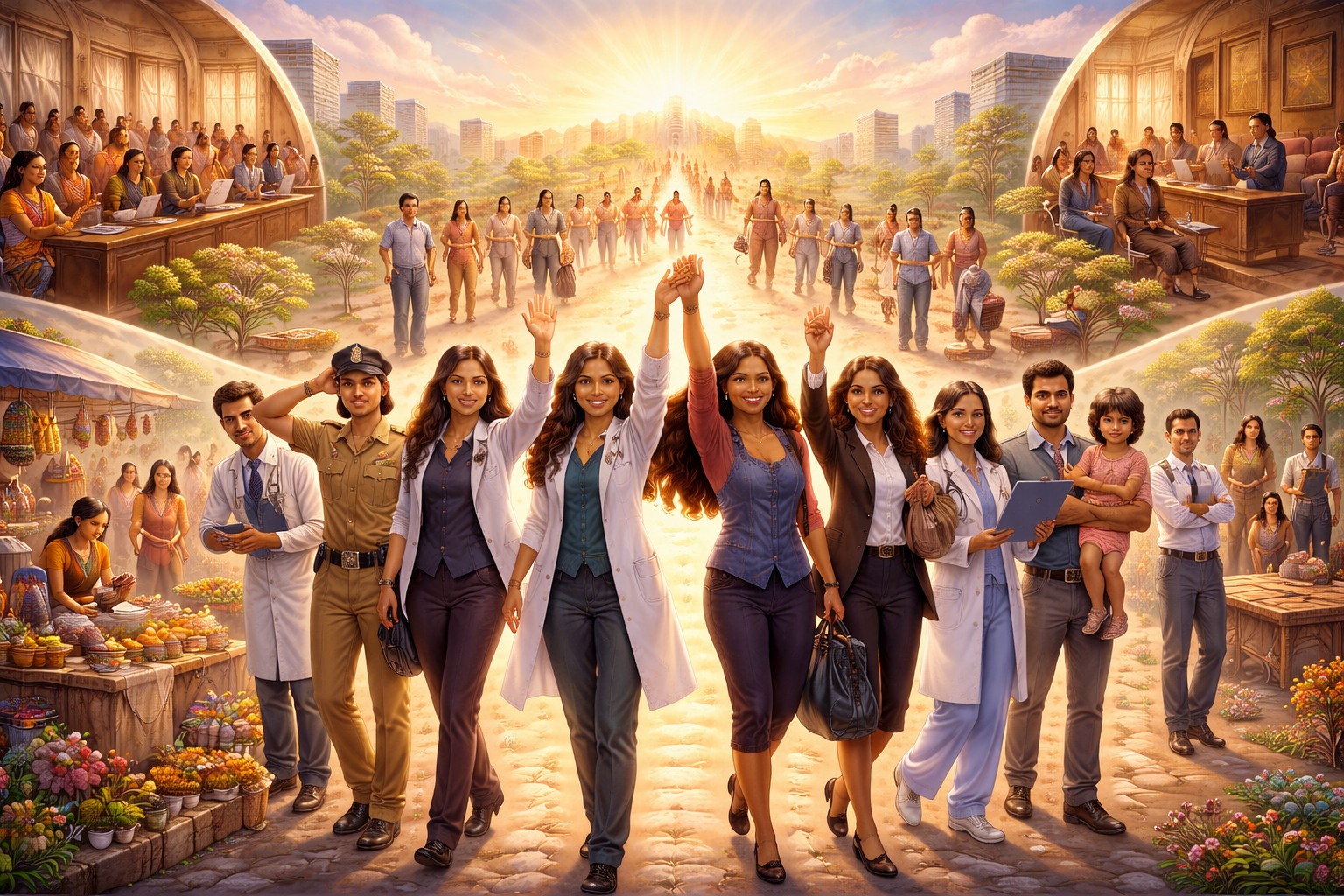
The future of equality will not be built in a single moment or movement. It will grow gradually through education, empathy, policy reforms, and the courage of countless women — and men — who continue to expand the horizon for those who follow.
Epilogue — Walking Together
The story of women’s progress is often told as a struggle against barriers. That struggle is real. Yet the future of equality cannot be built by women alone. It requires the participation, awareness, and empathy of men as well.
Across history, many men have stood beside women in the pursuit of dignity and justice. Social reformers like Jyotirao Phule supported the educational work of Savitribai Phule, helping establish one of the first schools for girls in India. Such partnerships remind us that social change rarely comes from one side alone.
True equality is not a competition between genders; it is a shared human project. When men listen to women’s experiences — about safety, workplace challenges, health, motherhood, and social expectations — understanding deepens and solutions become possible.
Writer Ruth Bader Ginsburg once said:
“Women belong in all places where decisions are being made.”
But for that vision to flourish, workplaces, homes, and institutions must become environments where men and women cooperate rather than compete for dignity.
This means men sharing domestic responsibilities, supporting women’s careers, respecting bodily autonomy, and challenging stereotypes in everyday conversations. Studies repeatedly show that societies where men participate equally in caregiving and household work experience better well-being, stronger families, and healthier economies.
In many ways, the deeper message of International Women’s Day is simple: a just society cannot emerge if half of humanity walks ahead while the other half struggles behind.
The future becomes brighter when both walk forward together.
Appendix — Suggested Books for Further Reading
Below are some insightful books that explore the history, struggles, achievements, and evolving role of women in India and the world.

The History of Doing
A landmark illustrated history of the women’s movement in India, tracing the journey from 19th-century social reforms to modern feminist activism.
Patriarchy
A concise and powerful explanation of how patriarchal systems operate in society, shaping family roles, culture, and institutions.
Women, Gender and History in India
Explores Indian history through the lens of gender, revealing how women’s experiences reshape our understanding of the past.
We Also Made History
A remarkable account of Dalit women’s participation in the Ambedkarite movement, highlighting voices often missing from mainstream narratives.
The Other Side of Silence
A powerful oral history of the Partition of India, revealing how women experienced one of the most traumatic events in South Asian history.
Borders and Boundaries: Women in India’s Partition
Examines the gendered impact of Partition through personal testimonies and historical analysis.
Why Loiter? Women and Risk on Mumbai Streets
A fascinating exploration of women’s right to public space and the importance of freedom of movement in urban environments.
Lilavati’s Daughters
An inspiring collection of essays about Indian women scientists and their journeys in research and discovery.
Lady Doctors
The untold story of India’s first women doctors who overcame enormous social resistance to practice medicine.
Seeing Like a Feminist
A thought-provoking introduction to feminist thinking in contemporary India, addressing everyday gender inequalities.
The Moment of Lift
Explores how empowering women improves societies worldwide through education, health, and economic opportunity.
Inferior
A scientific investigation that dismantles myths about biological differences between men and women.
Becoming
A deeply personal memoir about identity, ambition, and the power of perseverance.
I Am Malala
The inspiring story of a young girl who stood up for girls’ education and became a global symbol of courage.
15 Action Points for Advancing Gender Equality
1. Universal Access to Quality Education
Ensure every girl completes at least secondary education through scholarships, safe transport, and digital learning platforms. Education remains the strongest predictor of women’s empowerment.
2. Strengthen Women’s Health Systems
Expand access to reproductive healthcare, menstrual hygiene products, maternal care, and mental health services. Public health policy must treat women’s health as a central development issue.
3. Safe Public Infrastructure
Improve street lighting, surveillance, safe public transport, and responsive policing so women can move freely in cities and villages.
4. Equal Pay and Workplace Transparency
Encourage companies to publish gender pay data and implement equal pay policies. Closing pay gaps strengthens economic growth and fairness.
5. Shared Parenting Policies
Introduce paid parental leave for both mothers and fathers. Shared caregiving helps reduce career penalties faced by women after childbirth.
6. Gender-Sensitive School Curriculum
Integrate lessons about equality, consent, respect, and shared responsibility in school education.
7. Digital Empowerment
Provide women with access to smartphones, digital literacy, and online financial tools so they can participate fully in the digital economy.
8. Property and Land Rights
Strengthen legal frameworks and awareness programs that allow women to inherit and own land or property.
9. Encourage Women in STEM
Scholarships, mentorship programs, and visible role models can increase women’s participation in science and technology fields.
10. Representation in Media and Culture
Promote diverse and realistic portrayals of women in films, media, and literature to counter stereotypes.
11. Political Representation
Increase women’s participation in political decision-making through leadership training, electoral support, and institutional reforms.
12. Equal Access to Sports
Invest in sports infrastructure and training programs for girls to build confidence, leadership, and health.
13. Engage Men and Boys
Programs that educate men about gender equality, consent, and shared responsibilities are essential for long-term cultural change.
14. Support Women Entrepreneurs
Provide easier credit, mentorship, and market access for women-led businesses.
15. Build Cross-Disciplinary Collaboration
Encourage collaboration between governments, universities, civil society, and technology sectors to address gender issues holistically.