

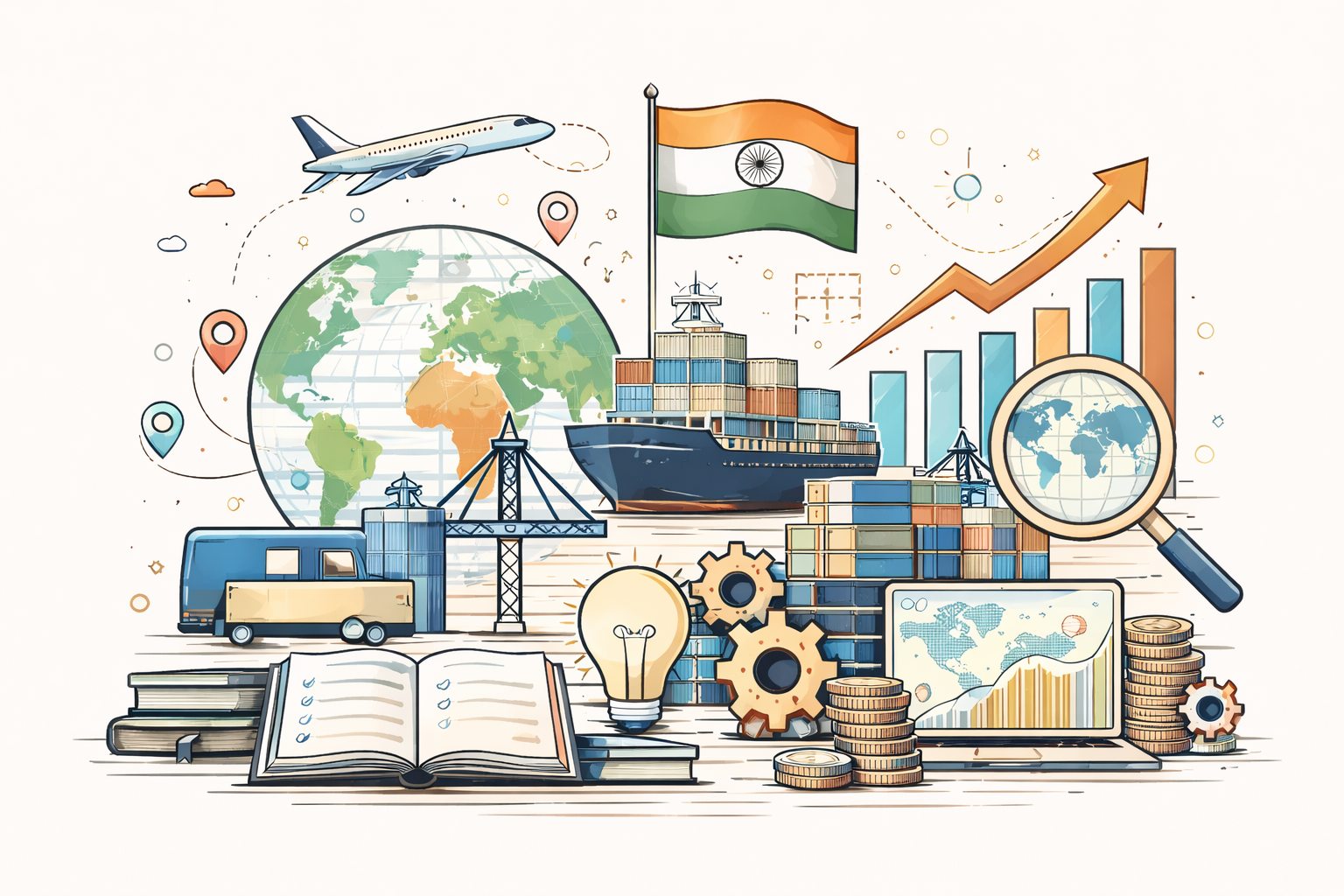
Prelude: The Scale of the Ocean We Are Entering
Global merchandise and services trade today is roughly USD 32–34 trillion annually. This is the real marketplace of the modern world—larger than the GDP of any single nation, and growing not just in volume but in complexity.
India, despite being the most populous country on Earth, commands only about 2.1–2.3% of global exports. China exports nearly 14%, Germany around 7%, even smaller nations like South Korea and Vietnam punch far above their demographic weight.
This gap is not a moral failure. It is an intellectual one—a failure of how we think about production, scale, incentives, quality, risk, and time.
So, this article does not begin with schemes. It begins with minds.
Chapter 1: Think Like Feynman — Eliminate Variability
Richard Feynman believed understanding begins when excuses end. If he examined Indian exports, he would not ask how to increase volume. He would ask why shipments fail. In many Indian manufacturing exports, failure is not dramatic; it is subtle. Tolerances drift. Finishes vary. Documentation mismatches creep in. None of these are fatal individually, but together they destroy trust.
Globally successful exporters obsess over small errors. They measure them, publish them internally, and redesign processes to eliminate them. India rarely does this systematically. Rejected consignments are treated as accidents, not evidence.
If India learns to study export failure the way aviation studies crashes, quality will improve faster than any subsidy can deliver.
→ Product to master: precision-engineered components—fasteners, bearings, valves—where global demand is large and success depends entirely on consistency.
Chapter 2: Think Like Einstein — Shift the Buyer’s Frame
Einstein taught that reality changes with perspective. India evaluates exports from the producer’s frame: cost, incentives, margins. Global buyers operate from a different frame: risk. They ask whether quality will be identical across batches, whether delivery will match their production schedule, and whether policies will remain stable.
Vietnam’s rise as a manufacturing exporter did not come from dramatic innovation. It came from aligning its systems to the buyer’s clock. Ports, customs, refunds, and approvals were designed to fit global supply chains.
India still expects buyers to adjust to domestic administrative rhythms. That mismatch limits integration.
Exports grow when the country internalises how buyers think and redesigns itself accordingly.
→ Product to master: electronics sub-assemblies such as cable harnesses, enclosures, and PCB assemblies that must plug seamlessly into global manufacturing lines.
Chapter 3: Think Like Newton — Build Momentum
Newton showed that motion continues only when friction is controlled. India applies force to exports through schemes and incentives, but friction remains high. Delays, unclear processes, and working-capital stress slow everything down.
Export growth depends less on first orders and more on repeat orders. Once a buyer trusts a supplier across several cycles, switching becomes costly. Momentum sets in.
China’s export rise was not explosive; it was incremental. Each year reduced friction slightly. Over time, this compounded into dominance.
India often celebrates new exporters but neglects the systems that keep buyers returning. Without momentum, exports stall.
→ Product to master: auto components and EV sub-systems—brakes, suspension parts, thermal modules—where long-term supplier relationships matter more than initial pricing.
Chapter 4: Think Like Adam Smith — Specialise Deeply
Adam Smith understood that productivity emerges from focus. India still spreads its export effort thin. Districts chase multiple sectors, hoping something will succeed. The result is shallow capability everywhere.
Where India has specialised, results are visible. Tiruppur in knitwear, Surat in man-made fibres, Morbi in tiles—each became competitive because everyone focused on the same thing. Skills, suppliers, quality norms, and informal learning evolved together.
Export success rarely starts nationally. It begins locally, through obsession.
Trying to export everything weakens learning. Choosing one thing and mastering it accelerates it.
→ Product to master: technical and performance textiles—medical fabrics, industrial filters, protective materials—where global demand is growing and cluster-level expertise matters.
Chapter 5: Think Like Ricardo — Choose What to Drop
David Ricardo’s idea of comparative advantage forces hard decisions. Countries grow not by doing everything, but by doing what they do relatively better—and exiting the rest.
India struggles with exits. Sectors that cannot compete globally continue to absorb attention and capital. This slows upgrading elsewhere.
Successful exporting nations made uncomfortable choices. Japan exited low-end textiles. Korea exited cheap consumer goods. Resources moved toward sectors with long-term advantage.
India must develop the discipline to stop exporting where it consistently loses ground. This is not failure. It is strategic clarity.
→ Product to master: specialty chemicals and intermediates for pharmaceuticals, agrochemicals, and materials science—areas where India’s chemistry talent and process depth already provide an edge.
Chapter 6: Think Like Schumpeter — Allow Renewal
Joseph Schumpeter argued that progress requires creative destruction. Firms must be allowed to fail so better ones can grow.
India often protects exporters as companies rather than protecting exporting capability as a system. Inefficient firms linger. Scale never forms. Technology adoption slows.
Countries that export well allow consolidation. They enable mergers, exits, and reinvention without stigma. What survives is not the firm, but the capability.
Export ecosystems must evolve continuously. Freezing them in place destroys competitiveness.
→ Product to master: consumer durable sub-assemblies—motors, compressors, power modules—where scale, automation, and consolidation are essential for global competitiveness.
Chapter 7: Think Like Weber — Build Institutional Trust
Max Weber showed that capitalism rests on predictable institutions. Trust is not cultural; it is procedural.
Indian IT exports succeeded because contracts were enforceable, service levels were clear, and disputes were resolved efficiently. Manufacturing exporters do not enjoy the same certainty.
When legal and regulatory outcomes are unpredictable, buyers quietly move elsewhere. No incentive compensates for institutional risk.
Exports scale when the system itself becomes trustworthy.
→ Product to master: regulated, compliance-heavy exports such as medical devices, diagnostics, and precision instruments—where institutional reliability is as important as technical capability.
Chapter 8: Think Like Keynes — Stabilise Expectations
John Maynard Keynes understood that uncertainty paralyses investment. Exporters and buyers plan years ahead. Sudden policy changes destroy confidence instantly.
India’s periodic export bans and abrupt rule changes undermine credibility. Buyers respond rationally by diversifying away.
Countries that export well are predictable. Their policies evolve slowly, transparently, and with notice.
Stability is not a luxury. It is a competitive advantage.
→ Product to master: processed food ingredients—spice extracts, plant proteins, nutraceutical inputs—where long-term contracts dominate and policy predictability matters more than innovation.
Chapter 9: Think Like Drucker — Measure the Right Things
Peter Drucker warned that what is measured determines behaviour. India measures export success mainly by value. Leading exporters measure reliability.
On-time delivery, rejection rates, buyer retention, and upgrade speed reveal far more than shipment totals. These metrics drive internal improvement.
Without them, firms optimise for volume, not trust.
Exports improve when measurement shifts from celebration to discipline.
→ Product to master: finished engineering goods—industrial pumps, electrical equipment, tools—where quality is visible and performance metrics can differentiate Indian firms globally.
Chapter 10: Think Like Amartya Sen — Strengthen Human Systems
Amartya Sen reminded us that development expands human capability. Exports are no exception.
Factories cannot sustain quality if workers are unstable. High churn, poor housing, and long commutes erode consistency. Bangladesh’s garment export success rests as much on worker ecosystems as on machinery.
India often treats labour as a variable cost rather than as a system to be stabilised.
Export competitiveness requires investing in worker continuity.
→ Product to master: mid-range garments and footwear—segments where ethical production, quality consistency, and labour stability matter more than ultra-low costs.
Chapter 11: Think Like Solow — Raise Productivity
Robert Solow showed that long-term growth comes from productivity, not inputs. Many Indian exporters rely heavily on labour while underinvesting in technology.
This limits precision, scalability, and consistency. Global buyers increasingly demand automated, data-driven manufacturing.
Productivity is not about replacing workers; it is about amplifying capability.
Export incentives must reward efficiency gains, not just output.
→ Product to master: industrial machinery and capital goods—packaging machines, affordable CNC tools, renewable-energy equipment—where engineering depth and productivity dominate price competition.
Chapter 12: Think Like Taleb — Design for Shocks
Nassim Taleb teaches that systems must survive volatility. Future trade will face geopolitical, climate, and supply disruptions.
Exporters dependent on single markets or rigid production collapse under shocks. Those with modular processes and diversified buyers adapt.
Resilience must be designed, not improvised.
India must build exports that benefit from uncertainty rather than fear it.
→ Product to master: modular and configurable products—machinery, furniture, enclosures—where flexibility allows rapid adaptation to changing global demand.
Chapter 13: Think Like Sun Tzu — Trade Is Strategy
Sun Tzu understood that influence is built quietly. Trade shapes alliances long before diplomacy does.
China used supply relationships to deepen geopolitical presence. Germany uses industrial interdependence to secure markets.
India often separates trade from strategy. This limits long-term positioning.
Exports should reinforce foreign policy, not run parallel to it.
→ Product to master: dual-use and infrastructure-related exports—rail components, power equipment, telecom hardware—that create long-term interdependence with partner countries.
Chapter 14: Think Like the Future — Export Trust
The future of exports belongs to countries that sell solutions, not just products. Trust, integration, and problem-solving will matter more than price.
India’s IT sector proved this in services. The same logic can extend to manufacturing-linked services.
Design, engineering, and R&D integrated with production allow countries to embed themselves deeply into global value chains.
India has the talent. What it needs is process discipline beyond IT.
→ Product to master: engineering services, industrial design, and R&D linked to manufacturing—where India can export thinking, not just things.
Conclusion: From Vision to Execution

To expand India’s share of global exports, the country must focus on systematic operational improvements rather than just conceptual ideas.

Analyse Failures: Study rejected shipments, quality variations, and process gaps. Redesign operations so errors become rare and trust becomes the default.
Specialise Deeply: Focus resources, skills, and infrastructure on sectors where India can genuinely compete. Build cluster-level expertise to accelerate learning and innovation.
Exit Uncompetitive Sectors: Stop investing in areas where India consistently loses ground. Redirect capital and talent to higher-potential industries to allow top sectors to scale faster.
Stabilise Human Systems: Ensure worker continuity through better housing, skill development, and engagement. Consistent, skilled labour underpins reliable quality and repeatable performance.
Maintain Predictable Policies: Minimise abrupt changes, bans, or surprises, and communicate clearly with exporters. Policy stability reduces risk for buyers and encourages repeat orders.
By following these steps, India can move from occasional export success to consistent, scalable global performance, embedding itself deeply into international value chains.
➤ Establish Export Failure Analysis Units in every major export cluster to study rejected or delayed shipments and publish anonymised lessons quarterly.
➤ Redesign export policy around repeat buyers, rewarding firms that sustain long-term international relationships rather than one-time shipments.
➤ Commit to 10-year export policy stability, with no retrospective changes and mandatory notice periods for any future revisions.
➤ Create district-level export specialisations, limiting each district to one or two globally competitive sectors.
➤ Set up local testing, certification, and quality labs within export clusters to reduce dependence on distant approvals.
➤ Introduce a formal Export Exit Policy to phase out sectors that consistently fail global competitiveness benchmarks.
➤ Enable fast-track mergers and acquisitions among exporters to create scale, technology depth, and global presence.
➤ Establish dedicated export commercial courts with six-month resolution timelines for contract and payment disputes.
➤ Mandate on-time delivery, rejection rates, and buyer retention as national export performance indicators.
➤ Integrate port operations, customs, GST refunds, and banking systems into a single digital export workflow.
➤ Expand export-oriented housing, healthcare, and transport for workers in major manufacturing clusters.
➤ Tie export incentives to productivity upgrades, automation, and technology adoption rather than output volume alone.
➤ Encourage market diversification, discouraging dependence on single countries or buyers through risk-weighted incentives.
➤ Align trade diplomacy with export strategy, giving Indian embassies explicit exporter-support mandates.
➤ Create a National Export Playbook Authority to document successful state-level models and fund their replication elsewhere.
➤ Require every state to run at least two export replication pilots based on another state’s proven success.
➤ Build buyer-facing export design cells staffed with global procurement and supply-chain professionals.
➤ Protect export credibility by restricting sudden export bans to extreme emergencies with transparent timelines.
➤ Extend IT-style process certifications to non-IT export sectors such as engineering services, medical devices, and design.
➤ Treat exports as national infrastructure, reviewed annually at the highest political and administrative levels.
Appendix: Inter-State Lessons and What Can Be Replicated

India’s export future will be built by states. Several states have already solved parts of the puzzle.
Gujarat: Long-term policy predictability matters more than subsidies. Other states can replicate stable power tariffs, clear industrial rules, and minimal mid-course changes.
Tamil Nadu: Demonstrates the power of deep clusters. District-level export specialisation, shared skill institutes, and local testing labs can be copied across northern and eastern states.
Telangana: Proves that speed itself is an export advantage. Time-bound approvals, officer accountability, and deemed clearances reduce working-capital stress.
Maharashtra: Illustrates how ports, finance, and firms must work as one system. Export facilitation at ports and faster GST refunds are replicable coastal-state strategies.
Karnataka: Shows that process discipline and certification build trust. This model can be extended to engineering services, design, and R&D exports.
Kerala: Demonstrates that small firms can export if aggregation, branding, and cooperatives are strong—valuable for hill and northeastern states.

National Mechanism Needed: The missing institution is one that forces cross-state replication, documents what works, and funds pilots elsewhere. Without this, lessons remain trapped locally.
Epilogue: Key References on Exports & Trade Strategy

India’s Export Blueprint – Case studies and actionable strategies for building India’s export sectors.
Export-Import Theory, Practices, and Procedures by C. Rama Gopal – Practical insights into India’s export-import mechanisms.
Jugaad Innovation by Navi Radjou – Frugal, creative solutions for resource-constrained manufacturing and exports.
Frugal Innovation by Navi Radjou – Scaling products and services for global markets under cost constraints.
Global Business by Mike W. Peng – Understanding international trade, supply chains, and global competitiveness.
Made in India: Science, Technology, and Manufacturing by K. N. Bajaj – Lessons from Indian industrial clusters and production models.
The World Is Flat by Thomas Friedman – Insights on globalization and how nations compete in international trade.
Trade Policy Review: India by WTO – Official analyses of India’s trade strengths, weaknesses, and opportunities.
Strategic Management: Concepts & Cases by Fred David – Linking policy, industrial strategy, and long-term export growth.
The Lean Startup by Eric Ries – Innovating efficiently for export-ready products in competitive global markets.
Competitive Advantage by Michael Porter – Cluster development, state competitiveness, and trade specialization.
Industrial Clusters and Trade Strategy by Alfred Marshall (classic) – Foundations of cluster-based competitiveness for exports.