

✦ Introduction: A Classroom Where Society Walked In
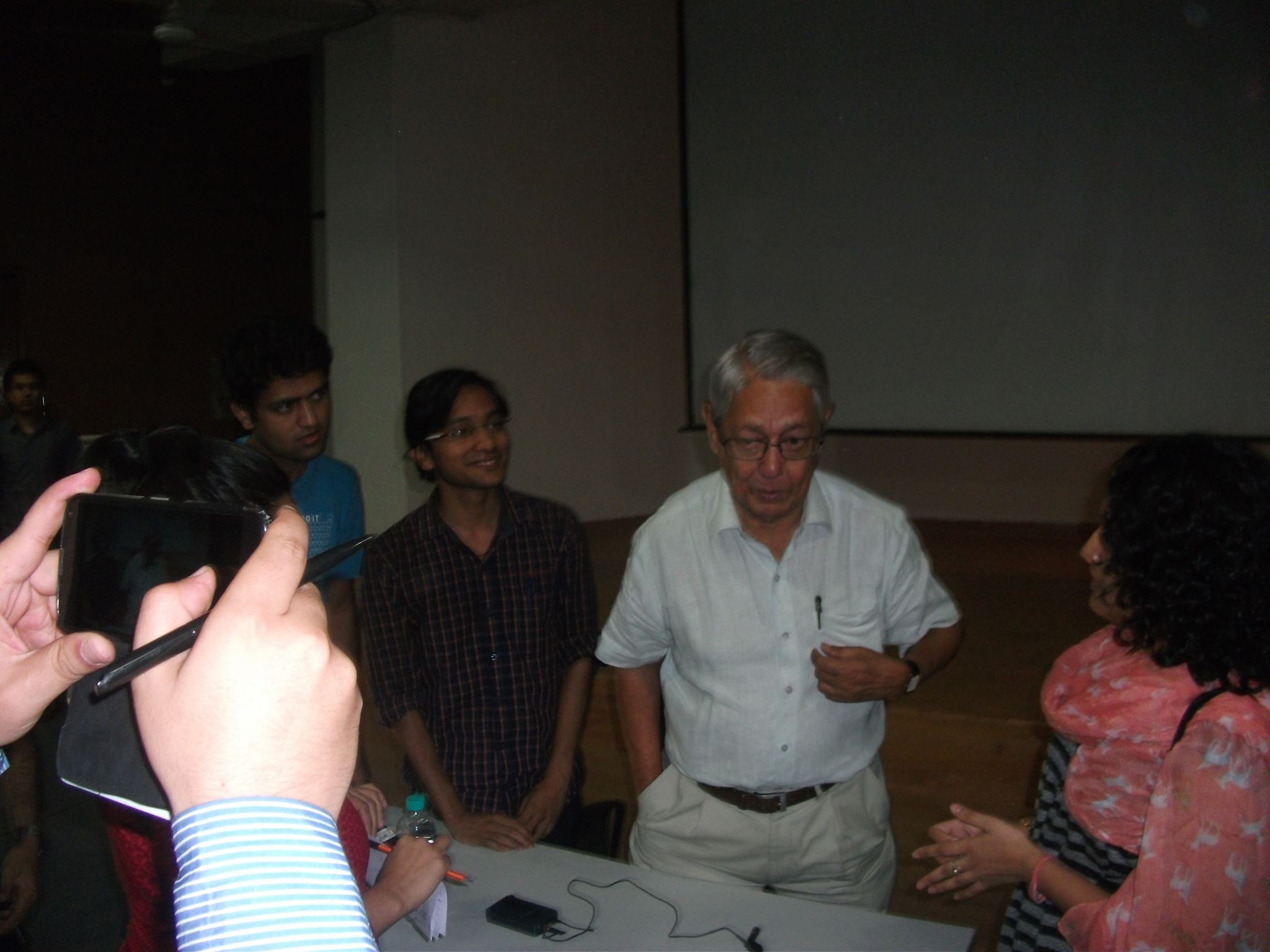
The year was 2013. The place was the SACAC auditorium. An eighty-year-old professor walked in—unhurried, not very tall, his posture marked by the faint bend that comes from long years of looking closely at the world. His hair was white, neatly kept. Thin spectacles rested lightly on his face. He wore a simple white shirt, crisply pressed, a pen tucked into its pocket as if it had always belonged there. There was nothing performative about his presence. No commanding gestures. No dramatic pause. He carried no visible authority except time itself.
People whispered that he was the wisest man in India. He did not acknowledge the label. He did not need to. He came to teach sociology.
The audience was unlikely: engineers, lawyers, designers, writers, entrepreneurs, chartered accountants, historians. People trained to solve problems, optimize systems, construct arguments. He began not with theory or definitions, but with life—family, marriage, caste, kinship, tribes. Ordinary words. Everyday arrangements. Things everyone thought they understood, and almost no one had examined.
His voice was soft, patient, almost conversational. Sentences unfolded slowly, as if inviting thought rather than demanding attention. Every now and then, he would add a gentle line of humor—never loud, never showy. Once, while referring to literature, he mentioned Amitav Ghosh and then paused, smiled faintly, and said, “Yes… another author whose name I keep forgetting.” The room laughed, partly at the joke, partly at the ease with which erudition wore humility.
At another moment, speaking of privilege, he glanced around the hall and remarked—almost casually—that comfort often disguises itself as talent, especially among rich kids. The line landed softly, but it stayed. Sociology, he showed us, did not need accusation. Observation was enough.
Soon, unfamiliar terms appeared on the board: participant observer, Sanskritization. Karthik raised his hand and asked a sharp, utilitarian question. The professor listened without interruption, pen resting quietly in his shirt pocket. Then, calmly, he dismantled the assumption beneath it, ending with a remark so understated that the room laughed a second late—not at Karthik, but at itself. Sociology had begun to work.
There was humor too, unintended and deeply human. Ardra, known for her curly hair and habit of climbing trees, froze when the professor paused mid-sentence, his face completely still. For a moment, a frightening thought crossed her mind—he is eighty… has he passed away? He resumed speaking, exactly where he had stopped. The class exhaled. A few smiled, slightly embarrassed. Sociology, once again, revealing how quickly the mind fills silence with fear.
He would go on to live to ninety-one. But in that auditorium, in that white shirt, with that soft voice—punctuated by patience, precision, and gentle humor—society had already walked in and taken a seat.
✦ Chapter 1: Seeing Beyond Appearances — The Sociological Eye
Sociology begins by unsettling what appears natural. Families feel natural. Authority feels deserved. Inequality feels unfortunate but inevitable. André Béteille’s work consistently challenged this comfort. He insisted that what looks natural is often historical, institutional, and contingent.
In Caste, Class and Power, Béteille showed that village hierarchies were not simply reflections of ritual status. Land ownership, education, political office, and administrative access reshaped influence. Brahmins without land lost authority; non-Brahmins with education gained it. What endured was not caste alone, but structured advantage.
This required a particular stance: that of the participant observer. Béteille neither romanticized nor condemned village life. He observed patiently, allowing complexity to surface. Sociology, in his hands, became an act of disciplined seeing—slower than judgment, firmer than opinion.
To see sociologically is not to lose faith in society. It is to lose faith in appearances.
✦ Chapter 2: Caste, Class, and Power — Why Single Explanations Fail
Public debate often isolates social categories. Caste is discussed without class. Class without power. Power without institutions. Béteille’s lasting contribution was to show that social reality emerges from their intersection.
In Caste, Class and Power, he demonstrated how democratic politics altered caste hierarchies—not by abolishing them, but by redistributing influence. Electoral politics gave numerical strength new weight. Education created new elites. Ritual status alone no longer guaranteed dominance.
Yet Béteille resisted the temptation to declare caste irrelevant. Instead, he showed how caste adapted—embedding itself within new economic and political structures. Hierarchy survived, but its grammar changed.
This sociological realism unsettled both traditionalists and radicals. It replaced moral certainty with analytical patience. The question was never Does caste exist? but How does it operate now, and through which institutions?
✦ Chapter 3: Inequality — Not an Exception, but a Pattern
One of Béteille’s most uncomfortable insights was also one of his most universal: inequality exists in every society. In Equality and Universality, he argued that what distinguishes societies is not the presence of inequality, but how it is justified.
Traditional societies invoked birth. Modern societies invoke merit. Both generate hierarchy. The language changes; the structure persists.
Béteille refused to moralize this observation. His aim was not to normalize inequality, but to understand it clearly. Ideals of equality, he insisted, are meaningful precisely because they confront stubborn realities.
Sociology, therefore, does not ask whether inequality should exist. It asks how it is produced, defended, softened, or denied. Clarity becomes a moral act.
✦ Chapter 4: Equality as an Ideal, Not a Description
Modern institutions speak constantly of equality—before the law, in opportunity, in citizenship. Béteille respected this promise but warned against confusing aspiration with achievement.
In Ideology and Social Science, he showed how institutions proclaim neutrality while reproducing advantage. Universities reward merit—but merit is shaped by language, upbringing, and cultural confidence. Bureaucracies treat citizens equally—but access remains unequal.
For Béteille, equality was not weakened by sociological scrutiny. It was strengthened. Only by recognizing how institutions fall short can ideals retain meaning.
Sociology protects values from hypocrisy by refusing illusion.
✦ Chapter 5: Sanskritization, Westernization, and the Scientific Mind (M. N. Srinivas)
When Béteille spoke of social change, M. N. Srinivas was never far away. Srinivas approached sociology with the precision of a scientist, identifying two key processes—Sanskritization and Westernization—that shaped modern India.
Sanskritization described how lower castes adopted the customs, rituals, and lifestyles of higher castes to improve status. Crucially, Srinivas distinguished this from the fixed varna model. In reality, caste positions could shift. Land ownership, political power, Bhakti movements, hypergamy, and tribalization all facilitated mobility, blurring the boundary between ritual rank and secular authority.
Westernization added another dimension. British rule introduced new institutions, education systems, technologies, and values—especially humanitarianism, egalitarianism, and secularization. Customs once defended as religious became open to rational scrutiny. English became a gateway to professional life. Occupational hierarchies emerged alongside caste ones.
Béteille extended this insight by showing that neither Sanskritization nor Westernization abolished inequality. They reorganized it. Mobility increased; structures endured. Sociology’s task was to trace this movement without illusion.
✦ Chapter 6: Institutions Matter More Than Intentions
In Antinomies of Society, Béteille returned repeatedly to institutions. Good intentions, he argued, do not guarantee good outcomes. Institutions shape behavior long after intentions fade.
Families may value education; schools decide results. Leaders may promise reform; procedures determine survival. Societies function not on ideals alone, but on rules, norms, and constraints.
This institutional focus made Béteille’s sociology sober and durable. It explained why reforms fail, why inequality persists, and why stability sometimes survives incompetence.
Sociology shifts attention from personalities to design.
✦ Chapter 7: Tradition and Modernity — Not Opposites
Andre Béteille consistently resisted the temptation to frame Indian society as a battle between tradition and modernity. In The Idea of Natural Inequality and his village studies, he showed how modern institutions were rarely built on a clean slate. In South Indian villages, electoral politics—supposedly modern—functioned through kinship, lineage, and caste networks. The vote was individual; persuasion was collective. Tradition quietly powered modern mechanisms.
At the same time, Béteille observed that cities did not dissolve hierarchy. In Caste, Class, and Power, he showed how urban professions reproduced privilege through schooling, language, and social networks. The software engineer and the bureaucrat appeared modern, yet their life chances bore the imprint of older social advantages.
Modernity, then, did not destroy tradition. It absorbed it. Change occurred through accommodation, translation, and selective forgetting. This insight saved sociology from nostalgia and from naïve progressivism. Béteille taught that societies move forward without ever fully leaving their past behind.
✦ Chapter 8: Democracy Without Romance
In Society and Politics in India, Béteille approached democracy without reverence or cynicism. He insisted on precision. Political equality, he argued, coexists with deep social inequality. One person, one vote does not mean one person, one influence.
Drawing from empirical observation, he showed how landowners, dominant castes, and educated elites converted social capital into political power. Elections redistributed authority, but they did not erase hierarchy. Democracy managed conflict; it did not abolish it.
For Béteille, this was not a flaw to be lamented theatrically. It was a condition to be understood soberly. Democracy survives not because citizens are equal, but because inequalities are contained within rules. Sociology, in this sense, does not weaken democratic faith. It replaces illusion with durability. By seeing democracy clearly, Béteille made it more credible—not less.
✦ Chapter 9: Education — Mobility and Reproduction
Education, Béteille agreed, opens doors. But he refused to treat it as a moral miracle. In essays on inequality and institutions, he showed how education simultaneously enables mobility and reproduces hierarchy.
Students who enter classrooms with linguistic ease, cultural confidence, and familial guidance extract more value from the same degrees. Credentials are identical; conversions are unequal. Merit exists—but it is socially shaped.
Béteille’s clarity unsettled comfortable beliefs, especially among the educated elite who benefited from the system. Education did not lie. But it did not tell the whole truth either. Sociology, once again, asked us to see the full mechanism—without self-congratulation.
This was not an argument against education. It was an argument against innocence. Institutions promise fairness; society determines outcomes.
✦ Chapter 10: Affirmative Action — Empirical Clarity
Few topics invited more moral noise than affirmative action. Béteille refused the noise. In essays on reservations and equality, he insisted on empirical evaluation. Who benefits? Who remains excluded? What new hierarchies form?
He neither sanctified nor condemned policy. He studied consequences. Reservation, he argued, was not a symbolic gesture—it was an administrative instrument. Like all instruments, it had effects, limits, and unintended outcomes.
By shifting the debate from emotion to evidence, Béteille made sociology uncomfortable. But also indispensable. Justice, he implied, cannot be sustained on slogans alone. It requires measurement, revision, and restraint.
This was sociology at its most demanding: refusing easy virtue, insisting on disciplined judgment.
✦ Chapter 11: Secularism as Institutional Restraint
For Béteille, secularism was not disbelief. It was discipline. In plural societies, survival depends not on shared belief, but on regulated difference.
In his writings on modern institutions, he argued that tolerance is not a sentiment—it is a structure. Secularism works when institutions restrain the impulses of majorities and minorities alike.
This view rejected both religious hostility and sentimental harmony. Faith was allowed; domination was not. The state did not erase religion—it limited its reach.
Béteille’s secularism was sober, procedural, and deeply sociological. It did not promise emotional unity. It promised coexistence. And that, he believed, was a greater achievement.
✦ Chapter 12: Comparative Thinking
Béteille’s comparative method was an antidote to narcissism. India, he insisted, was neither uniquely broken nor uniquely virtuous. In Comparative Sociology and related essays, he placed Indian institutions alongside others—carefully, without mimicry.
Comparison sharpened perception. It revealed patterns otherwise mistaken for destiny. Caste was distinctive, but hierarchy was universal. Democracy was Indian, but inequality was global.
Through comparison, sociology freed thought from panic and pride. Béteille taught that understanding improves when societies are neither romanticized nor isolated.
To compare was not to imitate. It was to see clearly.
✦ Chapter 13: The Slow Rhythm of Change
Béteille distrusted impatience. Revolutions attracted headlines; institutions shaped lives. In village studies and institutional analysis, he showed how social change unfolded unevenly—through negotiation, resistance, and compromise.
Reform rarely arrived as rupture. It arrived as adjustment. Old forms bent; they did not vanish. New rules entered slowly, often unevenly.
This was not pessimism. It was realism. Sociology tempered urgency with understanding. By respecting the tempo of society, Béteille protected reform from arrogance.
Change, he taught, is not an event. It is a process—often quiet, often frustrating, but real.
✦ Chapter 14: The Moral Discipline of Clarity
Above all, Béteille taught clarity. Not outrage. Not consolation. Clarity.
To see society as it is—without illusion, without despair—was a moral act. Precision was not coldness. It was responsibility.
His prose reflected this ethic. Calm. Exact. Unhurried. Sociology, under his pen, became a discipline of honesty.
Clarity did not simplify society. It respected its complexity.
✦ Epilogue: The Whiteboard
It was the last day of the class. Fellows lingered longer than usual. Some took photographs—Praveen among them, careful not to intrude. Some asked him to sign books; Dhanashree held hers close, waiting her turn. A few simply stood nearby, unsure what to say, as if words would make the ending too definite.
There was no closing lecture. No attempt to gather the semester into a final thought.
Before leaving, he turned to the whiteboard and wrote a line in French, carefully, in his steady hand:
Partir, c’est mourir un peu.
He looked at us and said, almost matter-of-factly, “To part is to die a little.” That was all.
No explanation followed. He did not tell us what to feel. As always, he left the thinking to us.
The teaching assistant, smiled. Not out of amusement, but recognition. The room was quiet—not solemn, not emotional, just aware. We knew the class was over, though it was less clear what we were carrying with us.
Later, many of us read the poem in full.
Rondel of Farewell
— Edmond Haraucourt
To part is to die a little,
To die to what we love;
We leave a part of ourselves behind
At every hour, in every place.
It is always the mourning of a wish,
The final line of a poem;
To part is to die a little.
And still we go—it feels like play,
And until the final farewell
It is our soul we scatter,
Scattered at every goodbye…
To part is to die a little.
✦ Appendix: Books That Shaped the Sociological Gaze 
André Béteille
Caste, Class, and Power
A foundational village study showing how caste hierarchy interacts with land ownership and political power, challenging simplistic views of stratification.
Inequality and Social Change
A careful, empirical examination of inequality—economic, social, and political—without moral exaggeration.
Society and Politics in India
A sober analysis of democracy, institutions, and power, reminding readers that political equality coexists with deep social inequality.
Antinomies of Society
Essays that explore enduring tensions—equality vs hierarchy, tradition vs change—without seeking easy resolutions.
Universities at the Crossroads
A reflective critique of higher education, merit, autonomy, and institutional decline.
The Idea of Natural Inequality and Other Essays
A philosophical engagement with inequality, merit, and the limits of egalitarian thinking.
Marxism and Class Analysis
A nuanced engagement with Marxist thought, attentive to both its insights and its limitations in the Indian context.
M. N. Srinivas
Social Change in Modern India
A classic work introducing the concepts of Sanskritization and Westernization to explain social mobility and transformation.
Religion and Society among the Coorgs of South India
An early ethnographic study that blends ritual, belief, and social structure with analytical clarity.
The Remembered Village
A reflective account combining ethnography with the sociologist’s own positional dilemmas as observer and participant.
Caste in Modern India and Other Essays
A collection that deepens the understanding of caste as a dynamic, adaptive institution rather than a static system.
Indian Society through Personal Writings
Autobiographical essays revealing how sociological insight is shaped by lived experience.