

A Story for the Next GST Council Meeting
Chapter 1 — The Room Where the Numbers Finally Speak
The room is not dramatic. A long table. Nameplates. Files stacked with routine seriousness. Outside, traffic moves the way it always does. Inside, someone clears his throat and says a number aloud—₹80 lakh crore.
Not a slogan. Not a promise. Just the combined annual budgets of India’s states, sitting quietly on a Wikipedia page that almost no one reads with curiosity.
Someone else adds, almost casually, “Eighteen percent.”
A few heads lift. Pens pause. Because 18% of ₹80 lakh crore is ₹14.4 lakh crore—and suddenly education is no longer a moral argument alone. It is arithmetic.
The GST Council was never meant to be a philosophical gathering. But sometimes, policy rooms stumble into philosophy by accident. Because once the number is spoken, the question refuses to leave: If education is on the Concurrent List, why does ambition still sit only at the Centre?
The lamps on the table glow steadily. No one is shouting. Yet something fundamental has shifted—from Can we afford it? to Why aren’t we doing it already?
Chapter 2 — The Concurrent List We Forgot to Read Properly
The Constitution did something quietly radical when it placed education on the Concurrent List. It trusted both the Centre and the states. Not as rivals. As collaborators.
But over decades, a habit formed. States took charge of schools—midday meals, buildings, teacher postings. The Centre took charge of ambition—IITs, IISc, IIMs, national labs. Excellence became centralized. Responsibility became fragmented.
This was never written into the Constitution. It was written into our administrative comfort.
The irony is sharp: states fund the bulk of education spending, yet feel like junior partners in higher education strategy. They wait for announcements. They lobby for campuses. They celebrate when an institute “comes” to them—as if knowledge were a visiting dignitary.
But a concurrent subject is not a spectator sport. It is a shared mandate. And shared mandates demand shared courage—not just shared files.
Chapter 3 — The Ecosystem Already Exists (We Are Not Starting from Scratch)
Here is the most misunderstood truth in Indian education debates:
We already have the ecosystem.
The IITs exist. IISc exists. IISERs exist. Central universities exist. State universities exist—older than many nations. Labs exist. Faculty exists. Alumni networks span Silicon Valley, Shenzhen, Zurich, and Bangalore.
What is missing is not talent. It is oxygen.
Most of these institutions are running not on vision but on survival math—deferred equipment upgrades, frozen faculty lines, shrinking fellowships, research proposals trimmed to fit outdated ceilings. We celebrate rankings while starving the roots.
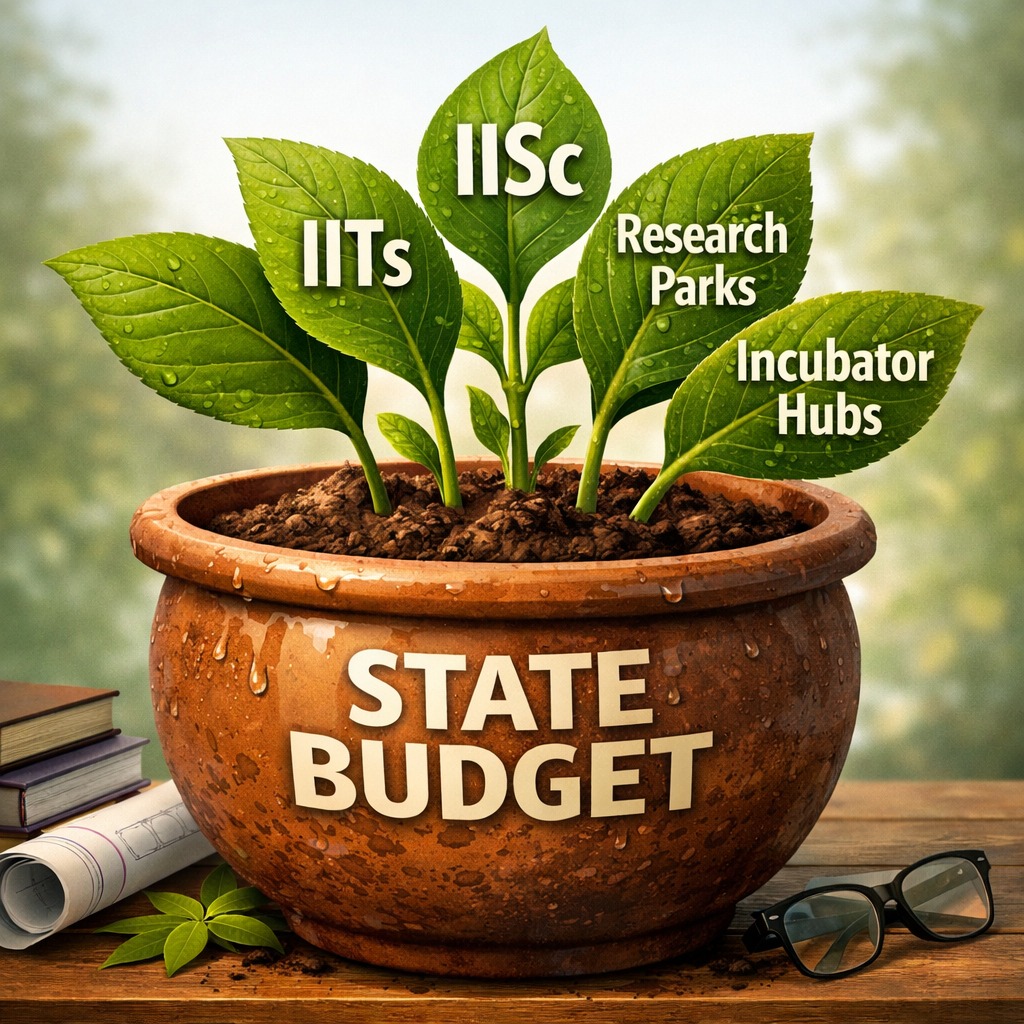
The ecosystem is like a mature forest asked to survive on bonsai budgets. You don’t plant a new tree every time growth slows. You water the soil that already knows how to grow.
A direct, predictable, annual infusion into higher education does not create chaos. It creates stability. And stability is what great research feeds on.
Chapter 4 — Brain Drain Is Not Emotional Loss, It Is Capital Flight
We talk about brain drain with sentiment—photos of smiling students holding foreign visas, farewell speeches, proud parents masking worry. But brain drain is not a cultural tragedy alone. It is economic leakage.
Each IIT graduate who leaves carries with him:
Subsidized education
Publicly funded labs
Years of faculty mentorship
Institutional reputation built over decades
And then builds intellectual property elsewhere.
The United States did not become a research superpower by importing intelligence alone. It paid to keep it. China did not reverse brain drain with slogans. It wrote cheques—large, boring, consistent ones.
Talent does not leave countries. It leaves funding ecosystems.
If we want minds to stay, return, or circulate meaningfully, we must offer not just pride—but platforms.
Chapter 5 — ₹1 Lakh Crore: Not a Dream, a Design Choice
Now comes the claim that makes the room lean forward:
₹1 lakh crore per year, directly injected into higher education—specifically IITs, IISc, and equivalent research universities.
Not as grants sprinkled thinly.
Not as one-time schemes.
But as structural funding, indexed, predictable, boring in the best way.
Out of ₹14.4 lakh crore, this is not extravagance. It is less than 7% of the education envelope. For states, pooled or matched with the Centre, it is entirely within fiscal reality.
This is not about building new IITs every year. It is about letting existing ones breathe—to hire globally, to fund risky research, to retain faculty, to back long-term science.
Great universities are not built by announcements. They are built by decades of uninterrupted belief, expressed in budgets.
Chapter 6 — Why the US and China Are Way Ahead (And It’s Not Culture)
American universities did not outrun the world because of freedom alone. Chinese universities did not surge because of discipline alone. Both did something deeply unromantic:
They spent.
They funded failure. They overpaid professors. They bought time—time to think, fail, revise, and think again. They treated universities not as cost centres but as national infrastructure, like power grids and ports.
China did not stumble into global academic dominance; it sequenced it deliberately. In the 1990s, it launched Project 211, identifying roughly 100 universities for focused investment to strengthen undergraduate education and research capacity.
This was followed by Project 985 in 1998, which concentrated far larger, sustained funding on a smaller group of elite universities to build world-class research ecosystems.
In 2017, China consolidated these efforts into the Double First-Class Initiative, shifting from rigid labels to outcome-driven excellence—funding both first-class universities and first-class disciplines, with periodic evaluation and renewal.
The pattern is unmistakable: long-term, predictable public funding; concentration rather than dilution; and an explicit belief that global leadership in knowledge must be designed, financed, and reviewed, not hoped for.
India often compares itself morally and civilizationally. But global leadership today is built on research density—citations, patents, labs per capita, doctoral output, interdisciplinary risk-taking.
Culture matters. But budgets decide.
Chapter 7 — The GST Council as an Unexpected Education Forum
No one came to the GST Council meeting expecting a debate on universities. But that’s how serious shifts happen—not through grand conventions, but through quiet agenda spillovers.
A finance minister mentions education pressure. Another mentions migration of students. Someone else notes skill gaps despite elite institutes. The numbers circle back. ₹80 lakh crore. 18%. ₹14.4 lakh crore.
And suddenly, the question lands softly but firmly:
If states can co-own tax architecture, why not co-own knowledge architecture?
Education on the Concurrent List was not an accident. It was an invitation. One we postponed answering.
Chapter 8 — Strengthening What Already Works
The temptation in India has always been expansion before consolidation. A new campus photograph travels faster than a repaired laboratory. But ecosystems do not grow horizontally first. They deepen.
The IITs, IISc, IISERs, and a small constellation of innovative public institutes already function as knowledge hubs, not just classrooms. They attract collaborations, host global conferences, seed startups, and quietly mentor the next generation of scientists.
Yet even these institutions operate with constraints that would be unthinkable in the US or China—faculty-to-student ratios frozen by approvals, labs waiting years for upgrades, researchers spending more time on paperwork than experiments.
A ₹1 lakh crore annual infusion is not about prestige. It is about unblocking throughput—letting ideas move faster from mind to material. When ecosystems are nourished, spillovers happen naturally. No reinvention required.
Chapter 9 — Research Is a Long Game, Budgets Must Match the Time Horizon
A serious research question rarely fits into a five-year plan. Some need ten. Some need twenty. Some fail nine times before succeeding once.
But Indian funding cycles are impatient. Grants are short. Renewals uncertain. Risk quietly discouraged.
The irony is painful: we expect world-class outcomes from short-term financial commitments.
A guaranteed annual flow into existing institutes changes behaviour immediately. Faculty dare more. Students stay longer. International collaborators commit deeper. Industry partners trust continuity.
Money, in this sense, is not incentive—it is assurance. Assurance that thinking long is not punished.
Chapter 10 — Faculty Are the Real Infrastructure
Buildings age. Equipment becomes obsolete. But great faculty create generations.
India trains brilliant scholars—and then watches them leave, not because they dislike the country, but because their work needs oxygen. Labs abroad offer autonomy, teams, funding horizons, and respect for time.
Injecting funds into existing institutes allows:
Competitive global salaries
Joint appointments
Funded sabbaticals
Proper doctoral and post-doc pipelines
This is not elitism. This is capacity building. When faculty flourish, students multiply excellence downstream.
Universities are not factories. They are cultures. And cultures are sustained by people, not policy PDFs.
Chapter 11 — Global Standing Is Built Quietly, Not Announced
China did not announce that it would overtake global research. It simply started funding its top universities—again and again, without drama.
The US does not debate whether MIT or Stanford “deserve” funding. It assumes they do—and asks how much more impact they can generate.
India already has names that carry weight. What they lack is predictable scale.
A ₹1 lakh crore annual commitment signals seriousness—not just to citizens, but to the world. It tells collaborators: India is not experimenting with research. It is committed to it.
Reputation follows consistency.
Chapter 12 — Why This Is a State Question, Not a Central Charity
States already spend the bulk of public money. They already manage universities. They already absorb the social cost of migration when talent leaves.
So the question is not whether states can contribute to higher education ecosystems—it is why they have been structurally discouraged from doing so.
Education is concurrent. That word matters.
A co-funded, formula-based mechanism—routed directly into existing national institutes—aligns incentives:
States invest in institutions their students attend
Institutes respond to regional research needs
The Centre retains national coherence
This is not federal friction. It is federal maturity.
Chapter 13 — Brain Drain Stops When Circulation Begins
The goal is not to chain talent to geography. It is to make staying, returning, or collaborating equally viable.
When funding is strong:
Students go abroad and come back
Faculty hold joint labs
Research networks circulate knowledge
This is how ecosystems behave when they are confident.
Brain drain is a symptom, not a moral failure. Strengthen the base, and circulation replaces escape.
Chapter 14 — A Quiet Resolution, Not a Grand Speech
Imagine the GST Council meeting ending without applause. No press release declares a revolution. Just a line item agreed upon. A mechanism approved. A number committed.
₹1 lakh crore. Every year. Into institutions that already work.
Sometimes, history turns not on speeches, but on budget tables.
Epilogue — Where the Numbers and Ideas Come Together
The claim does not float in abstraction. It rests on publicly available data—such as the Wikipedia page on Indian state budgets, which shows combined state expenditure nearing ₹80 lakh crore. At 18–20%, education already commands a massive envelope.
The question is not affordability. It is allocation.
For deeper thinking on why universities matter—and why states must invest in them—these books offer grounding:

The Idea of a University — John Henry Newman
The Great University Gamble — Andrew McGettigan
How China Became Capitalist — Ronald Coase & Ning Wang
The Rise of the Research University — Roger Geiger
Mission Economy — Mariana Mazzucato
State Capacity — Francis Fukuyama
Together, they echo a simple truth:
Nations do not stumble into knowledge leadership. They fund it—patiently, collectively, and without spectacle.