
✦ Chapter 1: The Terrace Classroom
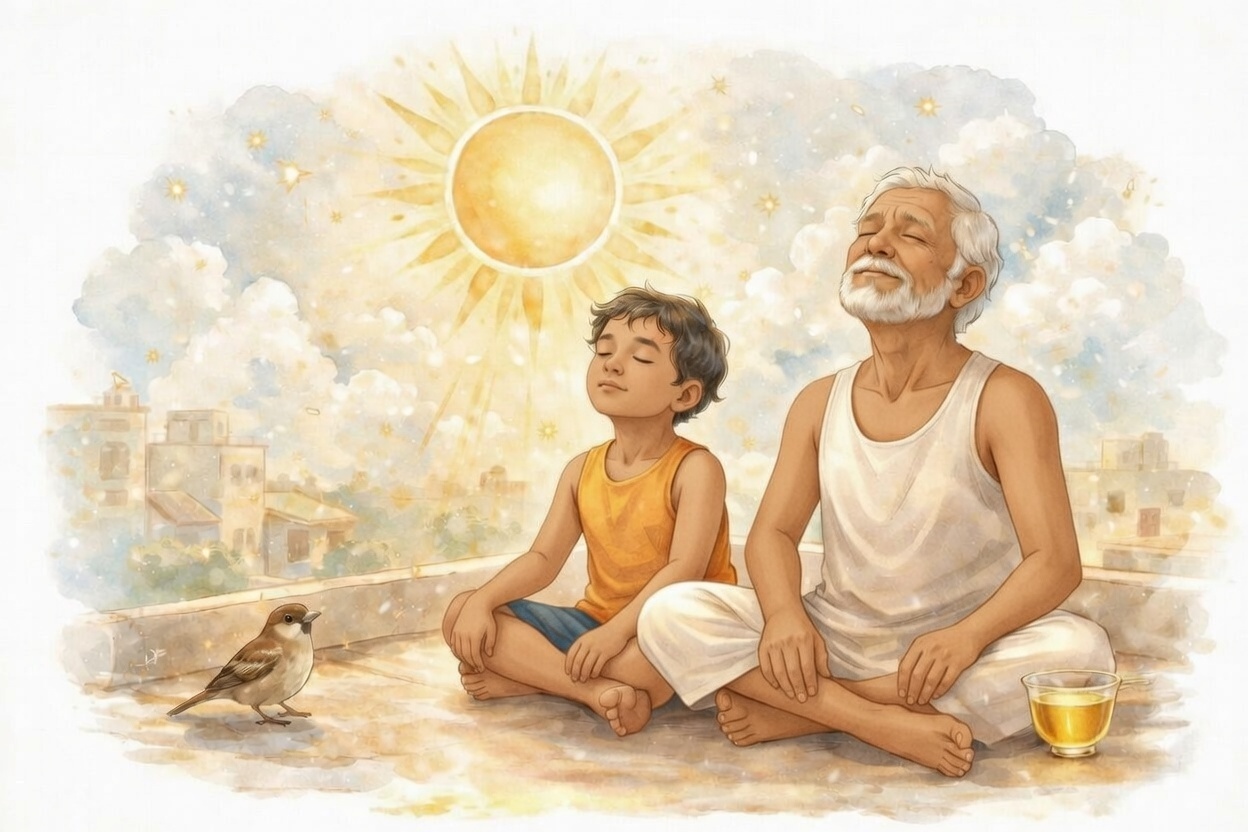
One winter morning, Rohan climbed to the terrace and saw his grandfather sitting quietly in the sunlight, oil glistening on his arms. “Are you charging yourself?” Rohan laughed. Grandfather smiled. “In a way, yes. The Sun is my charger.” He explained that the human body is designed to use sunlight, much like a solar panel uses energy from the sky. That day, the terrace became a classroom, and the Sun became the teacher.
Rohan stretched his hands into the warmth and felt something shift in his thinking. The Sun was no longer just light or heat. It was part of biology — part of him.
✦ Chapter 2: The Skin Factory
Grandfather explained that inside the skin lives a substance waiting for ultraviolet B (UVB) rays. When sunlight touches it, a chemical reaction begins:
7−dehydrocholesterol+UVB→VitaminD3
Sunlight does not “contain” Vitamin D. Instead, it activates the body’s own production system. Rohan was amazed to learn that sitting behind a glass window would not work because glass blocks UVB rays.
“So light can come in, but the magic cannot?” he asked.
“Exactly,” Grandfather replied.
Rohan realized the body was not passive — it was a living laboratory responding to the sky.
✦ Chapter 3: Birds, Animals, and Humans
A sparrow landed nearby, hopping freely in the sunlight. Rohan wondered why animals never worry about Vitamin D deficiency. Grandfather explained that animals live outdoors and rarely hide from the Sun. Humans, however, spend long hours inside buildings, wearing clothes that block sunlight.
“Civilization gave us comfort,” Grandfather said, “but it reduced our exposure to natural light.”
Rohan thought about school, homework, screens, and malls. The modern lifestyle had slowly replaced open skies with roofs and walls.
Maybe, he thought, humans had not lost the Sun — they had simply stepped away from it.
✦ Chapter 4: The Indian Paradox
Rohan’s biggest question came next. “India has so much sunshine. Why are people deficient?”
Grandfather explained that research suggests nearly 70–90% of Indians may have insufficient Vitamin D levels despite abundant sunlight. Pollution reduces UVB penetration. Urban lifestyles keep people indoors. Higher melanin levels in Indian skin mean longer sun exposure is needed for adequate production.
“So sunlight in the sky isn’t the same as sunlight on the skin?” Rohan asked.
“Exactly,” Grandfather replied.
The paradox was clear: availability does not guarantee absorption. Sunshine must meet skin to become biology.
✦ Chapter 5: Women and Sunlight
Grandfather explained that Vitamin D deficiency is especially common among women in many regions. In several Western countries, milk and cereals are fortified with Vitamin D, reducing deficiency rates. Supplements are commonly recommended, especially in colder climates.
In India, however, traditional clothing, indoor responsibilities, and social habits may limit sun exposure for many women. Historically, sunlight was assumed to be sufficient.
“Health is shaped by culture,” Grandfather said softly.
Rohan realized Vitamin D was not just chemistry — it was also lifestyle and society woven together.
✦ Chapter 6: The Calcium Key
Vitamin D’s most famous role is helping the body absorb calcium. Without it, even a diet rich in calcium may not strengthen bones effectively.
Calcium absorption ∝ Vitamin D levels
In children, severe deficiency can cause rickets. In adults, it may lead to soft bones and weakness.
“Vitamin D is like a key,” Grandfather explained. “Calcium is waiting outside the door.”
Rohan imagined doors inside his bones opening and closing. Without the key, strength cannot enter.
✦ Chapter 7: The Three-Step Journey
Vitamin D does not become active immediately after it forms in the skin. It travels through the body in stages:
VitaminD3→25(OH)D→1,25(OH)2D
First, the skin produces Vitamin D₃. Then the liver converts it to 25(OH)D — the form measured in blood tests. Finally, the kidneys transform it into its active hormone form.
“It’s like refining raw material into a finished product,” Grandfather explained.
Rohan was fascinated. Sunlight touched the skin, but its effects traveled deep inside.
✦ Chapter 8: The Immune Connection
Grandfather explained that Vitamin D is not only about bones. Immune cells have receptors for the active hormone. Adequate levels help regulate immune responses — supporting defense against infections while preventing excessive inflammation.
“So it trains the body’s soldiers?” Rohan asked.
“Yes,” Grandfather replied. “It promotes balance.”
Sunlight, in moderation, becomes part of the body’s internal defense strategy.
✦ Chapter 9: Geography and Mathematics
Grandfather brought out a globe and explained how latitude affects UVB intensity:
UV B intensity ∝ cos(latitude)
The farther a country lies from the equator, the weaker the UVB rays, especially during winter months. This explains why northern countries adopted food fortification policies early.
India’s deficiency problem, therefore, cannot be blamed solely on geography. It reflects changing lifestyles.
Rohan realized that even sunlight follows mathematical patterns.
✦ Chapter 10: Pollution’s Shadow
One hazy afternoon, Grandfather explained how pollution particles scatter and absorb UVB radiation. Even when the Sun looks bright, less effective UVB may reach the ground.
“Cities create invisible barriers,” he said.
Buildings, glass windows, air pollution, and indoor schedules all reduce natural exposure.
Rohan understood that health connects with environment. Clean air supports not only lungs but also bones.
✦ Chapter 11: Measuring the Invisible
Doctors measure Vitamin D by testing blood levels of 25(OH)D. Many guidelines suggest levels above about 20–30 ng/mL are sufficient, though debates continue.
Too little can weaken bones and possibly affect immunity. Too much supplementation can cause toxicity and dangerously high calcium levels.
“Balance is essential,” Grandfather said.
Interestingly, the body limits excessive Vitamin D production from sunlight, making moderate exposure safer than uncontrolled supplementation.
✦ Chapter 12: Food and Fortification
Certain foods contain Vitamin D — fatty fish, egg yolks, and fortified products. Western nations fortify milk and cereals because rickets once became widespread during industrialization.
In India, reliance on natural sunlight delayed large-scale fortification efforts, though they are increasing now.
“Milk and sunlight work together,” Grandfather explained.
Calcium provides the building material; Vitamin D ensures it is absorbed properly.
✦ Chapter 13: The Gene Messenger
The active form of Vitamin D behaves like a hormone. It travels through the bloodstream and binds to receptors inside cells, influencing gene expression.
It does not change DNA itself but regulates how genes function — turning certain biological processes up or down as needed.
“So sunlight becomes a message inside us?” Rohan asked quietly.
“Yes,” Grandfather replied. “It becomes communication.”
The Sun was no longer just outside — it was part of the body’s internal language.
✦ Chapter 14: Returning to the Sun
Over time, Rohan began climbing to the terrace without reminders. He understood that sensible sun exposure — about 15–30 minutes on arms and legs, depending on skin tone and season — could support healthy levels.
He avoided sitting behind glass and ensured he did not burn. Moderation became his rule.
The terrace no longer felt ordinary. It felt like reconnection — between modern life and ancient biology.
The Sun had always been present. Humans had simply drifted indoors.
Epilogue: The Quiet Conversation with the Sun
As the days grew warmer and the winter softened into spring, Rohan often found himself pausing on the terrace long after Grandfather had gone downstairs. The Sun would be lower in the sky, painting the clouds in gold and amber, as if the heavens themselves were closing a gentle book for the day. Beside the chair lay a small stack of research books — thick, serious volumes filled with charts and studies from scientists across the world. They spoke of bones and blood levels, of immunity and deficiency rates, of how nearly 70–90% of people in sunny countries like India could still lack enough Vitamin D.
Yet standing there in the fading light, Rohan felt that the story was larger than statistics.
It was the story of a species that once lived beneath open skies and slowly moved indoors. A story of glass towers rising between skin and sunlight. Of air thick with particles that dimmed invisible rays. Of habits changing faster than biology could adapt. Vitamin D was not merely a nutrient described in textbooks — it was a quiet reminder that humans remain part of nature, even when surrounded by concrete.
Grandfather once said, “The Sun has never stopped shining. We simply stopped stepping into it.”
Now Rohan understood.
Every sunrise felt like an invitation. Every beam of light carried a message older than civilization itself — a whisper to bones, to cells, to genes. The Sun did not demand attention. It did not shout. It waited patiently above rooftops and mountains, offering energy, balance, and renewal to anyone willing to stand beneath it.
And so, each morning, when the first light touched his skin, Rohan felt something deeper than warmth. He felt connection — to the Earth’s rhythm, to ancient biology, and to a truth both simple and profound:
Sometimes the most powerful medicine has been shining above us all along.

Appendix: Suggested Reading
The Vitamin D Solution: Michael F. Holick
A comprehensive guide explaining how Vitamin D works in the body, how deficiency develops, and safe sunlight strategies.
The UV Advantage: Michael F. Holick
Explores the science of sunlight exposure and its benefits beyond Vitamin D.
Vitamin D Prescription: John J. Cannell
Discusses the widespread global deficiency of Vitamin D and its health implications.
The Vitamin D Cure: James Dowd & Diane Stafford
A practical, reader-friendly overview of maintaining optimal Vitamin D levels.
Vitamin D: The Sunshine Vitamin: Jörg Spitz
Focuses on Vitamin D’s broader role in chronic disease prevention.